Private Network
Intelligence
Intelligence Journeys
Utilities Private Broadband Planning
AI Use Case Planning for Utilities

Policy

Telefónica and Nokia are piloting agentic AI to make network APIs easier to expose, discover, and consume, aligning with GSMA Open Gateway’s push for interoperable, developer-ready telecom capabilities. Industry efforts like GSMA Open Gateway and CAMARA have raised awareness of standardized network APIs, but uptake hinges on practical tooling that abstracts network complexity while preserving telco-grade security and control. Telefónica and Nokia are now testing agent-to-agent orchestration and context-sharing protocols to let AI “agents” reliably find, chain, and call network functions in a repeatable way.
T-Mobile is introducing a network-native AI translation service that activates during voice calls, signaling a new phase where AI runs inside the mobile network rather than on apps or devices. T-Mobile announced a beta of Live Translation, a voice-call feature that translates conversations in over 50 languages by activating an AI agent within its 5G Advanced network. The service is initiated by the T-Mobile subscriber using *87* during a call; only one caller needs to be on T-Mobile, and it also works while roaming on supported networks.
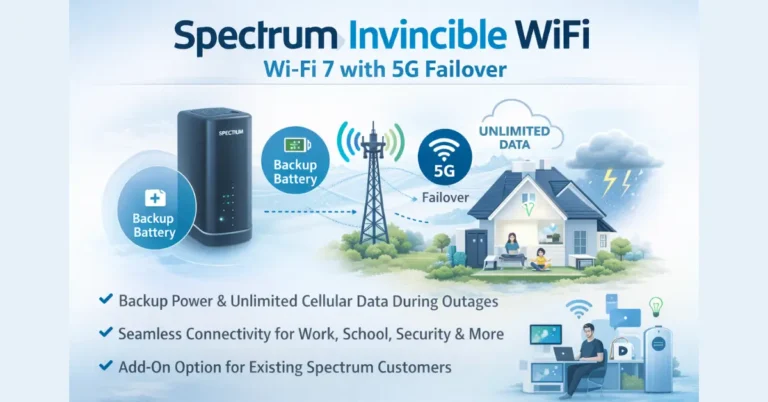
Charter introduced Spectrum Invincible WiFi, a package built around its Advanced Wi‑Fi 7 router paired with an integrated backup battery and an embedded 5G cellular pathway. The system automatically rides through local power interruptions for up to eight hours and, if the wired broadband link drops, switches to cellular with unlimited data until the primary connection returns. The offer targets households running multigig internet and dozens of smart devices, and is positioned as a simple add-on for existing Spectrum customers. Home connectivity has become mission‑critical for work, school, security and telehealth while weather-related disruptions and grid instability are rising.
Anthropic’s latest financing round resets the competitive map for enterprise AI and raises the stakes for telecom, cloud, and large-scale IT buyers planning agentic automation. Anthropic closed a $30 billion Series G at a $380 billion post-money valuation, led by GIC and Coatue with participation from D. E. Shaw Ventures, Dragoneer, Founders Fund, ICONIQ, and MGX, alongside a broad cohort that includes Accel, General Catalyst, Jane Street, and the Qatar Investment Authority. The raise follows sustained commercial momentum and arrives as competitive intensity with OpenAI deepens, signaling that AI platform consolidation and scale economics will define the next phase of the market.
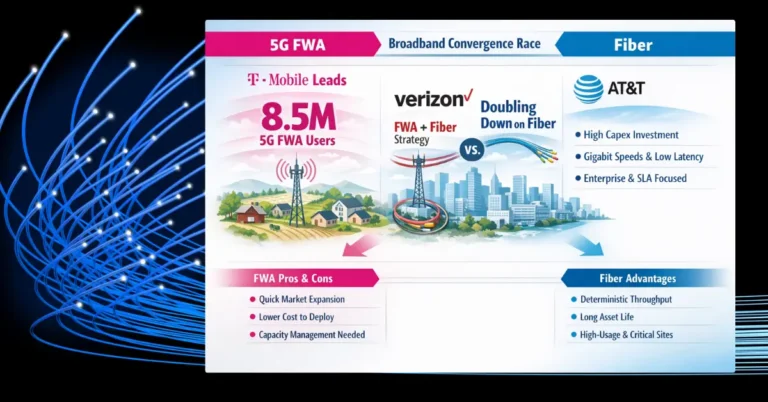
FWA is capex-light and fast to deploy, especially in mid-band-rich markets, which makes it ideal for quick share gains, addressable market expansion, and rural or underserved pockets. Its constraint is shared capacity: as mobile traffic grows, operators must manage prioritization, peak congestion, and plan mix to preserve experience. Fiber demands higher upfront capital but delivers deterministic throughput, low latency, and long asset life that underpins premium ARPU, enterprise SLAs, and wholesale opportunities. Expect operators to steer FWA toward segments with favorable traffic profiles and use fiber for high-usage clusters and enterprise-critical sites.
LG Uplus is moving from rule-based automation to closed-loop autonomy, using AI agents and digital twins to accelerate toward a fully autonomous network by 2028. Its core platform, the AI Orchestration Nexus (AION), is already automating repetitive operations and has contributed to a reported 70% reduction in customer complaints about network quality—an early signal that the approach is translating into measurable outcomes. The company plans to showcase these capabilities at MWC Barcelona 2026, underscoring growing operator interest in operational AI as 5G matures and traffic patterns become more volatile.
A German court has ordered Meta’s Edge Network Services to pay Deutsche Telekom roughly €30 million for network services tied to Meta traffic, reshaping leverage in Europe’s peering and interconnection market. The dispute centered on whether Meta’s subsidiary used Deutsche Telekom’s private interconnection and peering points under a valid, paid contract after an earlier agreement expired. The court sided with the operator, concluding that continued use of those private interconnection facilities created obligations to pay for services over a multi-year period covering traffic from Facebook, Instagram, and WhatsApp.
Singapore has confirmed an attempted cyber‑espionage campaign against its national telecom backbone, highlighting a rising class of APT activity aimed at network devices and virtualized cores rather than traditional IT endpoints. Singapore’s Cyber Security Agency (CSA) and Infocomm Media Development Authority (IMDA) disclosed that all four major operators—Singtel, StarHub, M1 and Simba Telecom—were targeted by UNC3886 in incidents last year. The threat actor gained limited access to segments of telco systems and exfiltrated a small volume of network‑related technical data. There was no service disruption, no personal data exposure and, critically, sensitive and segregated systems (including 5G networks) were not compromised.
A surprise endorsement from President Trump has thrust Nexstar’s proposed takeover of Tegna back into the spotlight, with implications that cut across broadcast consolidation, streaming competition, and FCC ownership policy. After criticizing large media combinations late last year, the President is now urging regulators to approve Nexstar’s bid for Tegna, framing it as a way to bolster competition against national TV networks and Big Tech platforms. Regulatory outcomes hinge on how the FCC treats national reach limits, market overlaps, and public‑interest conditions. The combined footprint would touch a supermajority of U.S. TV households—well beyond today’s national audience reach cap absent discounts or divestitures.
Imec is scaling its R&D footprint and inaugurating a NanoIC pilot line to accelerate sub‑2nm and 3D system innovation under a roughly €2.5 billion European semiconductor push. Imec, the Leuven-based semiconductor research hub, is expanding lab capacity and bringing a new NanoIC pilot line online to speed learning cycles for logic beyond 2nm and advanced 3D integration. The goal is clear: shorten the path from materials and device research to system‑level demonstrators that de-risk future foundry nodes and packaging flows. For vendors and operators, this is about getting sooner access to manufacturable building blocks—ultra‑efficient logic tiles, memory stacks, and optical I/O—that cut TCO and footprint across networks and data centers.
Virgin Media O2 has broadened its partnership with Zinkworks to deploy AI-driven monitoring and automation across its mobile footprint, designed to spot anomalies earlier, resolve incidents faster, and prevent customer-impacting outages. The rollout targets multiple network domains and operational workflows, advancing the operator’s move toward autonomous operations with engineers maintaining full oversight. The capabilities span radio access, core network systems, and network operations centers, combining real-time telemetry with intelligent automation. The stack runs on Google Cloud and taps services such as Vertex AI and Gemini to analyze patterns, orchestrate responses, and augment decision-making for operations teams.
Microsoft’s AI QuickStart, backed by IMDA and UOB, aims to turn generative AI intent into production outcomes in weeks, not years. AI QuickStart targets “Digital Leaders” in Singapore—SMEs and larger non-ICT enterprises that have already built basic digital capabilities and can fund transformation—by offering a fast, structured path to deploy enterprise AI. Each engagement is designed to finish within three months with a cost cap of up to S$20,000 per project, covering cloud, compute, and professional services, which directly addresses executive concerns over unpredictable pilot spend and elongated proofs-of-concept.

Partner Hubs

Telco AI Agent Leadership

Telco AI Agent Leadership Landscape - Network Equipment Vendors
Network Equipment Vendor Report
How are Amdocs, Salesforce, Comarch, Totogi, Qvantel, Oracle and other OSS/BSS vendors deploying telecom AI agents?
OSS/BSS Vendor Report
How are Amdocs, Salesforce, Comarch, Totogi, Qvantel, Oracle and other OSS/BSS vendors deploying telecom AI agents?
System Integrator Report
Scroll to Top