Private Network
Intelligence
Intelligence Journeys
Utilities Private Broadband Planning
AI Use Case Planning for Utilities
https://www.ciena.com/insights/blog/2026/rls-hyper-rail-solving-the-challenges-of-multi-rail-photonics?campaign=X1994626&channel=media-direct-buy&medium=display&source=tecknexus&ad-type=&campaign-type=&term=&region=&lid=D3JLmZ

LTE

Welcome to the TeckNexus Private Networks: Airports, Ports & Automotive Edition. Across transportation ecosystems, connectivity has shifted from an enabler to a strategic foundation. In airports, ports, and automotive environments, private LTE, 5G, and CBRS networks are delivering deterministic performance, real-time visibility, and secure operations—driving measurable gains in efficiency, safety, and resilience.

This edition showcases real-world deployments alongside exclusive insights from industry leaders shaping the future of mobility infrastructure. We also celebrate the 2025 TeckNexus Private Networks Award winners, recognizing organizations and partners setting new benchmarks for innovation and execution.

Through customer stories, executive interviews, and partner perspectives, the magazine highlights the power of ecosystem collaboration and introduces the Smart Airport and Smart Port Connectivity Blueprints—practical frameworks drawn from global deployments.

The message is clear: enterprises don’t invest in private networks for technology alone—they invest for outcomes.
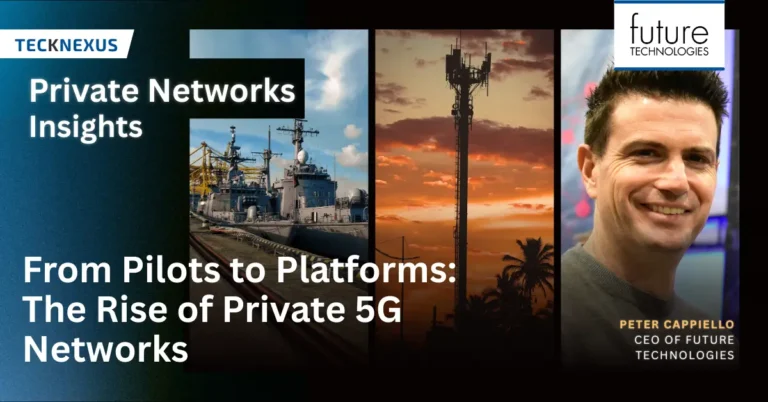
Private cellular networks are moving beyond pilots into mission-critical infrastructure. Derived from a conversation with Peter Cappiello, CEO of Future Technologies, this article explores how AI modernization, industrial scale, and hybrid network models are reshaping private LTE and 5G, often as an extension of existing enterprise networks—across energy, manufacturing, ports, and logistics.
The latest 3GPP cycle consolidates 5G-Advanced (Release 18), sets the agenda for Release 19, and frames early 6G studies, with direct implications for operator investment, enterprise use cases, and vendor roadmaps. Release 18, the first phase of 5G-Advanced, is moving from standards completion into implementation, bringing carrier-grade enhancements in spectral efficiency, energy savings, and mobility performance. Release 19 now builds on these foundations, prioritizing further RAN efficiency, XR and video delivery at scale, richer analytics/exposure in the core (NWDAF, NEF/CAPIF), and enterprise-grade reliability across private and public networks.
New data points to a step-change in cellular IoT adoption as 5G broadens into mid-tier and massive-scale use cases while 4G-era LPWA keeps expanding. Omdia forecasts cellular IoT connections to reach roughly 5.9 billion by 2035, driven by expanding addressable use cases across industrial automation, utilities, transportation, retail, and consumer-adjacent categories such as wearables. The growth profile is no longer tied only to premium 5G performance; instead, scaled adoption is coming from three complementary pillars: 5G RedCap for mid-tier performance at lower cost, 5G Massive IoT (evolving NB-IoT/LTE-M under a 5G core), and 4G LTE Cat-1bis for low-cost devices that still require voice or moderate throughput.
The Indian government has floated draft rules that refine how mobile operators can share spectrum, aiming to boost spectral efficiency and accelerate 5G expansion under the new telecommunications regulatory framework. The draft rules seek to formalize spectrum sharing under the new regime, giving operators a clearer pathway to pool or share spectrum holdings while ensuring compliance with license conditions. In practical terms, telcos would gain a more predictable mechanism to use underutilized spectrum, improve coverage, and optimize capacity without always resorting to new auctions or heavy capex.
The FCC has approved AT&T’s agreement to acquire a portfolio of UScellular wireless spectrum licenses for $1.02 billion, advancing AT&T’s mid-band capacity strategy and reshaping competitive dynamics in U.S. 5G markets. The licenses span select UScellular markets, bolstering AT&T’s holdings in areas where UScellular has long operated, including rural and midwestern regions. With FCC consent in hand, the parties can proceed to closing market by market, subject to routine administrative steps and any local obligations. Mid-band spectrum remains the sweet spot for balanced capacity and coverage. This positions AT&T to better support RedCap devices, uplink-sensitive applications, and the early wave of 5G-Advanced features.
Nokia’s deployment of a private LTE network using the 700 MHz band at Salinas Gold in Mato Grosso, Brazil, highlights how remote industrial operations can achieve fast, reliable connectivity. With integration support from Venko Networks and Ávato, the project showcases ecosystem collaboration, pragmatic deployment, and readiness for future IoT and 5G upgrades, setting a model for industrial wireless across Latin America.
https://www.ciena.com/insights/blog/2026/rls-hyper-rail-solving-the-challenges-of-multi-rail-photonics?campaign=X1994626&channel=media-direct-buy&medium=display&source=tecknexus&ad-type=&campaign-type=&term=&region=&lid=D3JLmZ
TECKNEXUS PRIVATE NETWORKS
Congratulations to the 2026 Award Winners
Explore the Winners →

Partner Hubs

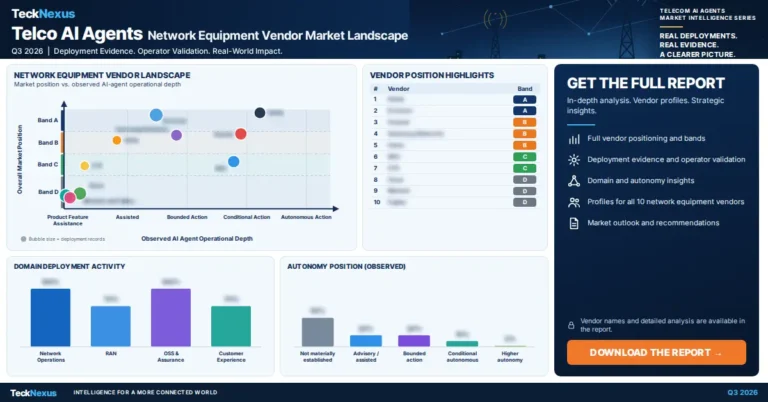
Telco AI Agent Leadership

Telco AI Agent Leadership Landscape - Network Equipment Vendors
Network Equipment Vendor Report
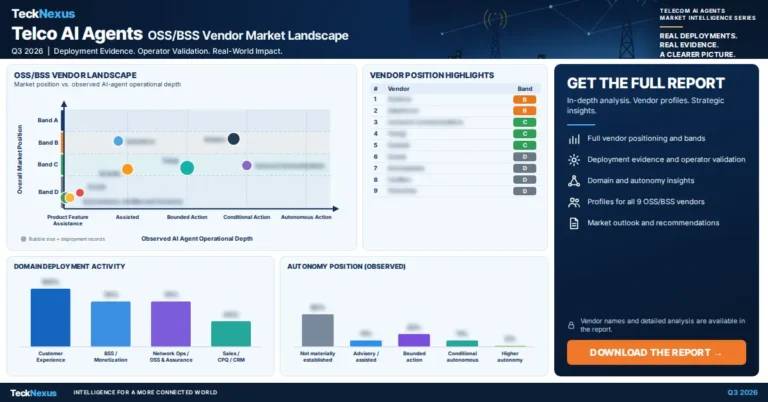
How are Amdocs, Salesforce, Comarch, Totogi, Qvantel, Oracle and other OSS/BSS vendors deploying telecom AI agents?
OSS/BSS Vendor Report
How are Amdocs, Salesforce, Comarch, Totogi, Qvantel, Oracle and other OSS/BSS vendors deploying telecom AI agents?
System Integrator Report
Scroll to Top