Private Network
Intelligence
Intelligence Journeys
Utilities Private Broadband Planning
AI Use Case Planning for Utilities
https://www.ciena.com/insights/blog/2026/rls-hyper-rail-solving-the-challenges-of-multi-rail-photonics?campaign=X1994626&channel=media-direct-buy&medium=display&source=tecknexus&ad-type=&campaign-type=&term=&region=&lid=D3JLmZ

LTE

Thiess is advancing digital mining with a custom-built private LTE network, implemented by Aqura Technologies. This network supports autonomous haul trucks and drills, ensures safety and uptime in extreme conditions, and empowers field teams with real-time data and collaboration tools. Looking ahead, Thiess is preparing to adopt 5G and IoT for next-level optimization and emissions reduction.
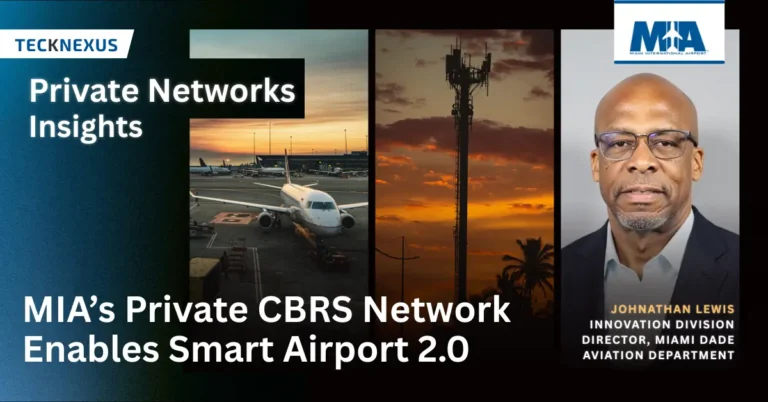
Miami International Airport (MIA) is transforming operations with its private CBRS network, central to its Smart Airport 2.0 strategy. The network enables secure, real-time automation across IoT devices, passenger services, and operational systems. From enhancing cybersecurity and reducing costs to monetizing connectivity for tenants, MIA demonstrates how airports can use private wireless to scale innovation efficiently and drive ROI.
Winner – Private Network Startups - Niral Networks, deploys private 5G and Edge AI network at GMR’s energy facility which faced critical connectivity and safety challenges. This air-gapped, industrial-grade solution supports plant automation, AI surveillance, and drone operations, offering high throughput, low latency, and centralized management across multiple sites.
Ericsson’s latest Mobility Report points to a clear shift: operators are turning 5G capabilities into differentiated, SLA-backed services rather than just selling more data at higher speeds. After years of building coverage and capacity, 5G networks are mature enough to commercialize features like guaranteed latency, uplink boosts, and application-aware prioritization. The catalysts are in place: more 5G Standalone (SA) cores, rising traffic from video creation and immersive apps, and enterprise demand for predictable performance across sites and clouds. The net result is momentum behind premium, differentiated connectivity that can be priced, assured, and exposed to partners.
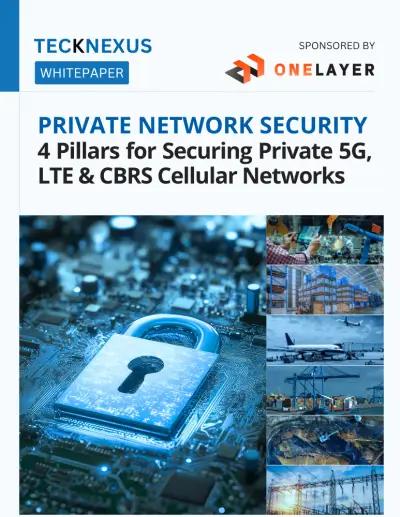
Private cellular networks are transforming industrial operations, but securing private 5G, LTE, and CBRS infrastructure requires more than legacy IT/OT tools. This whitepaper by TeckNexus and sponsored by OneLayer outlines a 4-pillar framework to protect critical systems, offering clear guidance for evaluating security vendors, deploying zero trust, and integrating IT, OT, and IoT under a unified, secure-by-design architecture.
CAF’s signalling division and Cellnex demonstrated that OPTIO, a modular and multi-bearer CBTC platform, operates reliably on a private 5G network in both lab and field conditions, including challenging scenarios such as tunnels. The system already supports Wi‑Fi and LTE; adding 5G confirms a multi-access design that lets operators choose the right bearer per line, phase, or location. Private 5G brings ultra-low latency, higher capacity, stronger QoS control, and end-to-end security under the operator’s domain. The project received European co-financing via the Recovery and Resilience Facility under Spain’s UNICO Sectorial 2023 program, underscoring public support for digital rail modernization.
AST SpaceMobile is signaling a pivotal year ahead as it moves from demonstrations to commercial direct-to-device coverage with major operators and an aggressive launch schedule. The company’s plan to begin “intermittent nationwide” service in early 2026, followed by continuous coverage later in the year, is also a forcing function for device vendors, standards work, and MNO network integration. As AST scales to 45–60 BlueBird satellites by end-2026, pass frequency and overlap increase to support “continuous” service across the U.S., Europe, Japan, and other priority markets. AST reports over $3.2 billion in cash and liquidity.
Palo Alto Networks is helping enterprises extend Zero Trust principles from IT to operational networks as they adopt private 4G and 5G. In this interview, Meir Cohen explains how AI-powered security frameworks ensure real-time visibility, strict segmentation, and policy consistency across IT, OT, and private mobile environments—laying the foundation for secure, scalable Industry 4.0 operations.
SkyMirr’s Sky5G Wireless Router being named a CES 2026 Innovation Awards Honoree signals that antenna-first design is emerging as a decisive lever for 5G customer-premises equipment performance and reliability. The Consumer Technology Association’s awards program recognizes design and engineering that materially advances user outcomes, and SkyMirr’s selection draws attention to a core differentiator: its MuLCAT (Multi-Layer Coupling Controlled Antenna Technology) architecture. Rather than treating the antenna as a downstream component, MuLCAT integrates a multi-layer coupling approach to increase isolation, broaden usable bandwidth, and suppress interference in compact enclosures.
Nokia’s tie-up with OneLayer brings carrier-grade security and OT-aware visibility into one stack, addressing the core adoption barrier for private 5G/LTE in utilities: protecting highly distributed, mission-critical operations at scale. Together, the companies deliver a zero-trust model that spans radio to application: authenticated device identity, continuous posture assessment, role-based segmentation at the cellular (DNN/QoS flow) and IP layers, and orchestrated mitigation. Bottom line: With utilities accelerating private LTE/5G rollouts, Nokia and OneLayer are packaging the controls that regulators, insurers, and boards now expect—bringing OT-aware zero trust into the cellular domain without adding operational complexity.
https://www.ciena.com/insights/blog/2026/rls-hyper-rail-solving-the-challenges-of-multi-rail-photonics?campaign=X1994626&channel=media-direct-buy&medium=display&source=tecknexus&ad-type=&campaign-type=&term=&region=&lid=D3JLmZ

Partner Hubs

Telco AI Agent Leadership

Telco AI Agent Leadership Landscape - Network Equipment Vendors
Network Equipment Vendor Report
How are Amdocs, Salesforce, Comarch, Totogi, Qvantel, Oracle and other OSS/BSS vendors deploying telecom AI agents?
OSS/BSS Vendor Report
How are Amdocs, Salesforce, Comarch, Totogi, Qvantel, Oracle and other OSS/BSS vendors deploying telecom AI agents?
System Integrator Report
Scroll to Top