Private Network
Intelligence
Intelligence Journeys
Utilities Private Broadband Planning
AI Use Case Planning for Utilities
https://www.ciena.com/insights/blog/2026/rls-hyper-rail-solving-the-challenges-of-multi-rail-photonics?campaign=X1994626&channel=media-direct-buy&medium=display&source=tecknexus&ad-type=&campaign-type=&term=&region=&lid=D3JLmZ

LTE

Virgin Media O2 has struck a multi‑year agreement with Starlink Direct to Cell to deliver satellite‑to‑mobile service across rural UK not‑spots, positioning O2 as the first British operator to integrate Starlink’s constellation with licensed mobile spectrum. Branded as O2 Satellite, the service will initially support messaging and basic data on existing smartphones when users move beyond terrestrial signal. O2 is targeting landmass coverage beyond 95% within a year of launch, using Starlink’s 650+ low‑Earth orbit satellites to act as “cell sites in space.” Customer rollout is planned for early 2026, with pricing to follow and an extra monthly fee anticipated.
Enterprises adopting private 5G, LTE, or CBRS networks need more than encryption to stay secure. This article explains the 4 pillars of private network security: core controls, device visibility, real-time threat detection, and orchestration. Learn how to protect SIM and device identities, isolate traffic, secure OT and IoT, and choose the right vendors for a robust private network security strategy.
Ubiik has secured Anterix certifications for its router and base station, signaling readiness for private LTE deployments on Anterix’s 900 MHz Band 106 spectrum. Anterix awarded Anterix Active badges to Ubiik’s Pyxis 5G LPWA RA810 router and its goRAN+ base station, confirming they meet Anterix operating criteria for 900 MHz private LTE. In addition, the high-power Pyxis RA320X variant received an Anterix Capable badge, validating a 28 dBm transmit option that extends reach compared to standard 23 dBm LTE modules. Together, the router and RAN designations give utilities and critical infrastructure providers a tested, end-to-end path to deploy pLTE on B106. Band 106 is licensed 900 MHz spectrum aligned with 3GPP LTE that Anterix has aggregated across the U.S., Puerto Rico, Alaska, and Hawaii.
New usage data shows AT&T subscribers are tapping into T-Mobile’s Starlink-powered T-Satellite more than expected, signaling a rapid shift in how carriers and customers think about direct-to-device connectivity. Speedtest intelligence indicates T-Mobile users account for the majority of direct-to-device (D2D) connections to Starlink, roughly six in ten overall and more than seven in ten among devices reporting active service at connection time. The surprise is AT&T’s footprint: about a third of observed connections come from AT&T subscribers, while Verizon’s share is minimal.
Sweden’s largest passenger rail operator SJ is consolidating its communications estate with Telia to accelerate 5G, IoT, and crisis-readiness across trains, stations, depots, and corporate operations. The partnership positions Telia as SJ’s primary provider for nationwide mobile and fixed communications, combining public 5G/LTE coverage with managed services that support day‑to‑day rail operations and passenger experience. For passengers, more consistent Wi‑Fi backhaul and seamless digital services are the immediate wins; for operations, the prize is reliability and faster recovery when incidents occur. European operators are scaling beyond discrete connectivity pilots toward platforms that unify onboard systems, station sensors, and back‑office analytics.
India’s nationwide launch of BSNL’s “Swadeshi” 4G stack moves the country from a services-first model to domestic production of core telecom equipment at national scale. India formally launched an indigenous 4G stack for state-run BSNL, alongside more than 97,500 towers announced from Jharsuguda, Odisha. Officials highlighted early reach metrics, noting that roughly 92,000 sites are active and connecting an estimated 22 million users. Telecom equipment sovereignty has become a board-level issue as operators de-risk supply chains, comply with trusted source mandates, and balance costs amid rising traffic and spectrum refarming needs.
Deutsche Telekom has launched 5G connectivity for the latest Apple Watch models using 3GPP RedCap over its 5G standalone network, marking a strategic first for Germany’s wearable market. This is one of the first mass-market RedCap launches tied to a high-volume consumer device, moving RedCap from trials and modules into mainstream adoption. It signals that 5G standalone is shifting from a technology milestone to a commercial differentiator, and that the wearables category is entering a new performance and battery-life phase beyond LTE-M and classic LTE. Expect accelerated RedCap adoption, intensified operator competition on SA coverage and certifications, and a new wave of enterprise-grade wearables built for 5G from the start.
Aviation is no longer a siloed industry - it’s a globally connected ecosystem where airports, airlines, regulators, telecom operators, and tech vendors must work in sync. As digital transformation accelerates, connectivity becomes a critical layer for collaboration, enabling real-time decision-making, safety, operational alignment, and a seamless passenger experience. From private 5G and edge computing to biometric boarding and IoT, the aviation industry must co-invest, co-develop, and co-govern digital infrastructure. Case studies from Heathrow, Changi, and DFW show that stakeholder alignment leads to measurable gains in efficiency, innovation, and trust. Connectivity is the enabler, but collaboration is what makes it scalable and sustainable.
Airport terminals are evolving into connected, intelligent environments powered by biometrics, IoT, and scalable infrastructure. These technologies are helping airports manage increasing passenger volumes, improve security, and deliver seamless experiences. From facial recognition at check-in to IoT-based baggage tracking and AR navigation, the connected terminal offers faster processing, predictive safety, and energy-efficient operations. Scalable, cloud-native systems future-proof infrastructure for demand surges and enable rapid integration of emerging tech like AI, digital twins, and virtual queuing. As global air travel rebounds, the connected terminal represents a blueprint for smarter, safer, and more sustainable airport growth.
KDDI’s move to enable satellite data on recent iPhones via “au Starlink Direct” is a meaningful step toward resilient, nationwide connectivity that blends terrestrial and non-terrestrial networks. KDDI now supports satellite data communication on all models of iPhone 13 through iPhone 17, plus iPhone Air—21 models in total, so consumers and field teams can use essential apps when they are outside cellular coverage. The satellite layer augments KDDI’s 5G/4G LTE footprint; combined, the operator aims to cover virtually all of Japan’s geography, not just its population centers. Notably, the service is available to au subscribers and customers of other carriers.
A multi-hour outage in the Dallas–Fort Worth airspace tied to legacy telecom services triggered cascading delays and cancellations, spotlighting urgent modernization needs for U.S. air traffic networks. On Friday afternoon, a telecommunications failure forced a ground stop across Dallas Fort Worth International (DFW) and Dallas Love Field, with ripple effects at several regional airports. The FAA attributed the incident to multiple failures in TDM-based data services delivered by a local telecom provider, compounded by redundancy gaps overseen by a prime contractor. Initial field reports tied the outage to fiber damage that simultaneously knocked out primary and backup data paths.
Argentina’s regulator ENACOM has created a new licensing framework and reserved spectrum to let enterprises run stand-alone private mobile networks across critical industries. ENACOM has designated the 2300–2400 MHz band for Private Wireless Broadband Systems, a category designed for on-premise, non-public LTE/5G networks serving operational technology and enterprise applications rather than consumer subscribers. The framework supports high-throughput, low-latency, and massive IoT use cases, enabling enhanced video, automation, and machine communications across industrial campuses and field operations; 2.3 GHz maps to widely supported 3GPP Band 40 (LTE TDD) and NR n40, giving enterprises access to a mature device and radio ecosystem.
https://www.ciena.com/insights/blog/2026/rls-hyper-rail-solving-the-challenges-of-multi-rail-photonics?campaign=X1994626&channel=media-direct-buy&medium=display&source=tecknexus&ad-type=&campaign-type=&term=&region=&lid=D3JLmZ
TECKNEXUS PRIVATE NETWORKS
Congratulations to the 2026 Award Winners
Explore the Winners →

Partner Hubs

Telco AI Agent Leadership

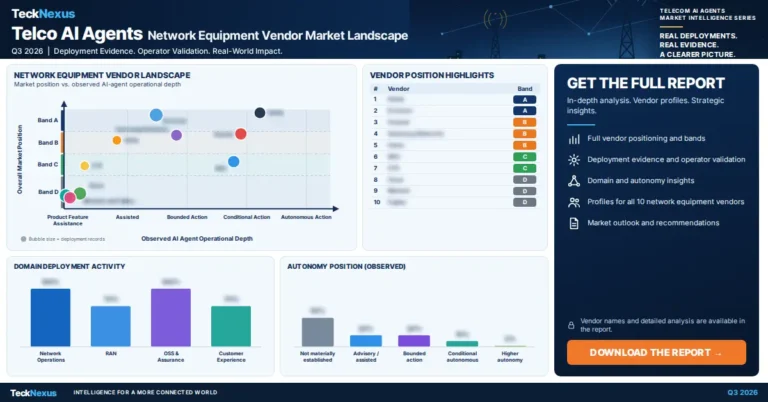
Telco AI Agent Leadership Landscape - Network Equipment Vendors
Network Equipment Vendor Report
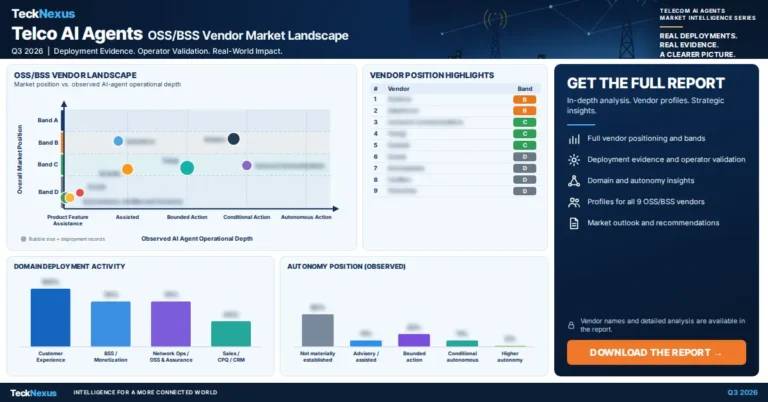
How are Amdocs, Salesforce, Comarch, Totogi, Qvantel, Oracle and other OSS/BSS vendors deploying telecom AI agents?
OSS/BSS Vendor Report
How are Amdocs, Salesforce, Comarch, Totogi, Qvantel, Oracle and other OSS/BSS vendors deploying telecom AI agents?
System Integrator Report
Scroll to Top