Private Network
Intelligence
Intelligence Journeys
Utilities Private Broadband Planning
AI Use Case Planning for Utilities

Devices

Ericsson is signaling a strategic shift toward defence, mission-critical, and AI-era network architectures as traditional RAN spending stays flat. Management expects the global RAN market to remain flat in 2026, sustaining a multi-year trend that now pegs annual spend at roughly the low-$30 billions. Ericsson is building for a traffic mix shift where AI applications push uplink throughput and latency to the forefront. Defence, utilities, transport, and public safety are moving from proprietary systems to standards-based 3GPP networks.
BlueBird 7 is slated to lift off in late February from Launch Complex 36 at Cape Canaveral Space Force Station on the New Glenn-3 mission. It is AST SpaceMobile’s first payload on New Glenn and the second satellite in its next-generation “Block 2” campaign, following BlueBird 6. BlueBird 7 mirrors BlueBird 6 and carries a deployable array of about 2,400 square feet—the company positions it as the largest commercial communications aperture in low Earth orbit. The design, backed by thousands of patent and patent-pending claims, is engineered to deliver peak downlink rates up to 120 Mbps directly to standard, unmodified devices for voice, data, and video.
GlobalGPT’s new mobile app signals a step change in how multimodal AI is consumed—shifting advanced reasoning, image and video generation, and research assistance into a pocketable, enterprise-ready workflow. With app availability on Google Play and support for both Android and iOS ecosystems, enterprises can plan for cross-device continuity, enabling employees to start a task on desktop and continue on mobile with minimal friction. GlobalGPT routes user prompts to advanced models such as GPT-5.2, Claude Opus 4.5, and Gemini 3 Pro to tackle analysis, explanations, and decision support beyond basic Q&A.
Enterprises are moving fast to private 5G to digitize operations, but the payoff only materializes if security scales with the new connectivity footprint. Private 5G brings deterministic wireless to factories, hospitals, ports, and energy sites, connecting robots, AGVs, cameras, and critical control systems. Security must follow identities and workloads, not subnets. Adopt a Zero‑Trust approach aligned to NIST SP 800‑207 with a single source of truth for identity and policy. Shift from perimeter controls to context-driven segmentation. Build on open standards and APIs to avoid lock‑in and simplify operations. Security must be foundational, measurable, and auditable from day one.
AI-driven experiences are flipping the traffic mix, pulling more capacity demand toward the uplink than U.S. mobile networks have historically planned for. Generative and vision-based AI are shifting usage from predominantly downloads to more continuous and bandwidth-heavy uploads. Recent benchmarking shows U.S. 5G networks prioritize downlink KPIs more than peers in Asia, even as uplink usage climbs. RootMetrics’ drive testing in late 2025 found all three U.S. carriers set roughly one-fifth of their midband Time Division Duplex (TDD) frame resources for uplink. That gap becomes material as AI, livestreaming, and enterprise camera workloads expand. U.S. carriers continued to win experience awards in early 2026, even as their uplink allocations trailed global leaders.
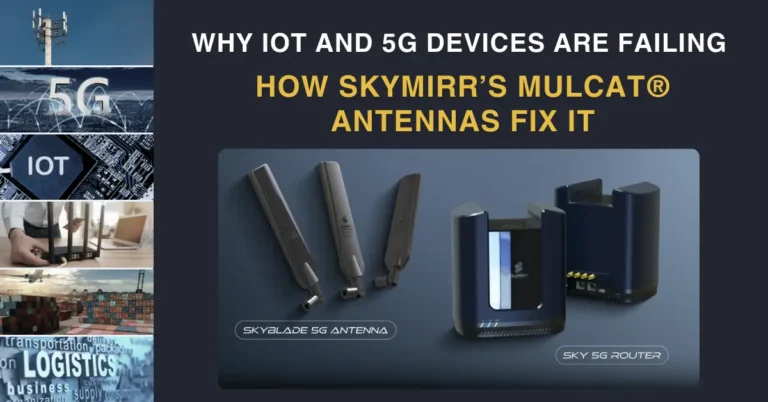
IoT and 5G devices are failing to meet performance expectations, often due to antenna inefficiencies and interference. Skymirr, founded by Eric Jo, tackles this with MuLCAT®, a proprietary antenna technology that delivers up to 2× the efficiency of conventional systems. Used in products like the Sky5G™ router, MuLCAT® eliminates antenna interference, boosts range, and enables real-world wireless reliability across IoT, fixed wireless, and logistics applications. By combining AI-driven RF design with an antenna-first approach, Skymirr is setting a new benchmark for wireless performance.
A European 6G-XR consortium led by Capgemini, Ericsson, i2CAT and Vicomtech demonstrated holographic calling and edge-anchored XR services on live standalone 5G, signaling how networks will evolve to support immersive collaboration at 6G scale. The team executed end-to-end trials of real-time holographic communication and distributed XR experiences spanning edge nodes across Barcelona and Madrid. To keep spatial media stable under cell load, the partners implemented proactive congestion detection and an on-demand quality mechanism that prioritizes holographic traffic. Notably, the consortium has referenced IMS Data Channel as a vehicle to anchor real-time holographic streams within operator service frameworks.
UK regulator Ofcom has opened formal investigations into BT (including EE) and Three after nationwide voice service outages this summer impaired access to other networks and to emergency services. BT notified Ofcom of a software-related failure that disrupted interconnect voice services to and from the EE mobile network on 24–25 July 2025. During the incident, many BT and EE customers could not complete mobile calls to other networks or reach emergency services. Three separately reported a UK-wide disruption to voice services on 25 June 2025, which also affected some customers’ ability to contact emergency services.
Orange Money Group and Visa are expanding a strategic partnership that brings a virtual Visa card into the Orange “Max it” app, letting users fund purchases directly from their mobile money balance for local and international e-commerce. The service is live in Botswana, Madagascar, Jordan, and now Côte d’Ivoire, with rollouts planned for Guinea, Burkina Faso, and the Democratic Republic of Congo. For Orange Middle East and Africa, which serves over 170 million customers in 17 countries and counts tens of millions of active mobile money wallets, this extends acceptance to the global Visa network while preserving the simplicity of a wallet-led user experience.
Google has introduced a sharply priced AI Plus subscription in India to push generative AI into the mass market and counter OpenAI’s ChatGPT Go. The AI Plus plan launches at ₹199 per month for new users for six months, then moves to ₹399 per month. The bundle raises usage limits for Gemini 3 Pro, unlocks video generation within Google’s apps, expands NotebookLM’s “deep research” capabilities, and adds 200GB of storage across Google Photos, Drive, and Gmail. Family sharing is included, signaling a household-centric growth strategy.
Rogers Communications has moved from beta to a commercial footprint for satellite-to-mobile in Canada, extending basic connectivity and select apps to consumer smartphones while adding an industrial IoT tier for remote operations. The new Rogers Satellite service enables a curated set of popular apps to work beyond terrestrial coverage, including WhatsApp calling, Google Maps, AccuWeather, X, and CalTopo on most modern smartphones. In parallel, Rogers introduced satellite-to-mobile for IoT businesses, targeting asset tracking along highways and rail, as well as sensor telemetry in forestry, mining, and other resource sectors where terrestrial cellular is sparse.
The latest 3GPP cycle consolidates 5G-Advanced (Release 18), sets the agenda for Release 19, and frames early 6G studies, with direct implications for operator investment, enterprise use cases, and vendor roadmaps. Release 18, the first phase of 5G-Advanced, is moving from standards completion into implementation, bringing carrier-grade enhancements in spectral efficiency, energy savings, and mobility performance. Release 19 now builds on these foundations, prioritizing further RAN efficiency, XR and video delivery at scale, richer analytics/exposure in the core (NWDAF, NEF/CAPIF), and enterprise-grade reliability across private and public networks.
TECKNEXUS PRIVATE NETWORKS
Congratulations to the 2026 Award Winners
Explore the Winners →

Partner Hubs

Telco AI Agent Leadership

Telco AI Agent Leadership Landscape - Network Equipment Vendors
Network Equipment Vendor Report
How are Amdocs, Salesforce, Comarch, Totogi, Qvantel, Oracle and other OSS/BSS vendors deploying telecom AI agents?
OSS/BSS Vendor Report
How are Amdocs, Salesforce, Comarch, Totogi, Qvantel, Oracle and other OSS/BSS vendors deploying telecom AI agents?
System Integrator Report
Scroll to Top