Private Network
Intelligence
Intelligence Journeys
Utilities Private Broadband Planning
AI Use Case Planning for Utilities

Devices

OECD data shows fixed and mobile broadband have shifted from build-out to scale-up, with fibre and 5G underpinning a new phase of digital infrastructure. Fixed broadband penetration across the OECD rose to 36.5 subscriptions per 100 inhabitants by end-2024, up from 32 in 2019, while the fibre share of fixed lines jumped from 28 percent to 47 percent over the same period. Gigabit-tier offers (≥1 Gbps) moved from 4 percent of subscriptions in 2019 to 19 percent in 2024, signaling both wider availability and growing appetite for very high throughput. On mobile, average monthly data consumption per subscription increased 2.5x—from 6 GB at end-2019 to 15 GB in 2024, aligned with more video, cloud, and AI-assisted applications shifting to handhelds and connected devices.
A coordinated launch in the Netherlands brings standardized, network-powered security APIs to market at national scale. KPN, Odido, and Vodafone Netherlands have jointly introduced a set of security services based on CAMARA, the open-source API framework hosted by the Linux Foundation and aligned with the GSMA Open Gateway program. Working with the Dutch COIN association, the operators are exposing harmonized, privacy-aware network signals that enterprises can use to strengthen authentication and reduce online fraud. The Dutch launch prioritizes identity-centric use cases. Number Verification allows apps to confirm that a user’s device and mobile number match the current session—often silently in the background—reducing one-time password SMS dependency.
At SK AI Summit 2025, CEO Jung Jaihun outlined plans to expand the Ulsan artificial intelligence data center (AIDC) to 1GW-class capacity, stand up a nationwide trio of hubs (Gasan in the Seoul metro, Ulsan in the south, and a new southwest site), and take the model into Southeast Asia starting with Vietnam. The operator is also deepening technology collaborations with Amazon Web Services (AWS) on Edge AI and with NVIDIA on AI-RAN and a Manufacturing AI Cloud; it intends to buy more than 2,000 NVIDIA RTX PRO 6000 Blackwell GPUs and scale Korea’s largest GPU cluster, Haein, as core compute for industrial AI workloads.
Virgin Media O2 has struck a multi‑year agreement with Starlink Direct to Cell to deliver satellite‑to‑mobile service across rural UK not‑spots, positioning O2 as the first British operator to integrate Starlink’s constellation with licensed mobile spectrum. Branded as O2 Satellite, the service will initially support messaging and basic data on existing smartphones when users move beyond terrestrial signal. O2 is targeting landmass coverage beyond 95% within a year of launch, using Starlink’s 650+ low‑Earth orbit satellites to act as “cell sites in space.” Customer rollout is planned for early 2026, with pricing to follow and an extra monthly fee anticipated.
Samsung and NVIDIA are scaling a 25-year alliance into an AI-driven manufacturing platform that fuses memory, foundry, robotics and networks on a backbone of accelerated computing. Samsung plans to deploy more than 50,000 NVIDIA GPUs to infuse AI across the company’s manufacturing lifecycle—from chip design and lithography to equipment operations, logistics and quality control. The “AI factory” is designed as a unified, data-rich fabric where models continuously analyze and optimize processes in real time, shrinking development cycles and improving yield and uptime. The scope goes beyond semiconductors to include mobile devices and robotics, signaling a company-wide digital transformation anchored in accelerated computing.
Enterprises adopting private 5G, LTE, or CBRS networks need more than encryption to stay secure. This article explains the 4 pillars of private network security: core controls, device visibility, real-time threat detection, and orchestration. Learn how to protect SIM and device identities, isolate traffic, secure OT and IoT, and choose the right vendors for a robust private network security strategy.
NVIDIA and Nokia unveiled a strategic partnership to deliver commercial AI-RAN products built on NVIDIA’s Aerial RAN Computer Pro (ARC-Pro) platform and Nokia’s RAN software portfolio, with NVIDIA committing a $1 billion equity investment in Nokia at approximately $6.01 per share, subject to customary closing conditions. The companies are targeting an AI-native RAN that runs both radio workloads and AI inference on a software-defined, accelerated platform, with a cumulative AI-RAN market opportunity that Omdia estimates will exceed $200 billion by 2030. ARC-Pro is positioned as a 6G-ready accelerated computing platform that couples connectivity, compute, and sensing, enabling upgrades from 5G-Advanced to 6G largely via software.
A renewed, three-year collaboration between Magic Leap and Google signals a pragmatic path to AI-capable AR glasses that prioritize visual quality, comfort, and manufacturability. Magic Leap is pivoting from building end-user headsets to becoming an ecosystem partner, offering waveguides, optics, device services, and manufacturing know-how to companies pursuing glasses form factors. The companies are aligning around Android XR, positioning the prototype showcased on stage at the Future Investment Initiative in Riyadh as a reference for future designs. The prototype highlights advances in see-through clarity, low-power displays, and an industrial design that approximates everyday eyewear.
The partnership targets two fronts: mission-critical rail communications for operations and high-speed broadband for passengers. The scope includes deploying advanced 5G infrastructure, testing FRMCS-based use cases, and running a real-world trial on an existing SAR line to validate performance, integration, and safety requirements. An innovation and test lab will be established to accelerate solution validation, and SAR teams will be trained on FRMCS/5G rail technologies to build in-house capability. The partners will explore 5G Standalone capabilities for operational communications, including quality-of-service guarantees, redundancy, and resilience needed for rail. FRMCS-aligned services such as mission-critical push-to-talk/data/video (MCX), Railway Emergency Call, and secure staff communications will be validated for integration with signaling and control systems.
SoftBank has reportedly approved the final $22.5 billion tranche of a planned $30 billion commitment to OpenAI, tied to the AI firm’s shift to a conventional for‑profit structure and a path to IPO. The investment completes a massive $41 billion financing round for OpenAI that began in April, making it one of the largest private capital raises in tech history. This funding and restructuring signal faster enterprise AI adoption, heavier infrastructure demand, and new platform dynamics that will ripple across networks, cloud, and edge. OpenAI is pushing deeper into enterprise tools, security features, and domain‑specific assistants.
Ericsson, Nokia, and Fraunhofer HHI jointly demonstrated a proof‑of‑concept codec that delivers meaningfully higher compression than today’s widely deployed standards—H.264/AVC, H.265/HEVC, and H.266/VVC—without a notable rise in complexity. The partners emphasize energy efficiency and scalability, which are critical for battery‑powered devices, edge compute, and large streaming workloads. Their submission was positively received by the ITU‑T Video Coding Experts Group and ISO/IEC MPEG, the bodies that jointly steward the H.26x/MPEG lineage. The work is positioned as an on‑ramp to the next standardization phase, targeting readiness to support commercial deployment around 2029–2030, in step with 6G timelines.
Germany’s largest operator is turning e-waste into engagement currency with a take-back drive that mixes material recovery with headline incentives. Deutsche Telekom estimates 195 million unused phones are sitting idle in Germany, locking up valuable materials and ESG progress. The company is reframing those devices as an urban mine—rich in gold, copper, and critical minerals—and as a lever to scale circularity ahead of its 2030 ambition to make all IT and network technology, and most end-user devices, recyclable or reusable. By the end of 2024, the operator had already taken back more than 11 million phones across the group.
TECKNEXUS PRIVATE NETWORKS
Congratulations to the 2026 Award Winners
Explore the Winners →

Partner Hubs

Telco AI Agent Leadership

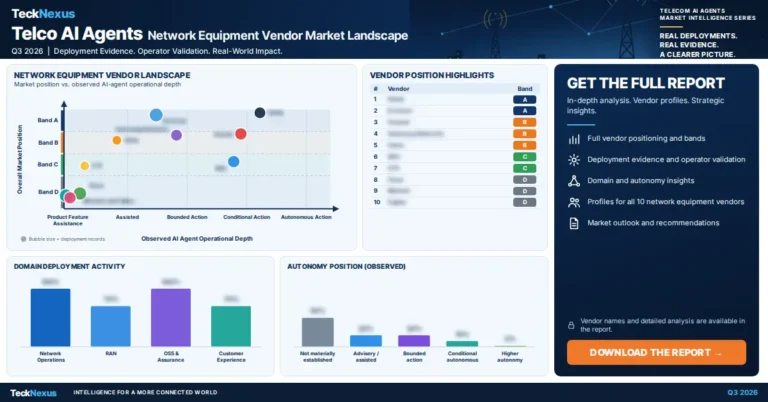
Telco AI Agent Leadership Landscape - Network Equipment Vendors
Network Equipment Vendor Report
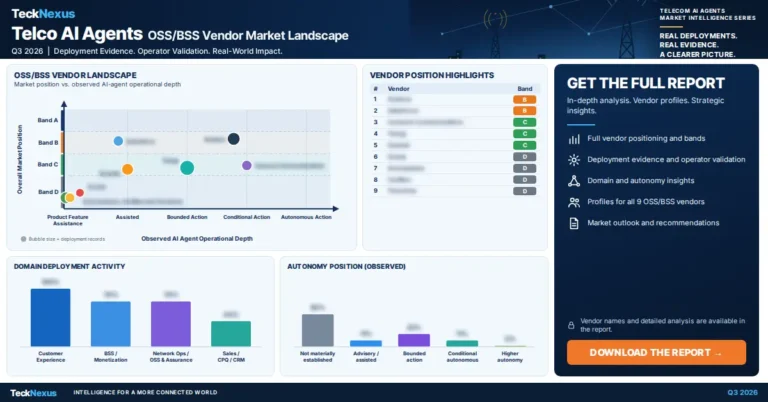
How are Amdocs, Salesforce, Comarch, Totogi, Qvantel, Oracle and other OSS/BSS vendors deploying telecom AI agents?
OSS/BSS Vendor Report
How are Amdocs, Salesforce, Comarch, Totogi, Qvantel, Oracle and other OSS/BSS vendors deploying telecom AI agents?
System Integrator Report
Scroll to Top