Data Center

Lumen is accelerating a multi-year, multi-billion-dollar expansion of its U.S. backbone to match the explosive rise of AI-driven traffic. The company plans to add 34 million new intercity fiber miles by the end of 2028, targeting a total of 47 million intercity fiber miles. In 2025, Lumen has already added more than 2.2 million intercity fiber miles across 2,500+ route miles, with a year-end target of 16.6 million intercity fiber miles. Network capacity grew by 5.9+ Pbps year-to-date, and Lumen earmarked more than $100 million to push 400Gbps connectivity across clouds, data centers, and metros—now covering over 100,000 route miles with 400G-enabled transport.
OpenAI and NVIDIA unveiled a multi‑year plan to deploy 10 gigawatts of NVIDIA systems, marking one of the largest single commitments to AI compute to date. The partners outlined an ambition to stand up AI “factories” totaling roughly 10GW of power, equating to several million GPUs across multiple sites and phases as capacity and supply chains mature. NVIDIA plans to invest up to $100 billion in OpenAI, with tranches released as milestones are met; the first $10 billion aligns to completion of the initial 1GW. The first waves will use NVIDIA’s next‑generation Vera Rubin systems beginning in the second half of 2026.
African AI Compute Is Moving Local. Telecom operators and digital infrastructure players are racing to stand up AI-grade capacity on the continent as demand, latency, and data-sovereignty pressures converge. MTN Group is negotiating with US and European partners to co-invest in AI-ready facilities and offer capacity to enterprises across multiple African markets. Cassava Technologies is accelerating its sovereign cloud strategy with five AI-focused facilities slated across key African markets in the next 12 months. Earlier this year, Cassava partnered with Nvidia to launch an AI data centre in South Africa powered by the chipmaker’s GPUs, establishing a reference for accelerated infrastructure on the continent.
Gartner’s latest outlook points to global AI spend hitting roughly $1.5 trillion in 2025 and exceeding $2 trillion in 2026, signaling a multi-year investment cycle that will reshape infrastructure, devices, and networks. This is not a short-lived hype curve; it is a capital plan. Hyperscalers are pouring money into data centers built around AI-optimized servers and accelerators, while device makers push on-device AI into smartphones and PCs at scale. For telecom and enterprise IT leaders, the message is clear: capacity, latency, and data gravity will dictate where value lands. Spending is broad-based. AI services and software are growing fast, but the heavy lift is in hardware and cloud infrastructure.
India’s Digital Communications Commission has sent most of TRAI’s satellite spectrum recommendations back for review, signaling a tougher stance on pricing, compliance, and market safeguards. TRAI recommended that satellite internet providers pay 4% of adjusted gross revenue (AGR) as spectrum usage charges, an additional Rs 500 per urban subscriber per year, and a minimum annual spectrum fee of Rs 3,500 per MHz when the AGR-linked payout falls short. At its September 16 meeting, the DCC—comprising senior DoT officials and representatives from finance, IT, and NITI Aayog—reviewed the satcom framework and withheld approval on most elements.
Tens of billions in new US tech commitments are set to reshape the UK’s data center footprint, power needs, and network design over the next four years. Microsoft plans to deploy $30 billion into UK AI infrastructure, its largest commitment in the country, split between new-build capacity and financing via partners such as Nscale. Alphabet added roughly £5 billion for AI research and infrastructure over two years and opened a new data center campus in Hertfordshire. These moves sit under a broader US-UK “Tech Prosperity Deal” announced during a state visit, spanning AI, quantum, and nuclear cooperation. The overall vector is clear: more compute, closer to UK users, on a faster timeline.
SK Telecom has been named OpenAI’s exclusive B2C partner among Korean carriers as OpenAI opens its Korea office, signaling an aggressive push to scale consumer AI access and localize go-to-market in a strategically important market. The two companies unveiled a promotion for ChatGPT Plus, giving new or returning subscribers who purchase one month two additional months at no cost. While the immediate focus is consumer-facing, SK Telecom indicates the partnership will extend toward business services and potential collaborations across the broader SK Group.
SK hynix says it has completed development and readied mass production of HBM4, signaling a new performance and efficiency baseline for next‑generation AI accelerators and cloud infrastructure. HBM4 doubles per‑stack bandwidth versus the prior generation by moving to a 2,048‑bit I/O interface and pushing data rates beyond 10 Gbps per pin, exceeding the JEDEC baseline of 8 Gbps for this class of memory. The company also cites more than 40% improvement in power efficiency, a critical lever as AI clusters strain data center power envelopes. Taken together, SK hynix claims this can lift end‑to‑end AI service performance by up to roughly two‑thirds.
Deutsche Telekom is formalizing a sovereignty-first cloud strategy with the launch of T Cloud and new leadership roles that aim to reduce European dependence on non-EU technology stacks. At Digital X in Cologne, Deutsche Telekom’s enterprise arm T-Systems introduced T Cloud, an independent, multi-cloud offering positioned around “levels of sovereignty.” For telcos, public-sector buyers, and regulated enterprises, the message is clear—data location, jurisdiction, and operational control are now first-class design choices, not afterthoughts. T Cloud is pitched as a seamless partner ecosystem spanning public and private cloud, with services tailored to workload criticality and data classifications.
Lumen has introduced Wavelength RapidRoutes, a pre-engineered 100G/400G service with a 20-day delivery SLA aimed at removing months-long bottlenecks from enterprise and hyperscaler connectivity. The company is packaging pre-defined, high-demand optical paths as a catalog of ready-to-deploy waves, removing custom design cycles from many standard routes. Lumen’s RapidRoutes offers 100G and up to 400G wavelength services on prioritized intercity routes with an industry-forward 20-day service delivery SLA, shifting the customer experience from quote-engineer-build to select-provision-activate on pre-engineered paths. A portal-enabled experience with AI-driven tools and more than 300 automated workflows underpins ordering, change management, and capacity scaling.
OpenAI is reportedly partnering with Broadcom to bring a custom AI accelerator into mass production next year, a move aimed at cost control, supply assurance, and tighter hardware–software integration. The reported partnership points to OpenAI deploying its own chips internally rather than selling them, following the playbooks of Google (TPU), Amazon (Trainium/Inferentia), Microsoft (Maia/Athena), and Meta (MTIA). AI training and inference costs remain stubbornly high as model sizes, context windows, and user demand surge. Custom silicon can shift the cost curve by optimizing for specific workloads, improving energy efficiency, and reducing total cost of ownership across compute, memory, and networking.
Nvidia has reportedly paused production activities tied to its H20 data center AI GPUs for China as Beijing intensifies national-security scrutiny, clouding a long-anticipated reentry into the market. Multiple suppliers have been asked to suspend work related to the H20, Nvidia's made-for-China accelerator designed to meet U.S. export rules. The pause arrives shortly after Washington signaled it would grant export licenses for the H20, reversing an earlier halt that triggered unsold inventory write downs at Nvidia. The H20 is Nvidia's linchpin for retaining a foothold in the worlds second-largest AI market; any prolonged disruption has material revenue and ecosystem consequences.
Sponsored by Palo Alto Networks
⚡ Utilities ⏱ 8 min ✓ Free
This tool is built and hosted by TeckNexus.
Launch Tool →
Whitepaper
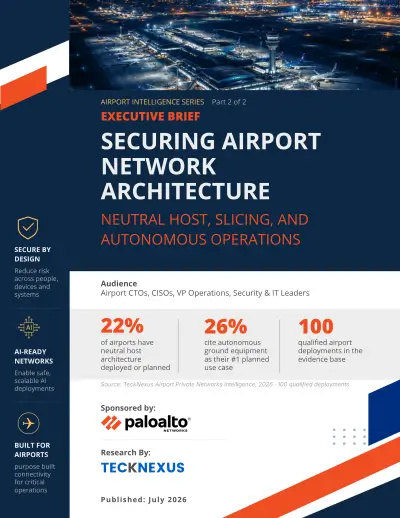
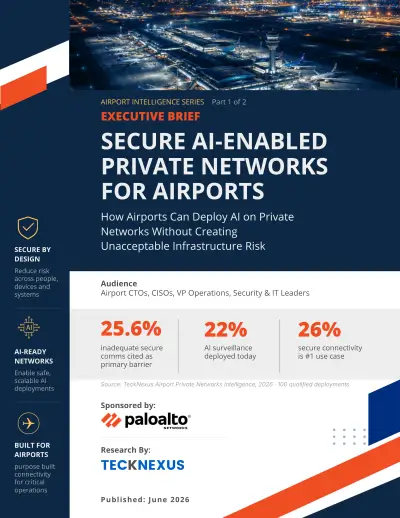
Airports are deploying AI surveillance, biometrics, and autonomous vehicles faster than most networks can secure them. See what 100 real-world airport deployments reveal about the airside/landside security gap — and the 4-layer framework built to close it....
Scroll to Top