Data Center

The telecom sector once hailed AI as a game-changer, but is it delivering? This article explores why many operators report low ROI on AI tools, and how legacy systems, cultural resistance, and regulatory hurdles stall adoption. Despite challenges, AI shows targeted promise in predictive maintenance, fraud detection, and 5G network slicing.
Vantage will invest more than $25 billion to build Frontier, a 1,200-acre, 10-building campus totaling roughly 3.7 million square feet near Abilene, about 120 miles west of Dallas Fort Worth. The site is designed for ultra-high-density racks of 250kW and above, paired with liquid cooling for next-generation GPU systems. Construction has started, with first delivery targeted for the second half of 2026. Vantage expects more than 5,000 jobs through construction and operations. This is the company's largest project to date and underscores its acceleration beyond a global footprint of 36 campuses delivering nearly 2.9GW of critical IT load. Vantage is a portfolio company of Digital Bridge Group.
AI buildouts and multi-cloud scale are stressing data center interconnect, making high-capacity, on-demand metro connectivity a priority for enterprises. Training pipelines, retrieval-augmented generation, and model distribution are shifting traffic patterns from north-south to high-volume east-west across metro clusters of data centers and cloud on-ramps. This is the backdrop for Lumen Technologies push to deliver up to 400Gbps Ethernet and IP Services in more than 70 third-party, cloud on-ramp ready facilities across 16 U.S. metro markets. The draw is operational agility: bandwidth provisioning in minutes, scaling up to 400Gbps per service, and consumption-based pricing that aligns spend with variable AI and data movement spikes.
SoftBank will invest $2 billion in Intel, taking roughly a 2% stake at $23 per share and becoming one of Intels largest shareholders. It is a financial vote of confidence in a company trying to reestablish process leadership, scale a foundry business, and convince marquee customers to commit to external wafer orders. SoftBank has been assembling an AI supply-chain franchise that spans IP, compute, and infrastructure. It owns Arm, agreed to acquire Arm server CPU designer Ampere Computing, injected massive capital into OpenAI, and aligned with Oracle under the Stargate hyperscale AI initiative backed by the current U.S. administration.
SK Telecom is partnering with VAST Data to power the Petasus AI Cloud, a sovereign GPUaaS built on NVIDIA accelerated computing and Supermicro systems, designed to support both training and inference at scale for government, research, and enterprise users in South Korea. By placing VAST Data's AI Operating System at the heart of Petasus, SKT is unifying data and compute services into a single control plane, turning legacy bare-metal workflows that took days or weeks into virtualized environments that can be provisioned in minutes and operated with carrier-grade resilience.
India has cleared a high-capacity semiconductor fabrication plant slated to produce up to 50,000 300mm wafers per month, a cornerstone move to localize chip supply for telecom, cloud, automotive, and industrial electronics. India's electronics and IT leadership confirmed plans for a large-scale silicon fab with a targeted capacity of 50,000 wafers per month. The project is being led by Tata Group, with technology partnership support widely expected from a specialty foundry player, aligning with earlier approvals for mature-node logic and power processes. The fab is planned in Gujarat's industrial corridor, building on India's recent momentum in assembly, test, and packaging investments.
Zayo has secured creditor backing to push major debt maturities to 2030, creating headroom to fund network expansion as AI-driven demand accelerates. Zayo entered into a transaction support agreement dated July 22, 2025, with holders of more than 95% of its term loans, secured notes, and unsecured notes to amend terms and extend maturities to 2030. By extending maturities, Zayo lowers refinancing risk in a higher-for-longer rate environment and preserves cash for growth capex. The move aligns with its pending $4.25 billion acquisition of Crown Castle Fibers assets and follows years of heavy investment in fiber infrastructure.
A new Ciena and Heavy Reading study signals that AI will become a primary source of metro and long-haul traffic within three years while most optical networks remain only partially prepared. AI training and inference are shifting from contained data center domains to distributed, edge-to-core workflows that stress transport capacity, latency, and automation end-to-end. Expectations are even higher for long-haul: 52% see AI surpassing 30% of traffic and 29% expect AI to account for more than half. Yet only 16% of respondents rate their optical networks as very ready for AI workloads, underscoring an execution gap that will shape capex priorities, service roadmaps, and partnership models through 2027.
South Korea's government and its three national carriers are aligning fresh capital to speed AI and semiconductor competitiveness and to anchor a private-led innovation flywheel. SK Telecom, KT, and LG Uplus will seed a new pool exceeding 300 billion won (about $219 million) via the Korea IT Fund (KIF) to back core and foundational AI, AI transformation (AX), and commercialization in ICT. KIF, formed in 2002 by the carriers, will receive 150 billion won in new commitments, matched by at least an equal amount from external fund managers. The platforms lifespan has been extended to 2040 to sustain long-cycle bets.
Vietnam is entering the hyperscale AI data center map, with VNPT and LG CNS positioning to meet local and regional demand. For telecom operators and enterprises, now is the time to align AI roadmaps with data center strategy: plan for high-density racks and liquid cooling, secure GPU capacity, engineer diverse connectivity, and build energy resilience. As the regions AI infrastructure forms, those who co-design workload placement, interconnect, and power from the outset will gain durable cost and performance advantages.
NTT DATA has launched a Global Microsoft Cloud Business Unit to help enterprises worldwide accelerate AI-powered cloud transformation. Backed by 24,000 Microsoft-certified specialists in over 50 countries, the unit focuses on cloud-native modernization, cybersecurity, Agentic AI orchestration, and sovereign cloud adoption. With deep integration into Microsoft’s engineering and sales ecosystem, NTT DATA aims to deliver secure, scalable, and compliant digital transformation at global scale.
OpenAI has raised $8.3 billion in a highly oversubscribed round led by Dragoneer Investment Group, bringing its valuation to $300 billion. The funding will accelerate OpenAI’s expansion into global AI infrastructure, monetization of ChatGPT, and broader enterprise deployment. With over 700M weekly users and $12–13B in annualized revenue, OpenAI is now one of the most capitalized AI firms worldwide, and possibly on the path to an IPO.
Sponsored by Palo Alto Networks
⚡ Utilities ⏱ 8 min ✓ Free
This tool is built and hosted by TeckNexus.
Launch Tool →
Whitepaper
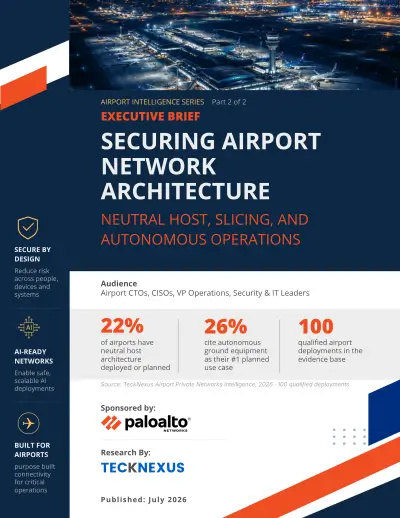
Neutral host, network slicing, and autonomous ground vehicles look like three unrelated topics — but they share the same hidden security risk. See what 100 airport deployments reveal about securing the components with the broadest reach across the network....
Whitepaper
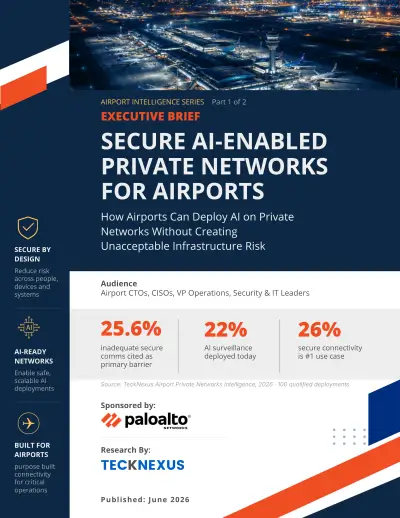
Airports are deploying AI surveillance, biometrics, and autonomous vehicles faster than most networks can secure them. See what 100 real-world airport deployments reveal about the airside/landside security gap — and the 4-layer framework built to close it....
Scroll to Top