Industry Intelligence
Intelligence Journeys
AI Use Cases for Utilities
Private Broadband for Utilities
Intelligence Tools
By Tool Type
▼
By Industry
▼
Access Type
▼
Tool Source
▼
Intelligence PlatformPaid
▼
Monthly Tracker
▼
Resources
▼
Technology Hubs
▼
Partner Hubs
▼

Home » Monetization » Page 11
Monetization
Monetization covers how operators turn networks and capabilities into revenue beyond traditional connectivity. As 5G investment has outpaced obvious new revenue, the industry is pursuing fresh models: network slicing, private networks, fixed wireless access, edge services, network APIs, and enterprise solutions. The recurring challenge is that consumers often perceive limited difference between strong 4G and 5G, making it hard to charge premiums for speed alone and pushing operators toward differentiated, enterprise, and platform-based revenue. For operators, monetization strategy increasingly determines whether network investment pays off; for vendors and enterprises, it shapes which capabilities get built and bought. This channel tracks telecom monetization across slicing, private networks, APIs, FWA, and enterprise services, with analysis of which models are generating real revenue and which remain aspirational, grounded in evidence rather than projection.
- Article & Insights
- February 23, 2024
- Hema Kadia

Explore Top 10 Telco and Tech Podcasts for industry insights, trends, and perspectives from industry leaders.
- News
- February 19, 2024
- Vaibhav Mehta
“Successful B-2-B Partnerships can evolve with Public Cloud Companies and Telcos, if Telcos start to offer network-capabilities in the form of APIs in collaboration with public cloud companies, to accelerate NaaS-based alliances.” - Vaibhav Mehta, Founder & Director, Nabstract.io
- News
- February 12, 2024
- Hema Kadia

Explore the strategic alliance between Verizon and Vonage as they join forces to expand 5G network API capabilities, offering developers new opportunities for innovation and digital transformation.
- News
- February 12, 2024
- News Feed

An industry-leading solution that enables communications service providers to unlock the monetization of new services by consistently delivering differentiated connectivity services
Simplifies network operations by managing conflicting intents to meet the desired business outcomes
Allows the network to respond, adapt and scale in a fully autonomous way to changes in network demands
Leverages one of the largest telco AI and automation use case libraries
Simplifies network operations by managing conflicting intents to meet the desired business outcomes
Allows the network to respond, adapt and scale in a fully autonomous way to changes in network demands
Leverages one of the largest telco AI and automation use case libraries
- News
- February 1, 2024
- Chris Gehlen

Discover Neutroon's latest SaaS innovations for 5G CSPs at MWC Barcelona 2024. Learn about new integrations, features, and partnerships with Druid, CTOne, and others for enhanced enterprise 5G solutions.
- Podcast
- January 17, 2024
- 5G Guys

In this episode of 5G Guys, hosts Wayne Smith and Dan McVaugh are joined by guest Jim Patterson, a veteran in the telecom industry with 30 years of experience. Patterson shares insights from the Las Vegas annual Consumer Electronics Show (CES). Major...
- News
- January 15, 2024
- News Feed

Discover the potential changes in 5G data plans by Reliance Jio and Bharti Airtel, signaling the end of free 5G services. Learn about the pricing strategies and the latest 5G testing developments.
- Whitepaper
- January 3, 2024
- RADCOM


Explore RADCOM's whitepaper 'Unleashing the Power of 5G Analytics' to understand how telecom operators can drive cost savings and revenue with 5G. Learn about NWDAF's role in network efficiency, innovative use cases, and analytics monetization strategies. Download now for key insights into optimizing 5G network performance.
- Article & Insights
- December 6, 2023
- Hema Kadia
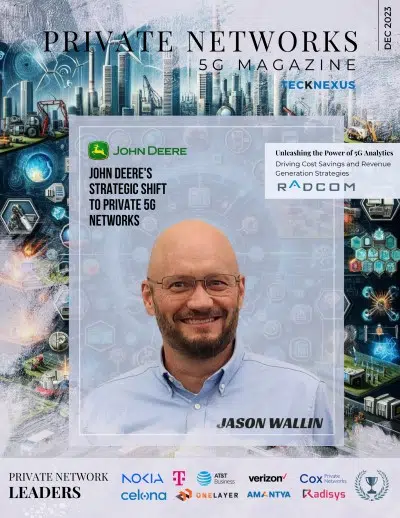
Explore the Private Network Edition of 5G Magazine, your guide to the latest in private 5G/LTE and CBRS networks. This edition spotlights 11 award categories including private 5G/LTE leader, neutral host leader, and rising startups. It features insights from industry leaders like Jason Wallin of John Deere and an analysis of RADCOM's 5G analytics. Covering sectors from manufacturing to healthcare and sustainability, it's a comprehensive read for those interested in the evolving landscape of private networks.
- Article & Insights
- December 6, 2023
- Tomer Ilan

Discover how 5G analytics, through NWDAF, enhances telecom operations, enabling cost reduction and new revenue channels.
- Article & Insights
- December 2, 2023
- Hema Kadia

Explore how Deutsche Telekom shapes transportation with 5G - from teleoperated shuttles to automated driving and connected vehicle tech.
Frequently Asked Questions
Is 5G actually making money for carriers yet?
It’s a mixed picture. Coverage and subscriptions have scaled massively, with global 5G subscriptions surpassing 3.1 billion in early 2026 after 162 million new subscriptions were added in just the first quarter, but the industry narrative has shifted from how fast networks can be built to how to make money from them, with revenue uplift and enterprise monetization still uneven across regions and operators. Some specific monetization avenues, like fixed wireless access, are showing clearer financial traction than others, like consumer-facing network slicing, which remains earlier in its commercial maturity. The honest summary is that 5G has succeeded as infrastructure far more decisively than it has yet succeeded as a profitable new revenue category.
What strategy are carriers using to monetize 5G right now?
The shift is from selling bandwidth to selling outcomes: using network slicing to offer guaranteed-performance services tailored to specific use cases, exposing network capabilities like location data or quality-of-service controls through APIs that outside developers can build on and pay for, and offering speed-based fixed wireless access tariff tiers that let customers pay more for guaranteed higher performance rather than a single flat-rate plan. Industry commentary from major vendors at events like Mobile World Congress 2026 has repeatedly emphasized this framing, arguing that simply selling faster connectivity at a similar price point doesn’t capture the genuine value 5G’s more advanced capabilities can actually provide to specific customer segments willing to pay a premium.
What are ‘network APIs,’ and how do they relate to monetization?
Network APIs let third-party developers tap into specific network capabilities, like verified location, fraud detection, or guaranteed bandwidth for a specific session, typically through aggregator platforms that combine APIs across multiple carriers so developers can build once and scale across markets rather than negotiating separate integrations with every individual operator. The operator-backed Aduna platform, for example, was specifically created to pull together network APIs from multiple operators into a single access point. This model lets operators monetize specific network capabilities directly, charging developers and businesses for access to things like quality-on-demand connectivity, rather than relying purely on consumers paying for basic data plans.
How much are carriers spending on network upgrades relative to what they’re earning back?
Capital intensity remains very high even as the industry pushes harder on monetization. Verizon alone guided $16 to $16.5 billion in U.S. network capital spending for 2026, explicitly tied to continued network investment rather than a pullback in spending despite monetization pressure. Whether that level of ongoing investment generates a proportionate financial return depends heavily on whether newer capabilities like 5G Standalone, network slicing, and enterprise API-driven services actually scale into substantial revenue streams, since basic connectivity revenue alone hasn’t grown enough to justify that scale of continued infrastructure spending without these newer revenue categories maturing significantly further.
Will 6G repeat the same monetization struggle as 5G?
Industry voices are explicitly framing current 5G Standalone monetization as a prerequisite for justifying 6G investment, arguing that proving sustainable, scaled revenue streams from 5G’s more advanced capabilities now is necessary before the industry can credibly justify the next full generational upgrade cycle to investors and regulators. This represents a meaningful shift in industry thinking compared to the 4G-to-5G transition, where rollout speed and coverage milestones were treated as the primary success metrics largely independent of immediate monetization proof. Whether the industry actually breaks this pattern before 6G arrives around 2030, or repeats a similar build-first, monetize-later cycle, remains an open and actively debated question.
Why has 5G monetization been harder than carriers initially expected?
Several factors made 5G monetization harder than many carriers initially expected. Consumers proved largely unwilling to pay significantly more for faster speeds alone once a good-enough connectivity experience was already widely available on 4G, undermining the simple charge-more-for-faster model many operators initially assumed would work. The more advanced, genuinely differentiated capabilities 5G enables, like network slicing and ultra-low latency services, required not just network infrastructure but also new billing systems and device ecosystem support that all took longer to mature than the radio network itself did. Enterprise customers, who represent much of the more promising opportunity, also require longer sales cycles than consumer mass-market products, slowing how quickly that revenue could scale.
What’s the difference between consumer and enterprise 5G monetization strategies?
Consumer 5G monetization has leaned heavily on tiered data plans, modest premium pricing for unlimited or higher-priority data, and fixed wireless access as a new product category competing with home cable and fiber broadband, generally still resembling familiar telecom pricing models. Enterprise monetization looks meaningfully different, focused on customized, often contractually negotiated services like dedicated network slices with guaranteed performance, private 5G networks built for a single organization’s exclusive use, and network API access sold to developers and businesses. Enterprise deals tend to be fewer in number but potentially much higher value per customer, and generally require more direct sales engagement and customization than the largely self-service consumer model.
Are any specific monetization strategies actually proving successful so far?
Some specific strategies are showing clearer success than others. Fixed wireless access has proven to be one of the more concretely successful 5G monetization stories, with the share of FWA offered specifically over 5G rather than 4G rising from 57 percent to 71 percent of providers in under a year, reflecting genuine, measurable revenue growth from a product carriers can sell with relatively straightforward positioning against existing home broadband competitors. Network slicing and API-based monetization, while generating real commercial deployments and partnerships, remain earlier in their maturity curve, with most market analyses describing them as still in the early stages of commercialization rather than fully scaled, proven revenue categories comparable to FWA’s more straightforward consumer success.