Partner Hubs

The next evolution of Ciena’s DCOM: OOB management for diverse data center needs
2027 Intelligence Programs

Open Source

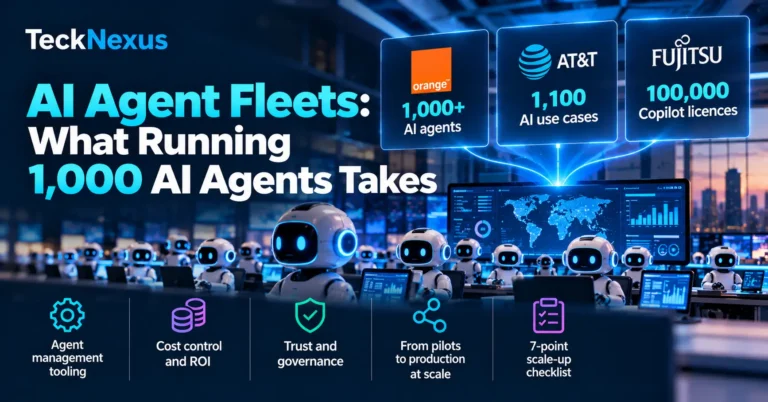
Orange Spain's 1,000-plus agents, Fujitsu's 100,000-licence Copilot rollout and AT&T's 1,100 AI use cases show the challenge has moved from building agents to running fleets of them. TeckNexus examines the new agent management tools, the economics of agent fleets, the trust and governance push led by TM Forum, and a seven-point scale-up checklist.
Anthropic has introduced Claude Code Security, an AI capability that reviews codebases, flags complex vulnerabilities, and proposes patches with human oversight, and its early results should change how security leaders plan for AI on both offense and defense. Anthropic reports that its latest Claude Opus 4.6 model helped uncover more than 500 vulnerabilities in production open-source projects, including issues that had persisted for years. The product centers on high-signal findings, structured triage, and human-in-the-loop remediation so it can slot into existing DevSecOps workflows.
Deutsche Telekom’s T-Systems has secured a multi-million-euro contract from Leibniz University Hannover to power SOOFI, a flagship initiative to build a 100-billion-parameter, European-operated large language model. The SOOFI (Sovereign Open Source Foundation Models) project will train a next-generation, open-source LLM focused on European languages and industrial requirements, replacing the current 7-billion-parameter Teuken7B with a model two orders of magnitude larger. T-Systems will host and operate the training environment in its new Industrial AI Cloud—an NVIDIA-powered facility that DT and NVIDIA unveiled as part of a €1 billion partnership.
Arm and Meta have inked a multi-year partnership to scale AI efficiency from hyperscale data centers to on-device inference, aligning Arm’s performance-per-watt strengths with Meta’s AI software and infrastructure stack. Meta plans to run its ranking and recommendation workloads on Arm Neoverse-based data center platforms as part of an ongoing infrastructure expansion. The companies are co-optimizing AI software components—spanning compilers, libraries, and frameworks like PyTorch, FBGEMM, vLLM, and the ExecuTorch runtime—so models can execute more efficiently on Arm CPUs in the cloud and on Arm-based devices at the edge. The work includes leveraging Arm’s KleidiAI optimizations to improve inference throughput and energy efficiency, with code contributions flowing back to open source.
ChatGPT users in the U.S. can now buy from Etsy sellers without leaving the conversation, with more than a million Shopify merchants “coming soon.” The feature, called Instant Checkout, is available to logged-in Free, Plus, and Pro users. It supports Apple Pay, Google Pay, Stripe, and credit cards. The flow is simple: ask for ideas, get curated products with images, prices, and reviews, tap Buy, confirm shipping and payment, and the merchant fulfills the order using its existing systems. Brands like Glossier, Skims, Spanx, and Vuori are expected to be part of the broader Shopify rollout.

Mistral AI’s new $14B valuation cements its role as a European AI powerhouse. As data sovereignty, GDPR, and the EU AI Act drive demand for open, governable AI, Mistral’s multilingual models and telco-friendly deployments position it at the center of sovereign AI adoption. From edge inferencing to RAN automation, European telcos and enterprises are rethinking AI stack choices.
2027 Intelligence Programs
Scroll to Top
TECKNEXUS MWC BARCELONA 2027
MWC27 EXECUTIVE INSIGHTS PROGRAM

Industry voices. Ideas that move.

SIX MAGAZINES. SIX BIG CONVERSATIONS.
EDITION 01 Networks as Platforms
EDITION 02 AI in the Real World
EDITION 03 The Intelligent Enterprise
EDITION 04 The Future of AI
EDITION 05 Securing the Digital Future
EDITION 06 The Next Frontier

Ways to Participate

Contributed Article Complimentary for eligible MWC sponsors
Sponsored Article & Executive Q&A
Executive Video Interview