Private Network
Intelligence
Intelligence Journeys
Utilities Private Broadband Planning
AI Use Case Planning for Utilities

Gaming

BT Group and its consumer brand EE plan to offer a Starlink-powered home broadband product focused on underserved locations where fixed-line build is constrained by terrain, sparsity, or cost. The service targets “ultrafast” downlink performance, with Starlink capable of delivering up to roughly 280 Mbps and latency in the low tens of milliseconds. Commercial availability is slated for the second half of 2026, giving BT time to industrialise ordering, installation, support, and integration into its existing product catalogue and systems. LEO fills the last 1–5% gap where full fibre is slow or uneconomic to reach.
OECD data shows fixed and mobile broadband have shifted from build-out to scale-up, with fibre and 5G underpinning a new phase of digital infrastructure. Fixed broadband penetration across the OECD rose to 36.5 subscriptions per 100 inhabitants by end-2024, up from 32 in 2019, while the fibre share of fixed lines jumped from 28 percent to 47 percent over the same period. Gigabit-tier offers (≥1 Gbps) moved from 4 percent of subscriptions in 2019 to 19 percent in 2024, signaling both wider availability and growing appetite for very high throughput. On mobile, average monthly data consumption per subscription increased 2.5x—from 6 GB at end-2019 to 15 GB in 2024, aligned with more video, cloud, and AI-assisted applications shifting to handhelds and connected devices.
India has ceded the lowest-tariff crown to Bangladesh and Egypt, yet it still leads on value through generous allowances and low data unit costs. Indian base plans commonly include unlimited voice, whereas Bangladesh and Egypt restrict voice to roughly 100 and 70 minutes respectively at entry level. On data, incremental purchase economics are unusually attractive: an extra Rs 100 typically buys around 26 GB, or about Rs 4 per GB, keeping India among the most affordable data markets globally. Even after adjusting for purchasing power parity, India remains at the affordable end of global tariff rankings.
Ericsson, Nokia, and Fraunhofer HHI jointly demonstrated a proof‑of‑concept codec that delivers meaningfully higher compression than today’s widely deployed standards—H.264/AVC, H.265/HEVC, and H.266/VVC—without a notable rise in complexity. The partners emphasize energy efficiency and scalability, which are critical for battery‑powered devices, edge compute, and large streaming workloads. Their submission was positively received by the ITU‑T Video Coding Experts Group and ISO/IEC MPEG, the bodies that jointly steward the H.26x/MPEG lineage. The work is positioned as an on‑ramp to the next standardization phase, targeting readiness to support commercial deployment around 2029–2030, in step with 6G timelines.
AWS experienced a major outage centered on its US-EAST-1 region in Northern Virginia, triggering cascading failures across dozens of cloud services and dependent applications worldwide. The incident began in the early hours of Monday and was initially mitigated within a few hours, though residual errors and recovery backlogs persisted through the morning in US-EAST-1. Engineering updates point to a DNS resolution problem affecting a key database endpoint (DynamoDB) alongside internal network and gateway errors in EC2, which then propagated across dependent services such as SQS and Amazon Connect. When a foundational component like DNS or an internal networking fabric falters, service discovery and API calls fail in bulk.
Jio closed the quarter ended 30 September with 234 million 5G users, up 86 million year-on-year and now approaching half of its 506.4 million total mobile base. Financial momentum tracked the subscriber and traffic surge. Jio Platforms posted quarterly revenue of INR 426.5 billion, up 14.9% year-on-year, and net profit of INR 73.8 billion, up 12.8%. Jio’s fixed wireless access service, Jio AirFiber, more than tripled year-on-year to 9.5 million subscribers. Bottom line: Jio’s 5G is now at meaningful scale with rising ARPU, heavier usage, and fast-growing FWA—setting up a monetization phase led by targeted pricing actions, application partnerships, and enterprise services as 5G-Advanced capabilities arrive.
Congratulations to the 2026 Private Network Leadership Award Winners
Explore Winners →

Partner Hubs

Latest Reports

It seems we can't find what you're looking for.

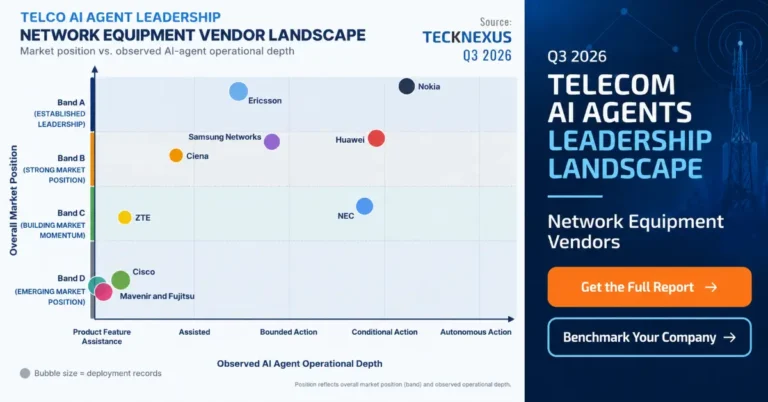
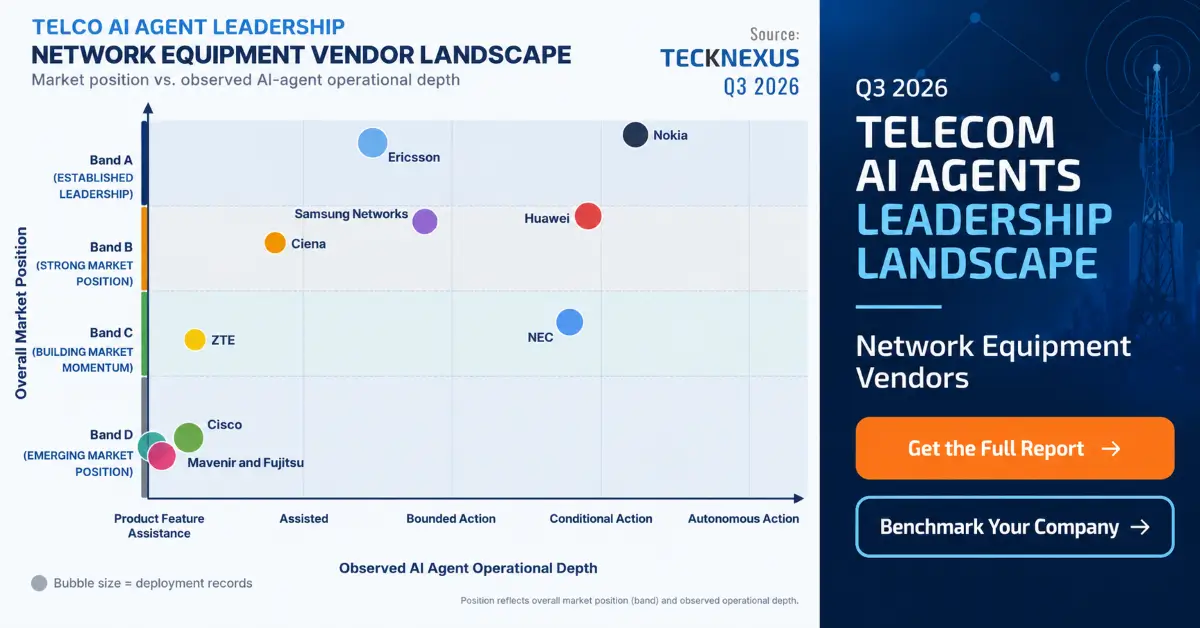
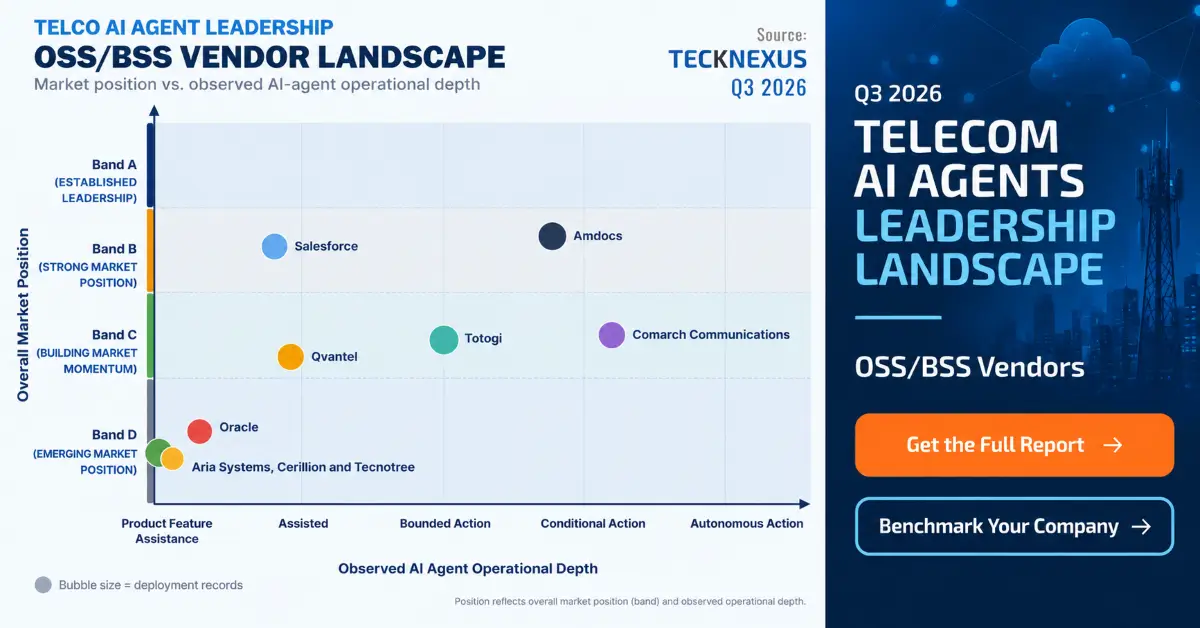
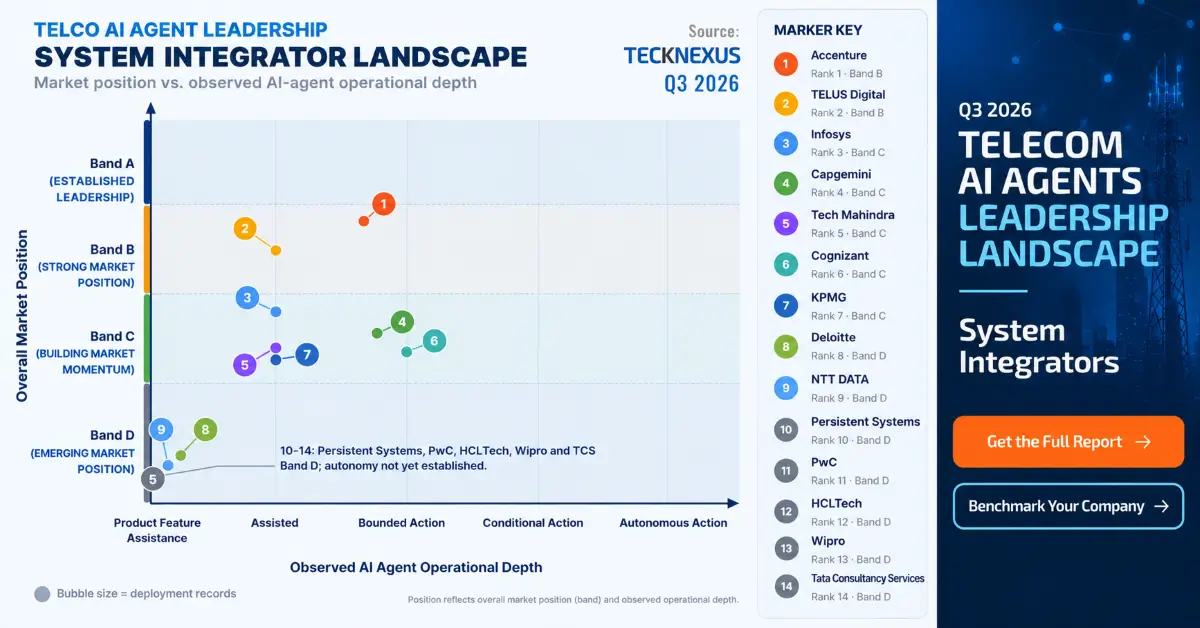
Telco AI Agent Leadership

Telco AI Agent Leadership Landscape - Network Equipment Vendors
Network Equipment Vendor Report
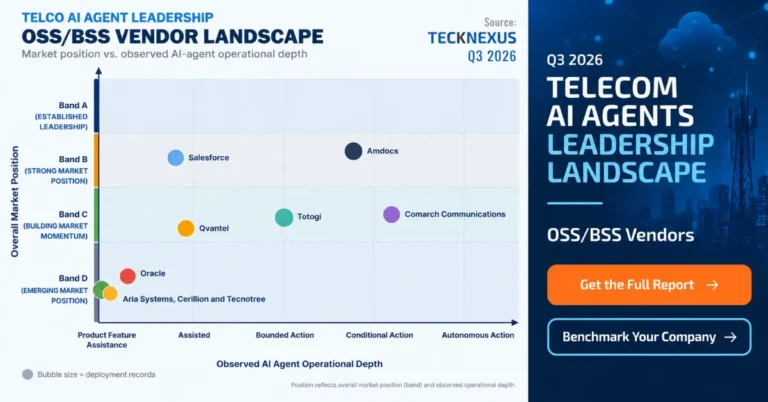
Telco AI Agent Leadership Landscape - OSS/BSS Vendors
OSS/BSS Vendor Report
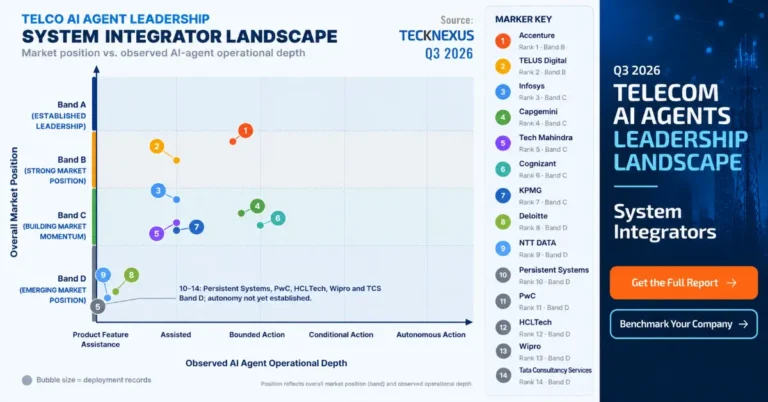
Telco AI Agent Leadership Landscape - System Integrators
System Integrator Report
Scroll to Top
TELECOM AI AGENTS Q3 2026 · Available Now

Explore the Telecom AI Agents Leadership Landscapes

Explore market positioning, deployment momentum and operator validation across the telecom AI agent ecosystem.

Explore Leadership Landscapes
Independent · Evidence-based · Telecom-focused