Ericsson

The Port of Tyne has deployed a private 5G network across its 620-acre site with support from BT and Ericsson. Leveraging edge computing, AI, and drones, the port has improved safety, operational agility, and data-driven decision-making, positioning itself as one of the UK’s most advanced smart ports.
A European 6G-XR consortium led by Capgemini, Ericsson, i2CAT and Vicomtech demonstrated holographic calling and edge-anchored XR services on live standalone 5G, signaling how networks will evolve to support immersive collaboration at 6G scale. The team executed end-to-end trials of real-time holographic communication and distributed XR experiences spanning edge nodes across Barcelona and Madrid. To keep spatial media stable under cell load, the partners implemented proactive congestion detection and an on-demand quality mechanism that prioritizes holographic traffic. Notably, the consortium has referenced IMS Data Channel as a vehicle to anchor real-time holographic streams within operator service frameworks.
New data points to a step-change in cellular IoT adoption as 5G broadens into mid-tier and massive-scale use cases while 4G-era LPWA keeps expanding. Omdia forecasts cellular IoT connections to reach roughly 5.9 billion by 2035, driven by expanding addressable use cases across industrial automation, utilities, transportation, retail, and consumer-adjacent categories such as wearables. The growth profile is no longer tied only to premium 5G performance; instead, scaled adoption is coming from three complementary pillars: 5G RedCap for mid-tier performance at lower cost, 5G Massive IoT (evolving NB-IoT/LTE-M under a 5G core), and 4G LTE Cat-1bis for low-cost devices that still require voice or moderate throughput.
Switzerland’s SBB has deployed an Ericsson IMS/VoLTE platform that interworks with legacy GSM-R, delivering Europe’s first live bridge between public 4G voice and mission-critical railway communications. Ericsson and SBB completed a nationwide IMS/VoLTE integration that extends reliable voice communications across Switzerland’s 3,100 km rail network and removes dependency on public 3G roaming for coverage gaps outside GSM-R footprints. The IMS core integrates multi-supplier elements and preserves EIRENE features such as functional numbering, group calls, emergency stop calls, and onboard announcements, ensuring safety-critical behavior is maintained. It also demonstrates that mission-critical requirements can be met over modern IP telephony when engineered with the right interworking, governance, and testing.
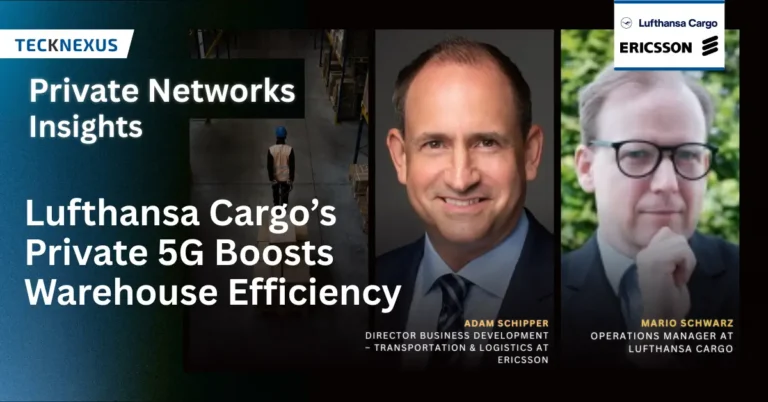
Lufthansa Cargo transformed its LAX warehouse operations with a private 5G network, eliminating Wi-Fi dead zones and reducing end-to-end process time by up to 80%. This deployment improved connectivity for handheld devices, increased workforce efficiency, and laid the groundwork for scalable digital transformation and sustainability initiatives across U.S. cargo hubs.
Policy choices over the next two years will set the capacity ceiling for 6G-era services through the 2030s. Mobile traffic is overwhelmingly urban, concentrated in a small fraction of national land areas and rising fastest in very dense zones. The GSMA’s new Vision 2040 analysis concludes these levers will not keep pace with demand growth on their own. The modeling indicates countries will need, on average, 2–3 GHz of total mid-band assigned for mobile by 2035–2040 to meet peak urban demand; higher-demand markets trend toward 2.5–4 GHz. Crucially, about 2 GHz needs to be operational by 2030 to avoid early congestion as 6G arrives.
Ericsson’s latest Mobility Report points to a clear shift: operators are turning 5G capabilities into differentiated, SLA-backed services rather than just selling more data at higher speeds. After years of building coverage and capacity, 5G networks are mature enough to commercialize features like guaranteed latency, uplink boosts, and application-aware prioritization. The catalysts are in place: more 5G Standalone (SA) cores, rising traffic from video creation and immersive apps, and enterprise demand for predictable performance across sites and clouds. The net result is momentum behind premium, differentiated connectivity that can be priced, assured, and exposed to partners.


Partner Hubs

Download content, access intelligence tools, and hear from executives.

Partner Events

  • M360 ASEAN
  • FutureNet Asia 2026
  • Network X Vienna 2026
Scroll to Top