Private Network
Intelligence
Intelligence Journeys
Utilities Private Broadband Planning
AI Use Case Planning for Utilities

DoT

India and the United Kingdom have launched the India–UK Connectivity and Innovation Centre to accelerate secure, AI-driven, and resilient telecom technologies over the next four years. The two governments committed an initial £24 million—roughly ₹250–₹282 crore depending on exchange rates—to fund applied research, joint testbeds, field trials, and standards contributions in emerging telecom domains. The investment concentrates on three pillars: AI in telecommunications, non-terrestrial networks (NTNs) for satellite and airborne connectivity, and telecoms cybersecurity with open, interoperable systems. The multi-year window aligns to the critical runway for 5G‑Advanced and early 6G experimentation.
Telecom Secretary Neeraj Mittal underscored that AI will be central to the next generation of networks, not an add-on. The direction aligns with industry momentum: 5G-Advanced is already introducing AI-enabled RAN and core features via 3GPP, while 6G initiatives under the ITU-R IMT-2030 framework envision AI-native control loops, sensing-assisted connectivity, and tight integration of compute and communications. India expects 6G trials to begin around 2028, with commercial deployments to follow. Operators that harden their AI and automation capabilities during 5G-Advanced will enter 6G with a competitive execution advantage.
India is poised to greenlight commercial satellite communication services once TRAI issues final pricing for satellite spectrum use and associated charges. The communications minister indicated the policy and licensing groundwork for satellite broadband is largely complete, with two GMPCS licenses issued and one additional letter of intent granted. The final trigger is the Telecom Regulatory Authority of India’s decision on spectrum pricing and usage fees for satcom bands. After that, operators can commence rollouts—initially for enterprise and backhaul, then for consumer broadband in selected markets. Bharti-backed Eutelsat OneWeb and Reliance Jio’s satellite unit are positioned to move early, with constellation capacity and gateways progressing.
India’s nationwide launch of BSNL’s “Swadeshi” 4G stack moves the country from a services-first model to domestic production of core telecom equipment at national scale. India formally launched an indigenous 4G stack for state-run BSNL, alongside more than 97,500 towers announced from Jharsuguda, Odisha. Officials highlighted early reach metrics, noting that roughly 92,000 sites are active and connecting an estimated 22 million users. Telecom equipment sovereignty has become a board-level issue as operators de-risk supply chains, comply with trusted source mandates, and balance costs amid rising traffic and spectrum refarming needs.
India’s Digital Communications Commission has sent most of TRAI’s satellite spectrum recommendations back for review, signaling a tougher stance on pricing, compliance, and market safeguards. TRAI recommended that satellite internet providers pay 4% of adjusted gross revenue (AGR) as spectrum usage charges, an additional Rs 500 per urban subscriber per year, and a minimum annual spectrum fee of Rs 3,500 per MHz when the AGR-linked payout falls short. At its September 16 meeting, the DCC—comprising senior DoT officials and representatives from finance, IT, and NITI Aayog—reviewed the satcom framework and withheld approval on most elements.
India's AI oversight for telecom is moving from recommendations to implementation, with policy review and technical workstreams running in parallel. The Telecom Regulatory Authority of India has issued recommendations on leveraging artificial intelligence and big data in telecom, including the creation of an independent statutory authority for AI governance. The proposed Artificial Intelligence and Data Authority of India (AIDAI) is envisioned to promote responsible AI development and regulate sectoral use cases. The Ministry of Electronics and Information Technology has initiated projects with research bodies and universities focused on how to ensure and test AI trustworthiness.

Partner Hubs

Latest Reports

It seems we can't find what you're looking for.

Telco AI Agent Leadership

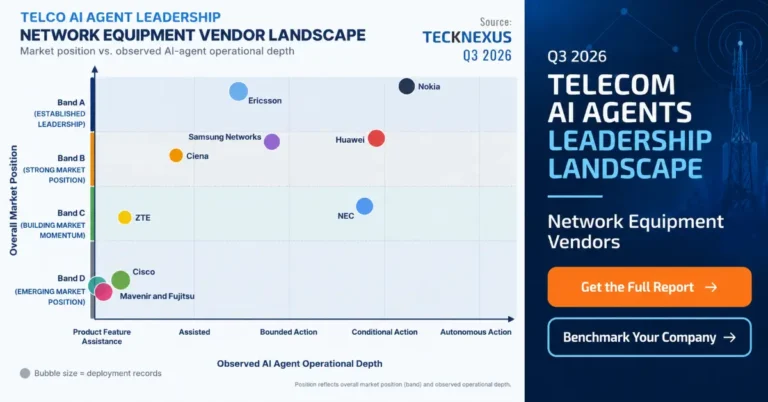
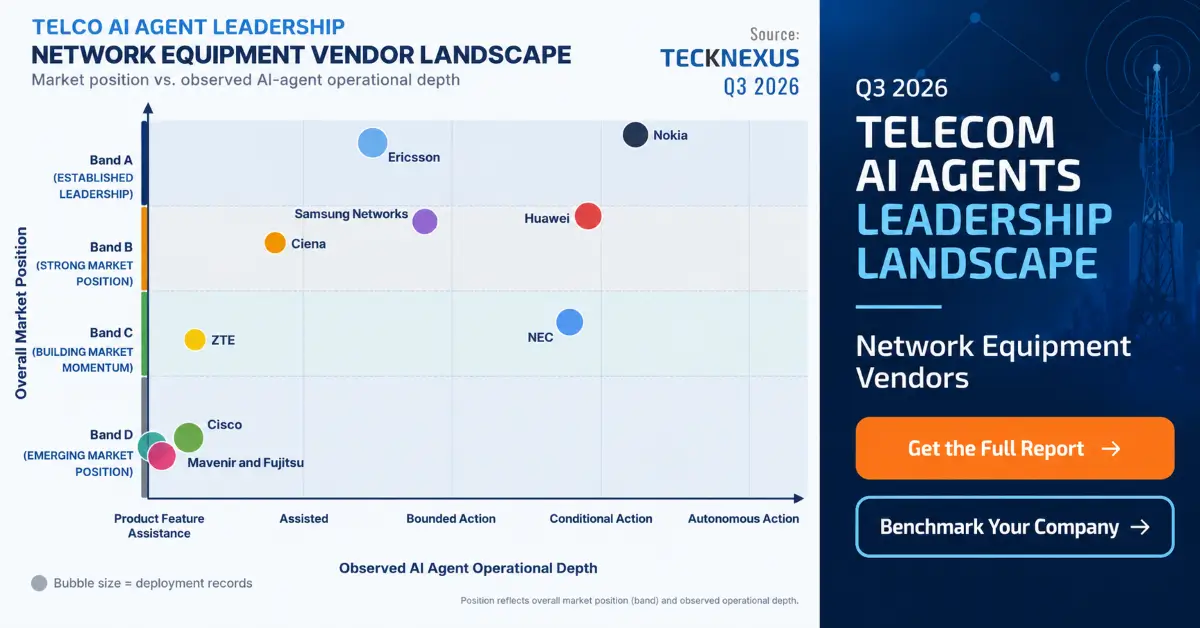
Telco AI Agent Leadership Landscape - Network Equipment Vendors
Network Equipment Vendor Report
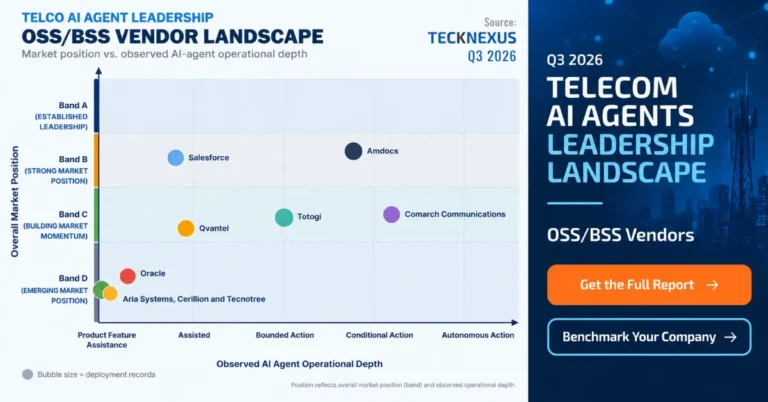
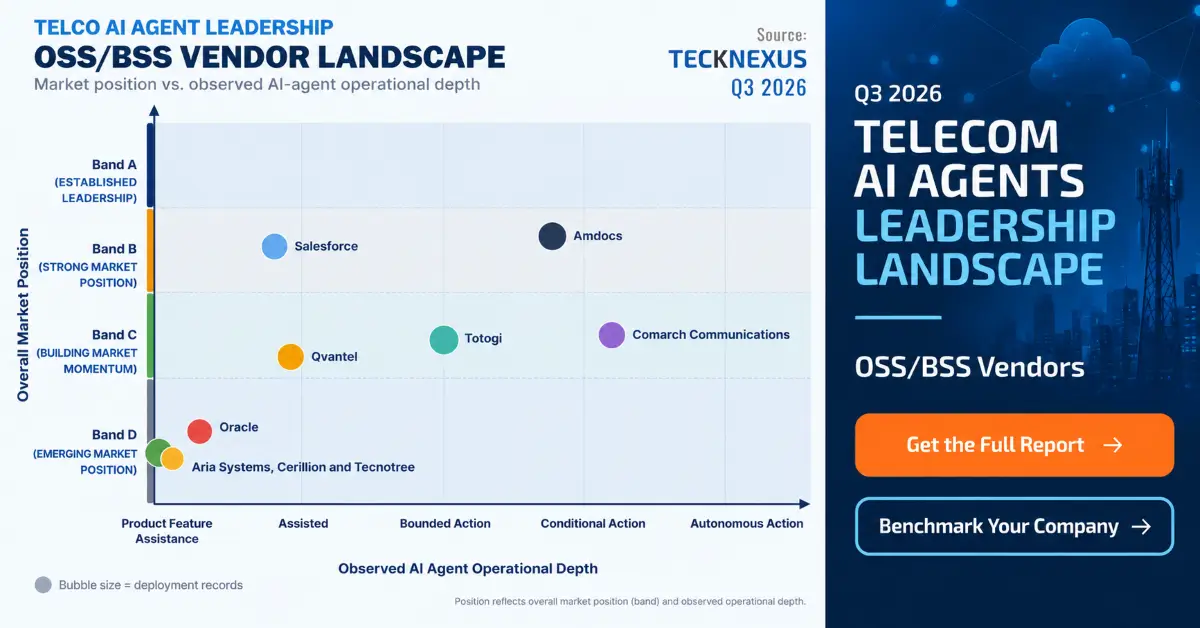
Telco AI Agent Leadership Landscape - OSS/BSS Vendors
OSS/BSS Vendor Report
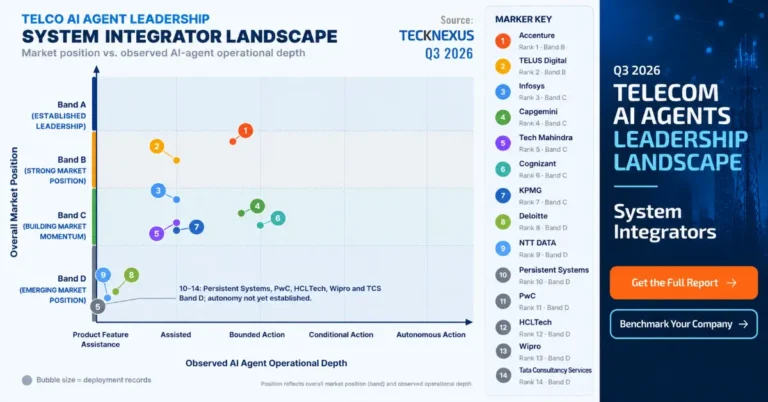
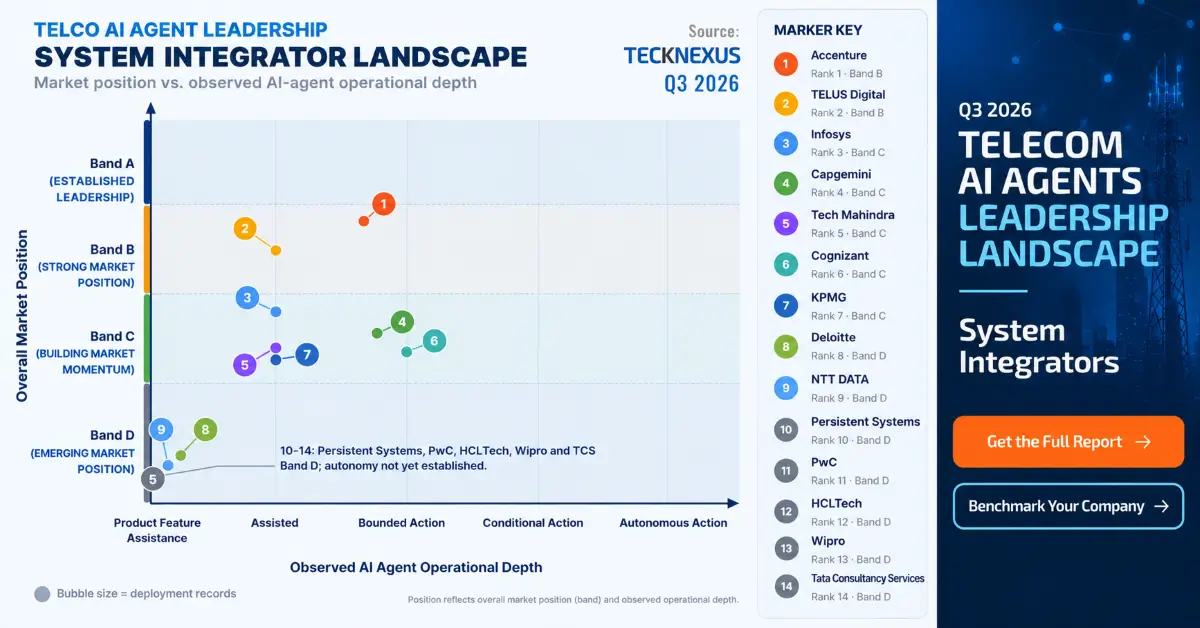
Telco AI Agent Leadership Landscape - System Integrators
System Integrator Report
Scroll to Top
TELECOM AI AGENTS Q3 2026 · Available Now

Explore the Telecom AI Agents Leadership Landscapes

Explore market positioning, deployment momentum and operator validation across the telecom AI agent ecosystem.

Explore Leadership Landscapes
Independent · Evidence-based · Telecom-focused