Private Network
Intelligence
Intelligence Journeys
Utilities Private Broadband Planning
AI Use Case Planning for Utilities

Devices

Canberra is signaling an industry shake-up after hundreds of emergency calls failed to reach Triple Zero, with four incidents linked to fatalities. Optus, Australia’s second-largest operator and a subsidiary of Singtel, reported a technical failure that prevented 624 calls from connecting to emergency services (000), affecting customers across Western Australia, South Australia, New South Wales, and the Northern Territory. The Australian Communications and Media Authority (ACMA) has opened an investigation into compliance with the Emergency Call Service rules, which require carriers to ensure 000/112 calls connect regardless of network status.
KDDI’s move to enable satellite data on recent iPhones via “au Starlink Direct” is a meaningful step toward resilient, nationwide connectivity that blends terrestrial and non-terrestrial networks. KDDI now supports satellite data communication on all models of iPhone 13 through iPhone 17, plus iPhone Air—21 models in total, so consumers and field teams can use essential apps when they are outside cellular coverage. The satellite layer augments KDDI’s 5G/4G LTE footprint; combined, the operator aims to cover virtually all of Japan’s geography, not just its population centers. Notably, the service is available to au subscribers and customers of other carriers.
SoftBank has validated a multi‑cell, end‑to‑end 5G link via a high‑altitude platform payload, marking a concrete step toward stratospheric coverage that works with standard smartphones. In a June field trial over Hachijō Island, Japan, SoftBank mounted a newly developed payload on a light aircraft at 3,000 meters to emulate a High Altitude Platform Station (HAPS) operating around 20 kilometers. The system stitched a millimeter‑wave feeder link at 26 GHz from a ground gateway to the aircraft with a sub‑2 GHz service link at 1.7 GHz from the aircraft to handsets, completing an end‑to‑end path through the 5G core.
Korea’s three national carriers have enabled Rich Communication Services (RCS) on iPhones via Apple’s recent iOS update, bringing Android–iOS parity for default messaging to a market long dominated by OTT apps. SK Telecom, KT, and LG Uplus now support RCS for iPhone users across Korea, extending capabilities that previously existed only on Android. RCS on iPhone is available on iPhone 11 series and newer models running the latest iOS update, with activation dependent on carrier support and user settings. Users gain modern chat features including group messaging with up to 100 Android participants, read receipts, typing indicators, replies, and support for richer media.
The global wearables market has more than doubled since 2021 and is entering a new cycle driven by AI-enabled, gesture-first devices. After a post-pandemic correction, volumes are stabilizing as value rises, helped by richer sensing, better compute and broader use cases. The next leg of growth centers on “intent-based” interaction—reading minute muscle or motion signals to control devices without touching a screen or speaking a command. The appeal is clear: faster command throughput, fewer errors in noisy environments, and safer operation in motion or sterile settings.
Manufacturers and wireless providers are shifting 5G from promising pilots to scaled, revenue‑relevant deployments across American factories. A joint report from the National Association of Manufacturers (NAM) and CTIA underscores a clear inflection point: commercial 5G, industrial AI and edge computing are maturing together. With 3GPP Release 16/17 capabilities such as URLLC, time‑sensitive networking integration, network slicing and non‑public networks, 5G is increasingly able to support time‑critical control, quality inspection and safety systems at scale. Production use cases are expanding and delivering measurable benefits. The message is consistent: companies that operationalize 5G alongside AI and automation will capture disproportionate productivity and resiliency advantages.
Tidal Wave Technologies has selected UK-based RANsemi to supply AI-enhanced Open RAN small cells for next-generation industrial private 5G networks across India. The companies will integrate RANsemi’s small cell platform into private 5G systems targeted at harsh, safety-critical environments. Initial focus areas include open-cast coal mines, large port terminals, and complex logistics hubs. The goal is to deliver resilient, low-latency connectivity for automation, remote operations, and worker safety. The partnership will be showcased at India Mobile Congress (IMC) 2025 with a live demonstration of integrated small cells and edge intelligence.
Argentina’s regulator ENACOM has created a new licensing framework and reserved spectrum to let enterprises run stand-alone private mobile networks across critical industries. ENACOM has designated the 2300–2400 MHz band for Private Wireless Broadband Systems, a category designed for on-premise, non-public LTE/5G networks serving operational technology and enterprise applications rather than consumer subscribers. The framework supports high-throughput, low-latency, and massive IoT use cases, enabling enhanced video, automation, and machine communications across industrial campuses and field operations; 2.3 GHz maps to widely supported 3GPP Band 40 (LTE TDD) and NR n40, giving enterprises access to a mature device and radio ecosystem.
Iridium Communications and Deutsche Telekom (DT) are collaborating to integrate Iridium NTN Direct with DT’s global IoT footprint, enabling DT customers to roam onto Iridium’s low Earth orbit (LEO) network for narrowband IoT. The service targets 3GPP-compliant 5G NTN for NB-IoT, bringing satellite reach to sensors, machines, and vehicles. Commercial launch is slated for 2026, pending integration, testing, and a roaming agreement. DT is among the first major mobile operators to pursue a standards-based NTN IoT integration, aligning with its broad NB-IoT/LTE-M roaming strategy. The pairing aims to offer seamless terrestrial-satellite service without proprietary devices or walled gardens.
Gartner’s latest outlook points to global AI spend hitting roughly $1.5 trillion in 2025 and exceeding $2 trillion in 2026, signaling a multi-year investment cycle that will reshape infrastructure, devices, and networks. This is not a short-lived hype curve; it is a capital plan. Hyperscalers are pouring money into data centers built around AI-optimized servers and accelerators, while device makers push on-device AI into smartphones and PCs at scale. For telecom and enterprise IT leaders, the message is clear: capacity, latency, and data gravity will dictate where value lands. Spending is broad-based. AI services and software are growing fast, but the heavy lift is in hardware and cloud infrastructure.
AT&T is testing a carrier-grade call-screening assistant that answers unknown calls on your behalf and filters out likely robocalls before your phone ever rings. The operator is trialing an AI “digital receptionist” with select customers that intercepts calls from numbers you don’t recognize, asks the caller to identify themselves and their purpose, and then decides whether to connect, take a message, or end the call. Because the service runs in AT&T’s network, it can also consider patterns from your calling history to recognize frequent contacts and allow them through automatically.
Space42 and Viasat plan to form Equatys, a joint venture designed to deliver standards-based Direct-to-Device (D2D) connectivity to smartphones and IoT devices over a unified satellite–terrestrial network. The partners intend to launch a 3GPP Non-Terrestrial Network (NTN) platform that integrates with 5G networks and works with unmodified handsets and IoT modules. The companies say Equatys will aggregate well over 100 MHz of harmonized Mobile Satellite Services (MSS) spectrum already assigned across more than 160 markets, describing it as the largest coordinated block available for this purpose. Equatys positions itself as a neutral “space tower” operator that multiple licensed service providers can share.
TECKNEXUS PRIVATE NETWORKS
Congratulations to the 2026 Award Winners
Explore the Winners →

Partner Hubs

Telco AI Agent Leadership

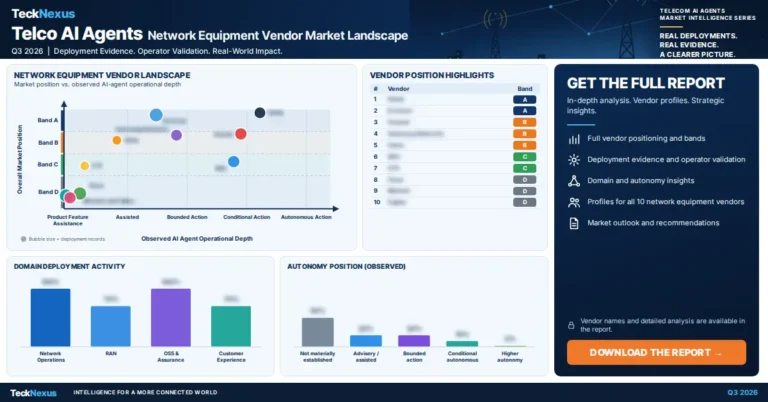
Telco AI Agent Leadership Landscape - Network Equipment Vendors
Network Equipment Vendor Report
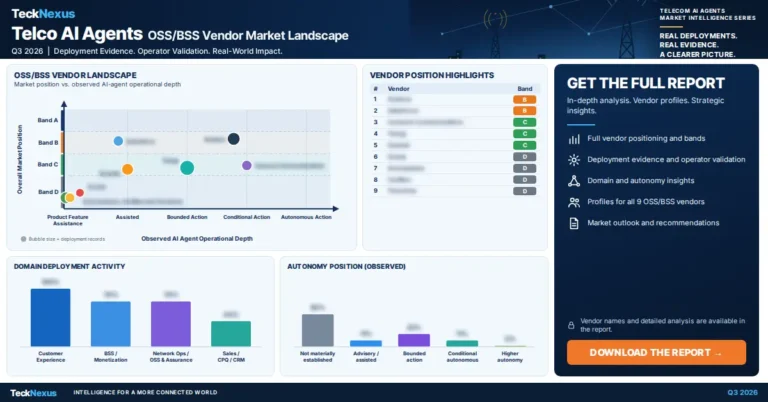
How are Amdocs, Salesforce, Comarch, Totogi, Qvantel, Oracle and other OSS/BSS vendors deploying telecom AI agents?
OSS/BSS Vendor Report
How are Amdocs, Salesforce, Comarch, Totogi, Qvantel, Oracle and other OSS/BSS vendors deploying telecom AI agents?
System Integrator Report
Scroll to Top