Broadband

Virgin Media O2 has broadened its partnership with Zinkworks to deploy AI-driven monitoring and automation across its mobile footprint, designed to spot anomalies earlier, resolve incidents faster, and prevent customer-impacting outages. The rollout targets multiple network domains and operational workflows, advancing the operator’s move toward autonomous operations with engineers maintaining full oversight. The capabilities span radio access, core network systems, and network operations centers, combining real-time telemetry with intelligent automation. The stack runs on Google Cloud and taps services such as Vertex AI and Gemini to analyze patterns, orchestrate responses, and augment decision-making for operations teams.
New guidance from the NTIA signals that BEAD-funded satellite providers, including SpaceX’s Starlink, must abide by standard program terms rather than negotiate bespoke carve-outs. An updated NTIA FAQ on subgranting makes clear that states cannot waive or dilute the statutory and programmatic requirements set out in the BEAD NOFO and subsequent guidance. Payments should be tied to objective milestones and verifiable outcomes, not front-loaded without proportional performance. Performance testing, reporting, and documentation must meet program and FCC-aligned standards; subgrantees cannot unilaterally narrow test samples or exclude locations to their advantage. The FAQ effectively answers whether BEAD can be implemented on a “vendor’s terms”: it cannot.
Colombia has cleared a milestone consolidation: Tigo has taken operational control of Movistar, creating a second national-scale incumbent to challenge Claro. The Superintendence of Industry and Commerce (SIC) approved the integration through Resolution 94169 of 2025, capping months of scrutiny and pushback from rivals and ISPs. The merger compresses Colombia’s competitive field at a time when 5G rollouts, fiber densification, and cloud-native cores demand scale. It creates a stronger counterweight to Claro, but also raises real concerns about a two-horse race and the downstream effects on MVNOs, ISPs, and enterprise buyers.
AT&T is deepening ties with Amazon by pairing its national fiber assets with AWS cloud and AI tooling while adding low Earth orbit connectivity from Amazon’s satellite network to fill coverage gaps for business customers. The collaboration has two pillars: cloud modernization on AWS and satellite-enabled reach via Amazon’s LEO network, with AT&T also supplying fiber capacity into AWS data centers to bolster high-performance infrastructure. Amazon’s LEO constellation will deliver fixed broadband connectivity for AT&T Business customers in areas where terrestrial options are limited, enabling primary service in hard-to-reach sites and resilient backup for SD‑WAN architectures.
The merger creates a $1.25 trillion private giant that fuses launch, satellites, and AI, but the strategic logic goes beyond orbiting data centers. SpaceX brings rockets, Starship scale, and the world’s largest NGSO broadband network via Starlink. xAI brings models, AI R&D, and a brand in the hottest capital market category. Together, they present a single story to investors: own the stack from compute to constellation to connectivity, on and off Earth. Consolidation gives Musk freedom to reallocate cash flows and simplifies the roadshow pitch.
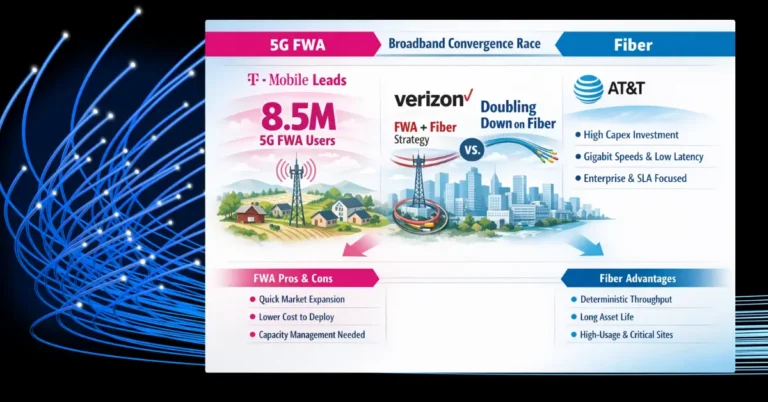
AT&T has closed its $5.75 billion cash deal to acquire Lumen’s consumer fiber business across 11 states, reshaping competitive dynamics in U.S. fiber-to-the-home and sharpening Lumen’s enterprise focus. The transaction moves more than 1 million fiber subscribers and over 4 million enabled fiber locations, including the Quantum Fiber brand and related consumer access networks, into AT&T’s portfolio. AT&T’s fiber home internet footprint now spans 32 states, adding major metros such as Denver, Seattle, and Salt Lake City where it can bring multi-gig services to market at scale.
The operators that control both dense fiber and performant 5G, and that package them coherently, will set the pace for the next telecom cycle. AT&T’s targets—more fiber passings, higher bundle attach, and measured wireless growth—put it squarely in the camp that sees integrated networks as the winning model. If the company executes on build cadence and cross-sell while keeping experience clean, expect continued share gains in fiber markets and a tougher environment for single-asset competitors. For buyers, the practical takeaway is to lean into converged sourcing now to lock in economics and resiliency as these footprints expand.
Verizon exits 2025 with standout subscriber growth and a leaner 2026 investment plan that shifts dollars from network build to integration, efficiency and customer retention. Verizon posted more than 1 million net additions in the fourth quarter, including 616,000 postpaid phone net adds—the best showing since 2019—and 372,000 broadband net adds driven by 319,000 fixed wireless access (FWA) additions and the strongest Fios Internet quarter since 2020. After years of 5G coverage build, Verizon is pivoting to densification, fiber integration and operating efficiency, allowing capex to step down without undermining network competitiveness. Capital will concentrate on fiber-led convergence, FWA capacity, and experience-centric technologies that reduce churn and support revenue quality.
Germany’s largest operator is pairing a go-to-market reset with a new in‑home sales model to lift fibre take-up, accelerate copper migration, and defend share in a tightening fixed broadband battle. Deutsche Telekom is moving beyond sidewalks and basements to deliver fibre all the way to the customer premise, including in-building cabling for multi-dwelling units on network level 4. After regional pilots in 2025, Deutsche Telekom is rolling out permanent local fibre consultancy teams to meet customers and property owners at the doorstep. Fibre is a considered purchase; informed on-site guidance shortens decision cycles and reduces fallout between order and activation.
BlueBird 7 is slated to lift off in late February from Launch Complex 36 at Cape Canaveral Space Force Station on the New Glenn-3 mission. It is AST SpaceMobile’s first payload on New Glenn and the second satellite in its next-generation “Block 2” campaign, following BlueBird 6. BlueBird 7 mirrors BlueBird 6 and carries a deployable array of about 2,400 square feet—the company positions it as the largest commercial communications aperture in low Earth orbit. The design, backed by thousands of patent and patent-pending claims, is engineered to deliver peak downlink rates up to 120 Mbps directly to standard, unmodified devices for voice, data, and video.
The European Commission’s Digital Networks Act (DNA) is a sweeping proposal to harmonize telecom rules, catalyze next‑generation investment, and turn 27 national markets into a functional single market for connectivity. The DNA is timed to underpin an AI‑driven economy that depends on fiber, 5G/6G, and low‑latency cloud‑edge fabrics spanning borders. Longer licence durations and more flexible sharing are intended to reduce renewal risk and unlock investment in 5G densification and 6G prep. Mandatory national plans to phase out copper between 2030 and 2035 will free OPEX and energy, but require careful migration of regulated wholesale products, vulnerable users, and critical services.
Comcast is recasting how it engages consumers by rolling out Xfinity Membership, a loyalty experience that ties perks and rewards to broadband, mobile, and media usage while expanding its retail footprint with new Xfinity Stores in South DeKalb, Georgia, and Chehalis, Washington. The strategy is straightforward: keep customers longer by making Xfinity more valuable the more services they use. Xfinity Membership packages ongoing perks and periodic rewards across Comcast’s portfolio, aligning incentives to broadband, Xfinity Mobile (MVNO on Verizon’s network), and NBCUniversal’s media assets such as Peacock.

Your Brand. Our Intelligence Tools.

Capture leads at the point of evaluation. Talk to Us →

Sponsored by Palo Alto Networks
⚡ Utilities ⏱ 8 min ✓ Free
This tool is built and hosted by TeckNexus.
Launch Tool →
Whitepaper
This whitepaper explains how utilities can use secure AI-enabled private mobile networks to modernize operations, support distributed intelligence, improve resilience, and strengthen cybersecurity across critical infrastructure. It covers AI applications, private network advantages, zero trust principles, multilayered security architecture, and governance considerations for AI-ready utility environments....
Whitepaper
Non-terrestrial networks are rapidly evolving from experimental satellite systems into an increasingly important part of the global 5G connectivity landscape. This eBook, developed by Radisys in collaboration with TeckNexus, explores how 3GPP standardization, satellite architecture innovation, and software-driven network design are reshaping NTN deployment models. It examines the transition from...
Whitepaper
Private cellular networks are transforming industrial operations, but securing private 5G, LTE, and CBRS infrastructure requires more than legacy IT/OT tools. This whitepaper by TeckNexus and sponsored by OneLayer outlines a 4-pillar framework to protect critical systems, offering clear guidance for evaluating security vendors, deploying zero trust, and integrating IT,...
Scroll to Top