Broadband

More than 60% of U.S. households are now serviceable by fiber, with double‑digit millions of new homes added in 2025 as operators, co‑ops, and municipalities pushed into suburban and rural areas. Median build benchmarks show underground construction around $18 per foot and aerial around $8 per foot, based on a broad sample of operator and contractor data across dozens of states. Most builders expect costs to rise again in 2026, and many anticipate longer schedules. Labor and materials remain the top pressure points, while permitting and make‑ready feature more prominently as networks stretch into harder‑to‑build pockets.
AI-driven experiences are flipping the traffic mix, pulling more capacity demand toward the uplink than U.S. mobile networks have historically planned for. Generative and vision-based AI are shifting usage from predominantly downloads to more continuous and bandwidth-heavy uploads. Recent benchmarking shows U.S. 5G networks prioritize downlink KPIs more than peers in Asia, even as uplink usage climbs. RootMetrics’ drive testing in late 2025 found all three U.S. carriers set roughly one-fifth of their midband Time Division Duplex (TDD) frame resources for uplink. That gap becomes material as AI, livestreaming, and enterprise camera workloads expand. U.S. carriers continued to win experience awards in early 2026, even as their uplink allocations trailed global leaders.
A new analysis of U.S. fixed wireless access shows subscriber momentum outpacing performance, a signal that capacity and management strategies are under pressure. Fixed wireless access from T-Mobile, Verizon, and AT&T added about 1.04 million net customers in Q3 2025, taking the U.S. FWA base to roughly 14.7 million. T-Mobile remains the U.S. FWA speed leader, posting a median download around 209 Mbps in Q3 2025. Median uploads dipped below 20 Mbps across providers, creating a hurdle for the FCC’s 100/20 benchmark. Urban FWA customers are more likely to meet the FCC’s 100/20 threshold than rural users due to radio geometry and site density.
3GPP has become the organizing framework for how public safety, utilities, transportation and enterprise security adopt LTE/5G for mission-critical communications (MCX). For mission-critical users, 3GPP’s scope includes capabilities such as push-to-talk, data and video designed for high availability, priority, pre-emption and end-to-end security. For agencies and enterprises, the value of 3GPP is practical: it lowers integration risk, clarifies feature expectations and aligns multi-year investment roadmaps. Standards are the foundation; operational reliability is the measure of success. 3GPP is the baseline for resilient, interoperable operations.
2025 has seen major telecom and tech M&A activity, including billion-dollar deals in fiber, AI, cloud, and cybersecurity. This monthly tracker details key acquisitions, like AT&T buying Lumen’s fiber assets and Google’s $32B move for Wiz, highlighting how consolidation is shaping the competitive landscape.
New consumer research commissioned by Viasat and executed by GSMA Intelligence signals that non-terrestrial networks (NTN) are becoming a mainstream buying factor for mobile subscribers. The survey of more than 12,000 smartphone users across 12 countries finds persistent coverage gaps: over a third of respondents lose basic cellular service multiple times per month. That pain point is translating into intent. Roughly six in ten consumers say they would pay extra for satellite-enabled connectivity on their phones, and nearly half indicate they would switch operators if out‑of‑coverage service were included in their plan. On average, those willing to pay would accept a 5–7% uplift on their current monthly bill, with outliers such as India approaching a 9% premium.
Netflix plans to acquire Warner Bros. Discovery’s studio and streaming assets in a $72 billion transaction that could reshape streaming, theatrical distribution, and the broader media supply chain. The cash-and-stock offer values Warner at $27.75 per share and implies an enterprise value of $82.7 billion including debt. The combination would join Netflix’s global streaming leader with Warner’s television and motion picture divisions, including HBO, HBO Max, and DC Studios. Closing is targeted within 12–18 months, subject to regulatory clearance. The deal encompasses Warner’s studios and streaming businesses and their associated IP libraries.
Versant’s lineup spans USA Network, CNBC, MS NOW (formerly MSNBC), Oxygen, E!, SYFY and Golf Channel, plus Fandango, Rotten Tomatoes, GolfNow, GolfPass and SportsEngine. Management argues the reach of up to ~65 million households and a 62% live programming mix gives it durable leverage in news and sports while it builds digital and direct-to-consumer (DTC) revenue. For MVPDs, vMVPDs and broadband providers, this is a new negotiating counterparty with incentives to protect affiliate value while expanding FAST, OTA and DTC channels that can bypass bundles. Versant stock will trade on Nasdaq as VSNT starting January 5, 2026.
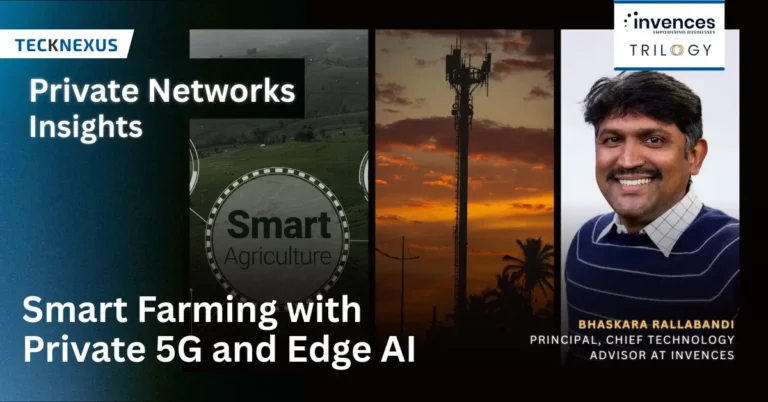
Winner – Private Network Excellence in Agriculture - Invences, in partnership with Trilogy Networks, are transforming agriculture with FarmGrid, a smart farming platform powered by private 5G, edge AI, and IoT. Deployed across multiple U.S. states, FarmGrid delivers 20–30% yield improvements, 25% resource savings, and a path to climate-resilient, digitally connected farming.
A high-stakes policy fight has emerged in India over the 6 GHz band, pitting global device and cloud ecosystems against mobile operators over whether the band should power unlicensed Wi‑Fi or licensed mobile (IMT) networks. Apple, Amazon, Cisco, Meta, HP, and Intel have jointly urged India’s regulator, TRAI, to reserve the full 6 GHz range for Wi‑Fi, arguing the band is not technically or commercially ready for IMT and that unlicensed use will deliver immediate, widespread capacity benefits. Reliance Jio, Bharti Airtel, and Vodafone Idea have countered that delicensing upper 6 GHz would permanently foreclose India’s option to deploy wide‑area licensed broadband in prime mid‑band spectrum.
Ericsson’s latest Mobility Report points to a clear shift: operators are turning 5G capabilities into differentiated, SLA-backed services rather than just selling more data at higher speeds. After years of building coverage and capacity, 5G networks are mature enough to commercialize features like guaranteed latency, uplink boosts, and application-aware prioritization. The catalysts are in place: more 5G Standalone (SA) cores, rising traffic from video creation and immersive apps, and enterprise demand for predictable performance across sites and clouds. The net result is momentum behind premium, differentiated connectivity that can be priced, assured, and exposed to partners.

Your Brand. Our Intelligence Tools.

Capture leads at the point of evaluation. Talk to Us →

Sponsored by Palo Alto Networks
⚡ Utilities ⏱ 8 min ✓ Free
This tool is built and hosted by TeckNexus.
Launch Tool →
Whitepaper
This whitepaper explains how utilities can use secure AI-enabled private mobile networks to modernize operations, support distributed intelligence, improve resilience, and strengthen cybersecurity across critical infrastructure. It covers AI applications, private network advantages, zero trust principles, multilayered security architecture, and governance considerations for AI-ready utility environments....
Whitepaper
Non-terrestrial networks are rapidly evolving from experimental satellite systems into an increasingly important part of the global 5G connectivity landscape. This eBook, developed by Radisys in collaboration with TeckNexus, explores how 3GPP standardization, satellite architecture innovation, and software-driven network design are reshaping NTN deployment models. It examines the transition from...
Whitepaper
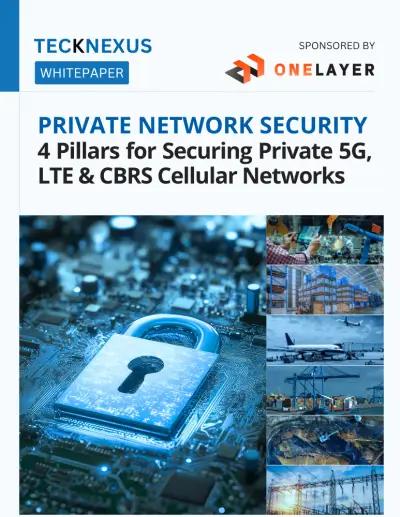
Private cellular networks are transforming industrial operations, but securing private 5G, LTE, and CBRS infrastructure requires more than legacy IT/OT tools. This whitepaper by TeckNexus and sponsored by OneLayer outlines a 4-pillar framework to protect critical systems, offering clear guidance for evaluating security vendors, deploying zero trust, and integrating IT,...
Scroll to Top