TeckNexus Awards
News & Insights ↗
Intelligence Tools
By Tool Type
▼
By Industry
▼
Access Type
▼
Tool Source
▼
Intelligence Platform
Paid
Intelligence Hub
▼
Monthly Insights
▼
Resources
▼
Channels
▼
Partner Channels
▼


FWA
Fixed wireless access (FWA) uses cellular networks — primarily 5G — to deliver home and business broadband as an alternative to cable and fiber. It has become one of 5G’s clearest commercial successes, letting operators monetize spectrum and capacity quickly, particularly where wired broadband is slow, costly, or unavailable. FWA’s economics depend on available mid-band capacity, device cost, and how aggressively operators price against fixed-line competitors. For operators, it offers fast revenue and subscriber growth; for enterprises and underserved regions, it offers viable connectivity without trenching fiber. This channel tracks FWA deployments, spectrum and capacity strategy, device developments, and the competitive dynamics between wireless and wired broadband, with analysis of where FWA delivers durable value and where capacity constraints limit its reach as adoption scales.
- Article & Insights
- January 25, 2024
- Hema Kadia

Explore how 5G and Fixed Wireless Access (FWA) are transforming high-speed internet connectivity, addressing capacity crunch challenges.
- Podcast
- January 15, 2024
- 5G Techritory

As Europe sets ambitious goals for its connectivity policy, this session assessed the progress made thus far and explore the proximity to achieving these objectives. Our experts delved into the societal benefits of enhanced rural connectivity, discussing how it fosters economic growth, empowers communities, and bridges the digital divide. We also examined the technical challenges that arise in delivering connectivity to remote areas, exploring innovative solutions, the potential business case for rural connectivity and also highlighted the pivotal role of technology and innovation in realizing the vision of inclusive connectivity across rural Europe.
- Article & Insights
- January 15, 2024
- Hema Kadia
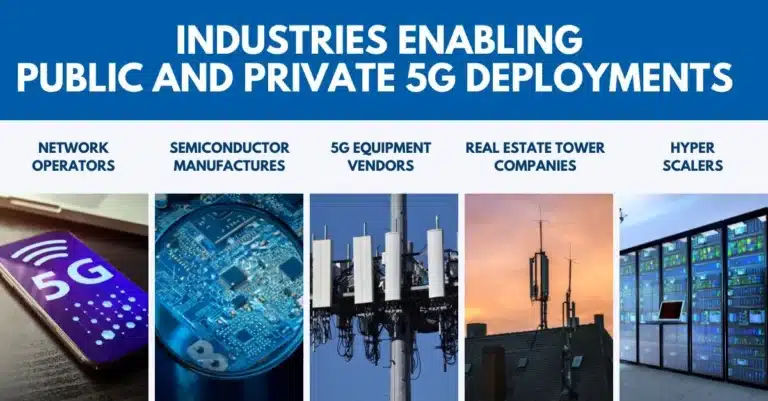
Investors seeking to maximize their profits from the potential of 5G should consider a multi-pronged approach and invest in companies that provide 5G network equipment, tower infrastructure, semiconductors, and hyperscalers as well as 5G mobile network operators. Here are the top companies across the sectors that are leading global public/private network rollouts.
- Podcast
- December 13, 2023
- 5G Guys

In this 5G Guys podcast episode, Wayne and Dan welcome TJ Maan from Samsung to discuss Fixed Wireless Access (FWA). TJ explains what FWA is and its benefits over traditional wireline broadband delivery technologies, noting its speed, reliability, and...
- News
- November 30, 2023
- News Feed

This article delves into the recent Ericsson Mobility Report, highlighting the robust growth of 5G technology with predictions of over 5.3 billion subscriptions by 2029 and a significant increase in average data usage per smartphone.
- News
- November 16, 2023
- Hema Kadia

Explore the Orange Satellite Internet, powered by Nordnet. This service ensures high-speed broadband access across all of France, bridging the digital divide with state-of-the-art satellite technology.
- Podcast
- November 14, 2023
- Carrie Charles

Leadership in the last mile requires a unique set of skills, and in this episode, Co-CEO Jamie Earp of Ubiquity shares insights with host Carrie Charles. Discover the driving force behind Ubiquity’s success and Jamie’s leadership style focused on empowerment, authenticity, and transparency. Gain valuable insights into the industry’s future, particularly in the realm of artificial intelligence and automation. Join us for a concise yet insightful conversation on empowering teams and staying ahead in the ever-evolving business landscape.
- Article & Insights
- November 9, 2023
- Hema Kadia

Discover the pivotal role of Fixed-Wireless Access (FWA) in the expansion of 5G technology. This article sheds light on FWA's contribution to enhancing broadband reach and capabilities, highlighting its rapid deployment and affordability.


Discover the transformative impact of 5G technology in comprehensive whitepaper on '5G Use Cases'. Get into the dynamics of 5G Fixed Wireless Access (FWA) and Private 5G Networks (P5G), exploring key drivers, market updates, and technological advancements. Learn how 5G is bridging the digital divide, revolutionizing industries, and shaping the future of connectivity.
- Podcast
- September 5, 2023
- Carrie Charles
Explore the many ways telecommunications can be used as an enabler for entrepreneurial growth and supporting community development. In this episode of 5G Talent Talk with Carrie Charles, we’re joined by Brian Mefford, VP of Broadband Strategy for VETRO FiberMap, to discuss their mission to simplify fiber management and drive community advancement radically. This engaging conversation explores VETRO FiberMap’s efforts of becoming the hub for all aspects of fiber construction, embracing a wide range of public-private partnerships. Additionally, Brian shares insights into the corporate culture at VETRO, their strategies for addressing the challenges that come with business growth, and how grant funding has changed with the latest technological shifts. Tune in to this insightful episode and join us in shaping the future of telecom through innovative approaches and community development.
- Podcast
- August 15, 2023
- Carrie Charles
How do we get the younger generation of workers interested in the telecommunications industry? As the skilled labor shortage continues to grow, the solution is certainly not ‘easy.’ Thankfully, the Fiber Broadband Association provides resources that make this industry-wide effort a whole lot simpler. Joining us today is Deborah Kish, VP of Research and Workforce Development for the Fiber Broadband Association. In this insightful interview, Carrie and Deborah dive into FBA’s top strategies, programs and playbooks to combat the telecom workforce shortage and prepare for the BEAD funding wave ahead.
Frequently Asked Questions
What is FWA, and how is it different from home fiber or cable?
FWA delivers home or business internet over a cellular signal to a receiver and router installed at the property, rather than requiring a physical fiber-optic or coaxial cable line to be run from the provider’s network to that specific address. It essentially repurposes the same mobile network infrastructure carriers use for smartphones to also serve as last-mile home broadband. This is fundamentally different from fiber, which uses dedicated physical cabling carrying a guaranteed amount of bandwidth directly to one property, and from cable, which shares bandwidth across a neighborhood through coaxial lines. FWA’s performance is instead shared across everyone connected to the same nearby cell site, similar to how mobile phone performance can vary based on how many other devices are using that cell at once.
Is FWA actually replacing cable and fiber broadband?
In specific markets, FWA is genuinely displacing cable and fiber, particularly where running new physical cables is expensive or impractical. Fixed wireless connections grew by roughly 27 percent year over year as of late 2025, a notably fast growth rate for an established broadband category, and the share of FWA specifically offered over 5G, rather than older 4G infrastructure, jumped from 57 percent to 71 percent of providers in under a year, reflecting both rising consumer demand and improving network capability. That said, FWA growth has been strongest in markets where wired broadband options were previously limited or expensive, rather than uniformly displacing fiber in areas with well-established, competitively priced wired infrastructure.
Why do carriers like offering FWA?
FWA lets carriers monetize existing 5G spectrum and infrastructure investment for home broadband revenue without the substantial additional capital expense of physically trenching new fiber or cable lines to every home. Since the underlying radio network already exists to serve mobile phones, adding FWA customers represents largely incremental revenue on top of infrastructure the carrier has already built. Some carriers have begun offering FWA through dedicated network slices with guaranteed performance, allowing them to position FWA not just as a budget alternative to wired broadband but as a premium, business-grade connectivity tier with contractually guaranteed speed and reliability, opening additional revenue tiers beyond a single flat-rate consumer offering.
Is FWA fast enough to replace fiber for heavy users like gamers or remote workers?
Whether FWA is fast enough for heavy use depends heavily on local network conditions rather than being a fixed yes-or-no answer. On dense, well-provisioned mid-band 5G coverage, FWA performance can genuinely rival fiber for most household needs, including multiple simultaneous heavy users. However, because FWA performance is shared across everyone connected to the same nearby cell site, it tends to be more susceptible to congestion during peak hours, like early evening, than a dedicated fiber line. It’s also more sensitive to distance from the cell site, obstructions like trees or buildings, and weather, none of which meaningfully affect a buried fiber connection.
Where is FWA growing the fastest?
FWA growth has been fastest in markets with limited existing fixed broadband infrastructure, particularly rural and other underserved regions where extending fiber or cable to every home would require substantial new construction. In these areas, FWA offers a meaningfully faster and cheaper path to delivering broadband, leveraging cell towers that may already exist rather than trenching cable across long distances between sparsely located homes. Suburban areas with growing housing development but limited wired competition have also seen strong FWA adoption as a lower-priced alternative to existing cable monopolies. Dense urban areas have generally seen comparatively slower FWA growth, since wired competition tends to be stronger and cell capacity is shared among more customers.
How does FWA installation actually work for a new customer?
Installation for a typical residential FWA customer is generally simpler and faster than wired broadband installation, since it doesn’t require a technician to run new physical cabling. A customer usually receives a self-install kit containing a receiver and router, places it near a window or in a location with good signal reception based on a coverage-checking tool, and the device connects to the nearest compatible cell site automatically. Some providers offer optional professional installation, particularly for outdoor-mounted receivers intended to capture a stronger signal than an indoor unit could, which can meaningfully improve performance in marginal-coverage areas. Compared to a multi-week wait for a fiber technician to run new lines, FWA’s typically same-day or next-day self-install process is a practical advantage.
What are the main downsides of FWA compared to wired broadband?
FWA’s main limitations stem directly from its reliance on a shared, wireless signal rather than a dedicated physical line. Performance can fluctuate based on network congestion during peak hours, weather conditions, and physical obstructions between the receiver and the nearest cell site, none of which affect a buried fiber connection. Upload speeds are often noticeably lower than download speeds, which can matter for significant video conferencing or large file uploads. Data caps or deprioritization after a certain usage threshold are also more common on FWA plans than on many wired broadband plans, since FWA shares finite radio spectrum capacity across many customers in the same area, whereas a dedicated fiber line has no equivalent shared-capacity constraint.
How does network slicing change what FWA can offer business customers?
Network slicing allows carriers to offer FWA business customers a dedicated, performance-guaranteed connection rather than the standard, best-effort residential FWA experience, where performance can vary with overall network congestion. A business relying on FWA for critical operations, like point-of-sale systems or VoIP phone service, can be offered a network slice with contractually guaranteed minimum bandwidth and reliability, similar in concept to a dedicated business-grade wired connection, but delivered wirelessly. Verizon Business, for example, has launched a dedicated FWA network slice product specifically aimed at giving business customers more predictable, guaranteed performance. This lets carriers position FWA across a spectrum of tiers, from a budget consumer alternative up to a premium, guaranteed-performance business service.