Private Network
Intelligence
Intelligence Journeys
Utilities Private Broadband Planning
AI Use Case Planning for Utilities

Assurance

Service and network assurance covers the tools and practices operators use to monitor, measure, and guarantee network performance and service quality. As networks grow more complex — spanning 5G standalone cores, virtualized functions, multiple clouds, and slices — traditional monitoring is giving way to AI-driven, closed-loop assurance that detects, diagnoses, and increasingly resolves issues automatically. Assurance is central to delivering service-level agreements, supporting network slicing, and enabling autonomous operations, making it a foundation for both reliability and new revenue. For operators, the shift is from reactive fault management toward predictive, intent-based assurance integrated with orchestration and automation. This channel tracks assurance platforms, observability, AI-driven operations, and the standards shaping how quality is measured and guaranteed across modern networks, with coverage aimed at teams modernizing operations rather than maintaining legacy monitoring.

The U.S. Federal Trade Commission has initiated a broad 6(b) study into consumer-facing AI companion chatbots, focusing on risks to children and teens and the governance controls companies have in place. The agency issued orders to seven firms operating at the center of generative AI and social platforms: Alphabet, Character Technologies (Character.AI), Instagram, Meta Platforms, OpenAI, Snap, and xAI. Under its Section 6(b) authority, the FTC is seeking detailed information on how these providers design, test, deploy, and monetize AI companions, and how they limit harms to children and adolescents. The Commission’s vote to proceed was unanimous, signaling cross-party attention on youth safety in AI.
Telefónica is translating years of network automation into tangible Level 4 autonomous operations in targeted domains—an inflection point for service quality, cost, and speed at 5G scale. Under its Autonomous Network Journey (ANJ), Telefónica is aligning to the TM Forum Autonomous Networks framework and pushing selected processes to Level 4—closed-loop autonomy with minimal human oversight. The company reports a 70% reduction in flapping-related service impact and removal of manual work in these incidents, advancing this use case to Level 4 maturity. The operator cites 80% faster analyses for planning, operations, and optimization; a 40% drop in capacity issues; more than 90% reduction in sites experiencing high load with widespread customer impact; and a 5% latency improvement via virtual optimization prior to rollout.
Deutsche Telekom is formalizing a sovereignty-first cloud strategy with the launch of T Cloud and new leadership roles that aim to reduce European dependence on non-EU technology stacks. At Digital X in Cologne, Deutsche Telekom’s enterprise arm T-Systems introduced T Cloud, an independent, multi-cloud offering positioned around “levels of sovereignty.” For telcos, public-sector buyers, and regulated enterprises, the message is clear—data location, jurisdiction, and operational control are now first-class design choices, not afterthoughts. T Cloud is pitched as a seamless partner ecosystem spanning public and private cloud, with services tailored to workload criticality and data classifications.
AI is shifting network design from throughput-first to data- and compute-aware architectures, where radios, baseband, and transport must expose telemetry for model training and inference at the edge. Consolidating 3GPP standardization, silicon design, radio development, lab verification, and New Product Introduction (NPI) in one campus shortens feedback loops between research, productization, and manufacturing. That is essential as the industry transitions through 5G-Advanced (3GPP Releases 18–19) to early 6G concepts such as joint communication and sensing, RAN compute offload, and AI-native control loops.
Boldyn Networks and Virgin Media O2 have launched the UK’s first full RAN managed 5G service at Sunderland’s Stadium of Light. Powered by JMA XRAN® and a neutral host architecture, the deployment transforms fan experience, reduces energy use by 60%, and boosts operational safety and efficiency—setting a new benchmark for smart stadiums across the UK.
Palo Alto Networks PAN-OS 12.1 Orion steps into this gap with a quantum-ready roadmap, a unified multicloud security fabric, expanded AI-driven protections and a new generation of next-generation firewalls (NGFWs) designed for data centers, branches and industrial edge. The release also pushes management into a single operational plane via Strata Cloud Manager, targeting lower operating cost and faster incident response. PAN-OS 12.1 automatically discovers workloads, applications, AI assets and data flows across public cloud and hybrid environments to eliminate blind spots. It continuously assesses posture, flags misconfigurations and exposures in real time and deploys protections in one click across AWS, Azure and Google Cloud.
A new Ciena and Heavy Reading study signals that AI will become a primary source of metro and long-haul traffic within three years while most optical networks remain only partially prepared. AI training and inference are shifting from contained data center domains to distributed, edge-to-core workflows that stress transport capacity, latency, and automation end-to-end. Expectations are even higher for long-haul: 52% see AI surpassing 30% of traffic and 29% expect AI to account for more than half. Yet only 16% of respondents rate their optical networks as very ready for AI workloads, underscoring an execution gap that will shape capex priorities, service roadmaps, and partnership models through 2027.
South Korea's government and its three national carriers are aligning fresh capital to speed AI and semiconductor competitiveness and to anchor a private-led innovation flywheel. SK Telecom, KT, and LG Uplus will seed a new pool exceeding 300 billion won (about $219 million) via the Korea IT Fund (KIF) to back core and foundational AI, AI transformation (AX), and commercialization in ICT. KIF, formed in 2002 by the carriers, will receive 150 billion won in new commitments, matched by at least an equal amount from external fund managers. The platforms lifespan has been extended to 2040 to sustain long-cycle bets.
Financial institutions are adopting artificial intelligence (AI) to navigate complex regulations, transforming compliance into a competitive advantage. AI's ability to process vast amounts of data quickly is proving transformative in meeting these challenges, automating tasks and improving efficiency. This shift allows compliance professionals to focus on strategic initiatives while ensuring regulatory compliance.
Telecom networks are facing unprecedented complexity with 5G, IoT, and cloud services. Traditional service assurance methods are becoming obsolete, making AI-driven, real-time analytics essential for competitive advantage. This independent industry whitepaper explores how DPUs, GPUs, and Generative AI (GenAI) are enabling predictive automation, reducing operational costs, and improving service quality. Discover key insights, real-world case studies, and strategic actions for telecom leaders. Download the Full Report Now to stay ahead in AI-powered service assurance.
Private networks are vital for mission-critical applications but face challenges like fragmented ecosystems, skill shortages, and financial pressures. Anritsu’s vendor-agnostic service assurance platform provides end-to-end visibility, proactive insights, and flexible operational models to address these issues. Learn how Anritsu enables enterprises to manage private networks effectively while ensuring scalability and reliability.
Private 5G/LTE and CBRS networks are revolutionizing industries by enabling smarter cities, safer workplaces, and more efficient factories. This edition celebrates award-winning deployments and insights from industry leaders who are driving digital transformation. Explore real-world examples of how these networks optimize manufacturing operations, enhance supply chain visibility, and promote sustainable practices, making grids resilient and industries future-ready.

Frequently Asked Questions

What does ‘network assurance’ actually cover day to day?
Day to day, network assurance covers continuous monitoring of network performance across multiple layers, from radio signal quality and data throughput at the cell site level, to the health of core network functions running in virtualized infrastructure, to end-to-end service quality as experienced by actual customers. It includes testing new network configurations or software updates before they’re deployed broadly, to confirm they don’t degrade performance unexpectedly. It also covers ongoing validation that service-level agreements, the specific performance promises made to certain customers or business clients, are actually being met in practice. In modern networks, assurance teams increasingly rely on automated tools that continuously collect and analyze performance data, rather than depending purely on customer complaints to surface problems.
How has assurance changed with the move to virtualized, cloud-based 5G networks?
Older, hardware-based networks were comparatively straightforward to monitor because each network function typically ran on its own dedicated, purpose-built equipment with well-defined performance characteristics. Modern 5G networks, by contrast, run largely as software across shared, virtualized cloud infrastructure, often spanning equipment and software from multiple different vendors. A single performance problem, like degraded call quality in a specific area, could originate from an issue in the radio equipment, a virtualized core network function, the underlying cloud infrastructure, or the interaction between several of these components. Assurance tools have had to evolve accordingly, gaining the ability to trace problems across these virtualized, distributed, multi-vendor layers in real time.
What role does AI play in modern network assurance?
AI is shifting network assurance from a largely reactive discipline, responding to problems once they’re detected or reported, toward a more proactive one, predicting and addressing problems before they meaningfully affect customers. By continuously analyzing enormous volumes of network performance data, AI systems can identify subtle patterns or early warning signs of degrading performance that would be extremely difficult for human analysts to spot manually across a network generating millions of data points constantly. This predictive capability is particularly valuable for energy optimization, since AI-driven assurance systems are increasingly used to dynamically adjust radio power consumption based on real-time traffic, cutting energy costs without degrading the customer experience.
Why does network slicing make assurance more complicated?
Network slicing means a single physical network now hosts multiple independent virtual networks, each with its own distinct performance guarantee, such as a specific latency target for one slice supporting cloud gaming, and a different reliability target for another slice supporting a hospital’s connected medical equipment. Assurance teams therefore can’t simply monitor the network as one undifferentiated whole; they need visibility into each individual slice’s performance separately, to confirm the operator is actually delivering on the specific promise made for that slice. This adds meaningful complexity, multiplying the number of distinct performance commitments an assurance system needs to track and correctly attribute problems to.
What’s the difference between assurance and basic network monitoring?
Basic network monitoring generally refers to passively observing network status and performance metrics, essentially watching dashboards and alerts to know what’s currently happening across the network. Assurance is a broader discipline that includes monitoring as one component, but also encompasses testing, validation, and proactive quality management aimed specifically at guaranteeing the network meets defined performance commitments, not just observing whatever performance happens to occur. In practice, assurance often involves comparing real-world performance data against specific targets, triggering automated or manual remediation when performance falls short, and continuously refining the network based on what that comparison reveals.
How do operators measure whether they’re meeting service-level agreements (SLAs)?
Operators typically define specific, measurable metrics tied to each SLA, such as maximum acceptable latency, minimum guaranteed bandwidth, or a target percentage of uptime, and then use assurance tools to continuously collect real performance data against those exact metrics, often for a specific customer, service, or network slice rather than the network in aggregate. Modern assurance platforms generally provide ongoing, automated reporting against these targets rather than relying on periodic manual audits, allowing operators to catch SLA violations quickly and, in more advanced setups, automatically trigger corrective action before a violation becomes severe enough to require contractual penalties or customer compensation.
What happens when an assurance system detects a problem?
When an assurance system detects a problem, the response generally follows a few possible paths depending on severity and how advanced the operator’s systems are. In simpler or higher-severity cases, the system alerts a human network operations team, providing diagnostic context to speed up manual troubleshooting. In more advanced, automated setups, the system may trigger an automatic remediation action directly, such as rerouting traffic or restarting a malfunctioning virtualized function, without requiring human intervention at all, particularly for well-understood, low-risk issues. Increasingly, AI-driven assurance systems aim to act before the problem becomes customer-visible at all.
Why is assurance increasingly tied to customer experience, not just technical uptime?
Assurance has expanded beyond pure technical uptime metrics because customer satisfaction and business outcomes don’t always track perfectly with simple availability statistics; a network can be technically up while still delivering a poor experience due to slow speeds or subtle quality issues that don’t register as a full outage. Modern assurance increasingly incorporates customer experience metrics directly, sometimes inferred from actual usage patterns and application performance, to get a more accurate picture of what customers are actually experiencing. This matters commercially too, since for enterprise customers paying for guaranteed performance through network slicing, technical uptime alone isn’t a sufficient measure of delivered value.

Congratulations to the 2026 Private Network Leadership Award Winners
Explore Winners →

Partner Hubs

Latest Reports

It seems we can't find what you're looking for.

Telco AI Agent Leadership

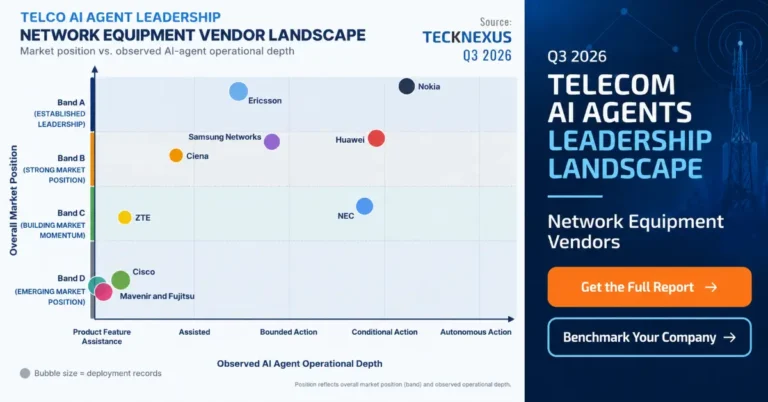
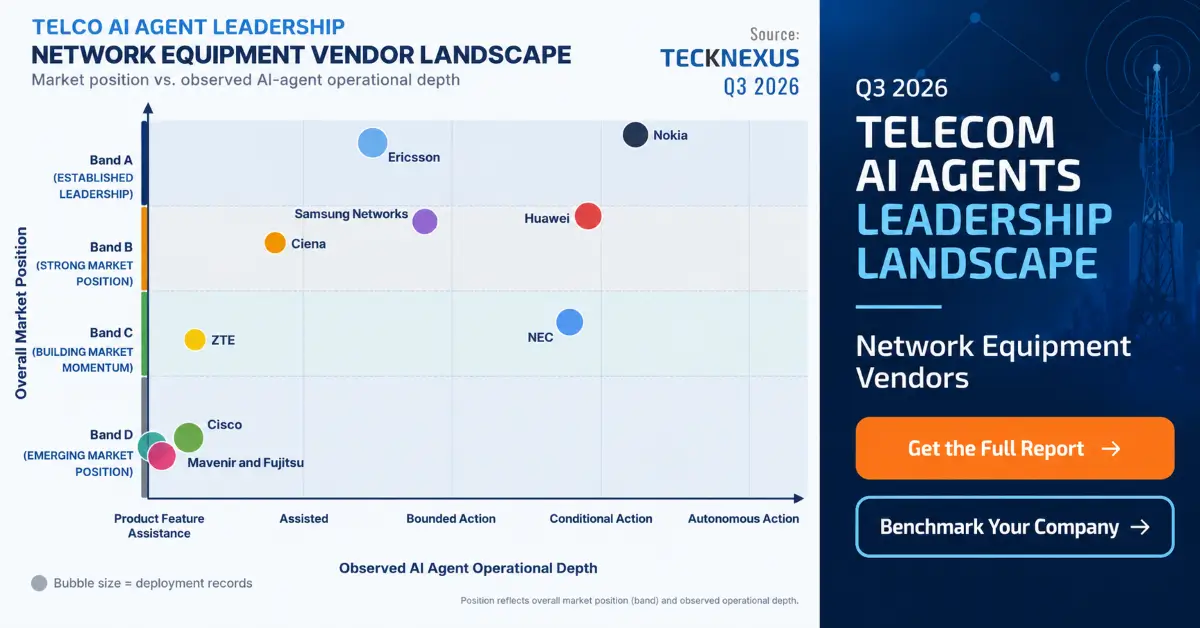
Telco AI Agent Leadership Landscape - Network Equipment Vendors
Network Equipment Vendor Report
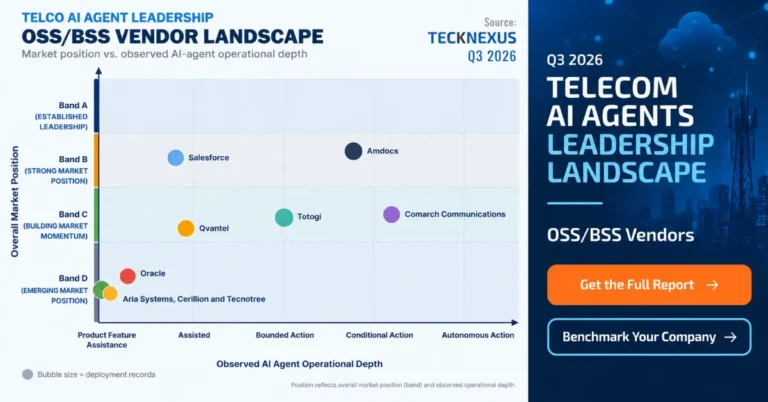
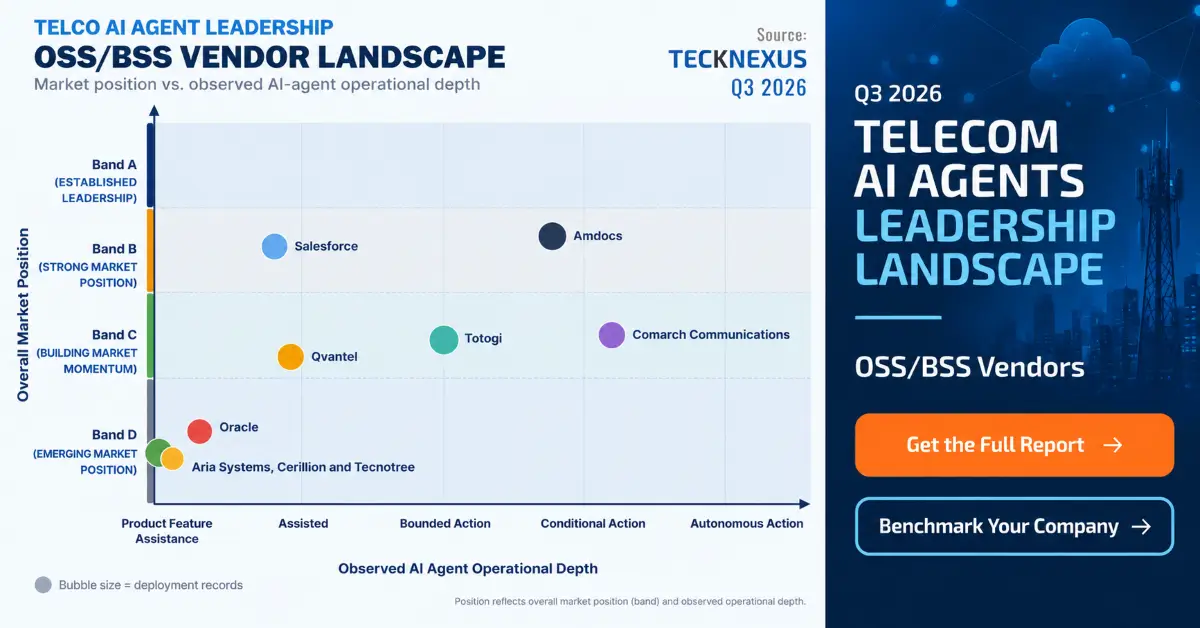
Telco AI Agent Leadership Landscape - OSS/BSS Vendors
OSS/BSS Vendor Report
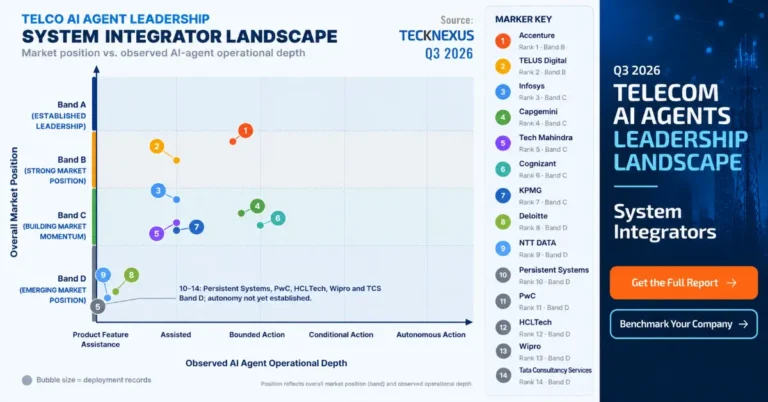
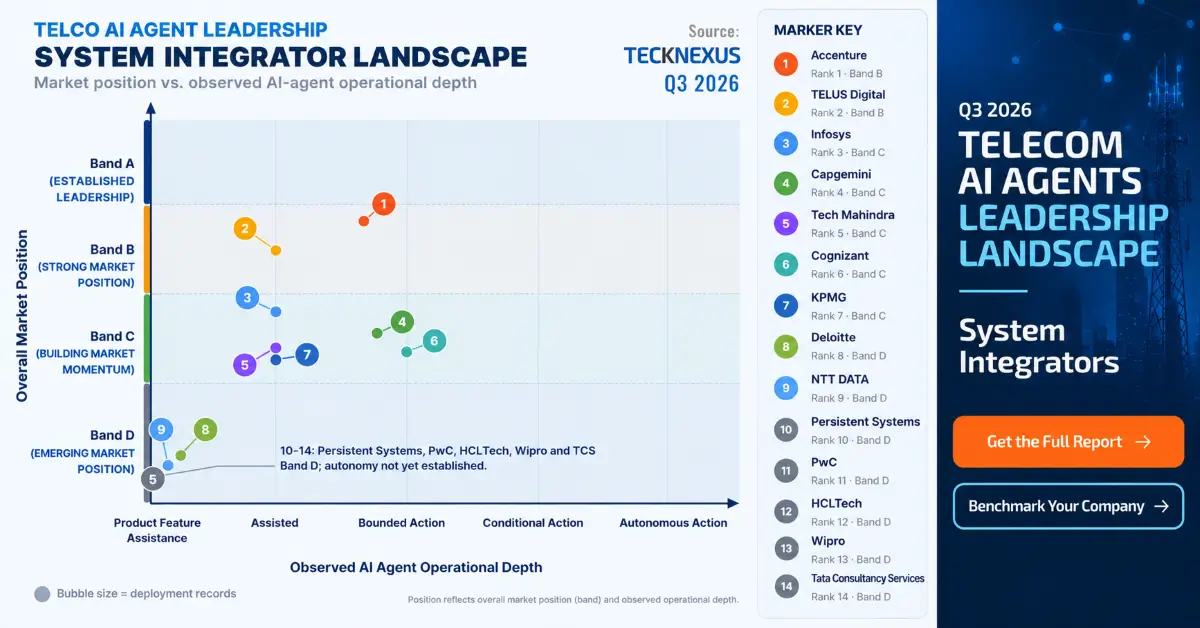
Telco AI Agent Leadership Landscape - System Integrators
System Integrator Report
Scroll to Top
TELECOM AI AGENTS Q3 2026 · Available Now

Explore the Telecom AI Agents Leadership Landscapes

Explore market positioning, deployment momentum and operator validation across the telecom AI agent ecosystem.

Explore Leadership Landscapes
Independent · Evidence-based · Telecom-focused