Private Network
Intelligence
Intelligence Journeys
Utilities Private Broadband Planning
AI Use Case Planning for Utilities

Assurance

Service and network assurance covers the tools and practices operators use to monitor, measure, and guarantee network performance and service quality. As networks grow more complex — spanning 5G standalone cores, virtualized functions, multiple clouds, and slices — traditional monitoring is giving way to AI-driven, closed-loop assurance that detects, diagnoses, and increasingly resolves issues automatically. Assurance is central to delivering service-level agreements, supporting network slicing, and enabling autonomous operations, making it a foundation for both reliability and new revenue. For operators, the shift is from reactive fault management toward predictive, intent-based assurance integrated with orchestration and automation. This channel tracks assurance platforms, observability, AI-driven operations, and the standards shaping how quality is measured and guaranteed across modern networks, with coverage aimed at teams modernizing operations rather than maintaining legacy monitoring.

OpenAI is reportedly preparing a standalone app for its next-gen video model, positioning AI-only short video as a consumer format in its own right. The app reportedly delivers a vertical feed with swipe navigation, reactions, and remixing familiar mechanics that lower friction for discovery and creation. Every clip is generated by Sora 2 rather than uploaded, with current limits around 10 seconds per video. A recommendation engine powers a personalized “For You” experience, aligning with how short-form attention is won and retained today. A notable feature is identity verification tied to likeness usage. Expect provenance signals and watermarking frameworks (for example, C2PA-style manifests) to become table stakes for platforms that remix human likeness at scale.
The Bethpage Black Ryder Cup turned a 1,500‑acre golf course into a pop-up smart city, giving HPE a high-stakes stage to showcase end-to-end AI, networking, and edge operations at scale. Golf is a network planner’s stress test: fans are constantly moving, crowd density swings hole-to-hole, and the venue is built from scratch for a few intense days. More than 250,000 spectators demanded seamless connectivity, broadcast-grade reliability, and instant digital services. This environment forced an enterprise-grade blueprint - fast deployment, elastic capacity, airtight security, and automated operations, mirroring the requirements of modern campuses, arenas, and industrial sites.
India’s nationwide launch of BSNL’s “Swadeshi” 4G stack moves the country from a services-first model to domestic production of core telecom equipment at national scale. India formally launched an indigenous 4G stack for state-run BSNL, alongside more than 97,500 towers announced from Jharsuguda, Odisha. Officials highlighted early reach metrics, noting that roughly 92,000 sites are active and connecting an estimated 22 million users. Telecom equipment sovereignty has become a board-level issue as operators de-risk supply chains, comply with trusted source mandates, and balance costs amid rising traffic and spectrum refarming needs.
AI is everywhere in telecom, yet most pilots never make it into production because the industry’s data, tooling, and operating models are not ready for scaled automation. Recent industry research suggests that about 95% of AI pilots in telecom fail to scale beyond proofs of concept. Leaders are moving from pilots to platforms by embedding AI in the systems that run the business and anchoring every initiative to measurable outcomes. Telecom AI will not scale through pilots alone; it scales when embedded in the systems that run revenue, experience, and networks.
Two narratives are converging: Silicon Valley’s rush to add gigawatts of AI capacity and a quiet revival of bunkers, mines, and mountains as ultra-resilient data hubs. Recent headlines point to unprecedented AI infrastructure spending tied to OpenAI. The draw is physical security, thermal stability, data sovereignty, and a narrative of longevity in an era where outages and cyber‑physical risks are rising. Geopolitics, regulation, and escalating outage impact are reshaping site selection and architectural choices. The AI build‑out collides with grid interconnection queues, water scarcity, and rising scrutiny of carbon and noise. Set hard thresholds on PUE and WUE; require real‑time telemetry and third‑party assurance.
Hitachi has launched a global AI Factory built on NVIDIA’s reference architecture to speed the development and deployment of “physical AI” spanning mobility, energy, industrial, and technology domains. Hitachi is standardizing a centralized yet globally distributed AI infrastructure on NVIDIA’s full-stack platform, pairing Hitachi iQ systems with NVIDIA HGX B200 platforms powered by Blackwell GPUs, Hitachi iQ M Series with NVIDIA RTX 6000 Server Edition GPUs, and the NVIDIA Spectrum-X Ethernet AI networking platform. The environment is designed to run production AI with NVIDIA AI Enterprise and support simulation and physically accurate digital twins using NVIDIA Omniverse libraries.
In 2024, the U.S. cable sector generated $568.7 billion in total economic output and supported 1.3 million jobs across the country. This footprint spans broadband networks, video programming, construction, manufacturing, and a broad vendor ecosystem. It underscores why cable remains a central pillar of America’s connectivity and media economy even as consumption shifts to IP and streaming. Cable broadband providers—led by Comcast, Charter Communications (Spectrum), Cox, Altice USA (Optimum), Mediacom, Cable One (Sparklight), and WOW!—accounted for $366 billion in total economic impact and nearly 888,000 jobs.
Databricks is adding OpenAI’s newest foundation models to its catalog for use via SQL or API, alongside previously introduced open-weight options gpt-oss 20B and 120B. Customers can now select, benchmark, and fine-tune OpenAI models directly where governed enterprise data already lives. The move raises the stakes in the race to make generative AI a first-class, governed workload inside data platforms rather than an external service tethered by integration and compliance gaps. For telecom and enterprise IT, it reduces friction for AI agents that must safely traverse customer, network, and operational data domains.
Canberra is signaling an industry shake-up after hundreds of emergency calls failed to reach Triple Zero, with four incidents linked to fatalities. Optus, Australia’s second-largest operator and a subsidiary of Singtel, reported a technical failure that prevented 624 calls from connecting to emergency services (000), affecting customers across Western Australia, South Australia, New South Wales, and the Northern Territory. The Australian Communications and Media Authority (ACMA) has opened an investigation into compliance with the Emergency Call Service rules, which require carriers to ensure 000/112 calls connect regardless of network status.
SoftBank has validated a multi‑cell, end‑to‑end 5G link via a high‑altitude platform payload, marking a concrete step toward stratospheric coverage that works with standard smartphones. In a June field trial over Hachijō Island, Japan, SoftBank mounted a newly developed payload on a light aircraft at 3,000 meters to emulate a High Altitude Platform Station (HAPS) operating around 20 kilometers. The system stitched a millimeter‑wave feeder link at 26 GHz from a ground gateway to the aircraft with a sub‑2 GHz service link at 1.7 GHz from the aircraft to handsets, completing an end‑to‑end path through the 5G core.
Nokia and Deutsche Bahn have activated a commercial-grade 5G Standalone network on the 1900 MHz band to validate Future Railway Mobile Communication System (FRMCS) operations on live tracks. The partners have launched a 5G SA deployment using the 1900 MHz (n101) spectrum band on DB’s digital railway test field in the Ore Mountains (Erzgebirge), Germany. The network is built with Nokia AirScale radio equipment and an optimized, cloud-native 5G core, and it operates on moving trains on outdoor tracks. The setup includes built-in failover, self-healing, and real-time monitoring to sustain service continuity in mission-critical environments.
Ericsson is embedding an agentic AI framework into its NetCloud platform to accelerate self-healing, intent-driven operations across private 5G, Wireless WAN, and SASE. Ericsson is evolving its AI assistant, ANA, from a prompt-based helper into a multi-agent system that can interpret high-level intents, plan workflows, and coordinate specialized agents to act across the enterprise networking stack. Ericsson’s rollout will be staged. A troubleshooting orchestrator is planned for Q4 2025 to handle high-frequency pain points such as offline devices and degraded radio conditions, with a projected reduction in downtime and support cases by more than 20 percent.

Frequently Asked Questions

What does ‘network assurance’ actually cover day to day?
Day to day, network assurance covers continuous monitoring of network performance across multiple layers, from radio signal quality and data throughput at the cell site level, to the health of core network functions running in virtualized infrastructure, to end-to-end service quality as experienced by actual customers. It includes testing new network configurations or software updates before they’re deployed broadly, to confirm they don’t degrade performance unexpectedly. It also covers ongoing validation that service-level agreements, the specific performance promises made to certain customers or business clients, are actually being met in practice. In modern networks, assurance teams increasingly rely on automated tools that continuously collect and analyze performance data, rather than depending purely on customer complaints to surface problems.
How has assurance changed with the move to virtualized, cloud-based 5G networks?
Older, hardware-based networks were comparatively straightforward to monitor because each network function typically ran on its own dedicated, purpose-built equipment with well-defined performance characteristics. Modern 5G networks, by contrast, run largely as software across shared, virtualized cloud infrastructure, often spanning equipment and software from multiple different vendors. A single performance problem, like degraded call quality in a specific area, could originate from an issue in the radio equipment, a virtualized core network function, the underlying cloud infrastructure, or the interaction between several of these components. Assurance tools have had to evolve accordingly, gaining the ability to trace problems across these virtualized, distributed, multi-vendor layers in real time.
What role does AI play in modern network assurance?
AI is shifting network assurance from a largely reactive discipline, responding to problems once they’re detected or reported, toward a more proactive one, predicting and addressing problems before they meaningfully affect customers. By continuously analyzing enormous volumes of network performance data, AI systems can identify subtle patterns or early warning signs of degrading performance that would be extremely difficult for human analysts to spot manually across a network generating millions of data points constantly. This predictive capability is particularly valuable for energy optimization, since AI-driven assurance systems are increasingly used to dynamically adjust radio power consumption based on real-time traffic, cutting energy costs without degrading the customer experience.
Why does network slicing make assurance more complicated?
Network slicing means a single physical network now hosts multiple independent virtual networks, each with its own distinct performance guarantee, such as a specific latency target for one slice supporting cloud gaming, and a different reliability target for another slice supporting a hospital’s connected medical equipment. Assurance teams therefore can’t simply monitor the network as one undifferentiated whole; they need visibility into each individual slice’s performance separately, to confirm the operator is actually delivering on the specific promise made for that slice. This adds meaningful complexity, multiplying the number of distinct performance commitments an assurance system needs to track and correctly attribute problems to.
What’s the difference between assurance and basic network monitoring?
Basic network monitoring generally refers to passively observing network status and performance metrics, essentially watching dashboards and alerts to know what’s currently happening across the network. Assurance is a broader discipline that includes monitoring as one component, but also encompasses testing, validation, and proactive quality management aimed specifically at guaranteeing the network meets defined performance commitments, not just observing whatever performance happens to occur. In practice, assurance often involves comparing real-world performance data against specific targets, triggering automated or manual remediation when performance falls short, and continuously refining the network based on what that comparison reveals.
How do operators measure whether they’re meeting service-level agreements (SLAs)?
Operators typically define specific, measurable metrics tied to each SLA, such as maximum acceptable latency, minimum guaranteed bandwidth, or a target percentage of uptime, and then use assurance tools to continuously collect real performance data against those exact metrics, often for a specific customer, service, or network slice rather than the network in aggregate. Modern assurance platforms generally provide ongoing, automated reporting against these targets rather than relying on periodic manual audits, allowing operators to catch SLA violations quickly and, in more advanced setups, automatically trigger corrective action before a violation becomes severe enough to require contractual penalties or customer compensation.
What happens when an assurance system detects a problem?
When an assurance system detects a problem, the response generally follows a few possible paths depending on severity and how advanced the operator’s systems are. In simpler or higher-severity cases, the system alerts a human network operations team, providing diagnostic context to speed up manual troubleshooting. In more advanced, automated setups, the system may trigger an automatic remediation action directly, such as rerouting traffic or restarting a malfunctioning virtualized function, without requiring human intervention at all, particularly for well-understood, low-risk issues. Increasingly, AI-driven assurance systems aim to act before the problem becomes customer-visible at all.
Why is assurance increasingly tied to customer experience, not just technical uptime?
Assurance has expanded beyond pure technical uptime metrics because customer satisfaction and business outcomes don’t always track perfectly with simple availability statistics; a network can be technically up while still delivering a poor experience due to slow speeds or subtle quality issues that don’t register as a full outage. Modern assurance increasingly incorporates customer experience metrics directly, sometimes inferred from actual usage patterns and application performance, to get a more accurate picture of what customers are actually experiencing. This matters commercially too, since for enterprise customers paying for guaranteed performance through network slicing, technical uptime alone isn’t a sufficient measure of delivered value.


Partner Hubs

Latest Reports

It seems we can't find what you're looking for.

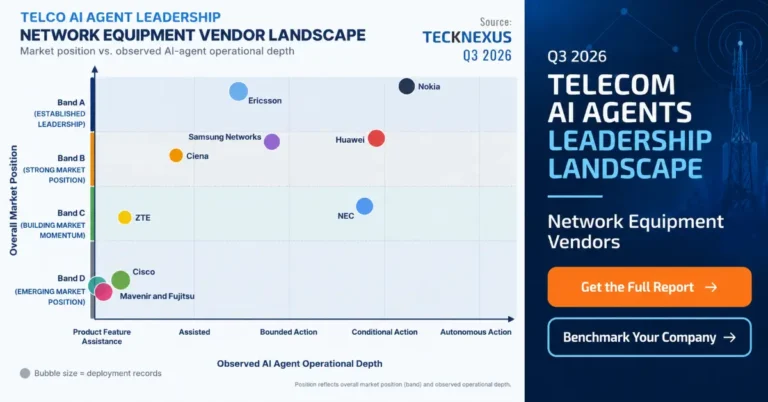
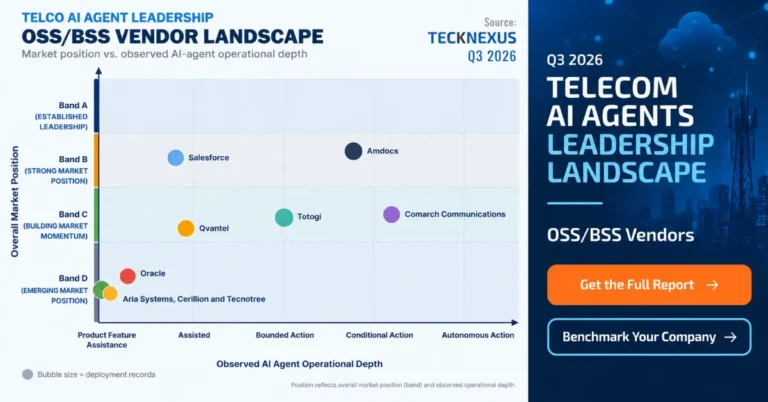
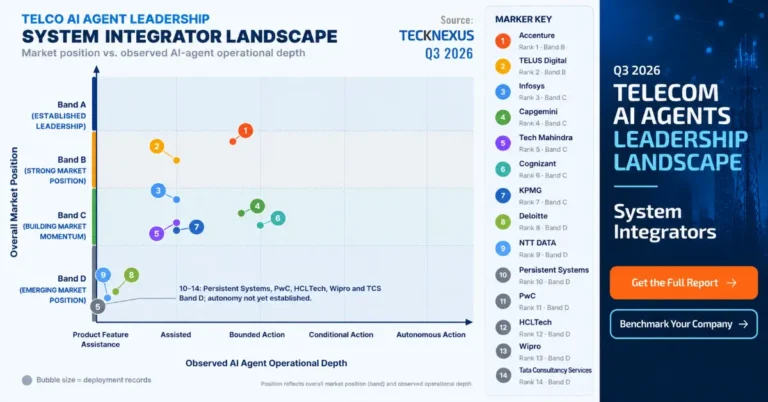
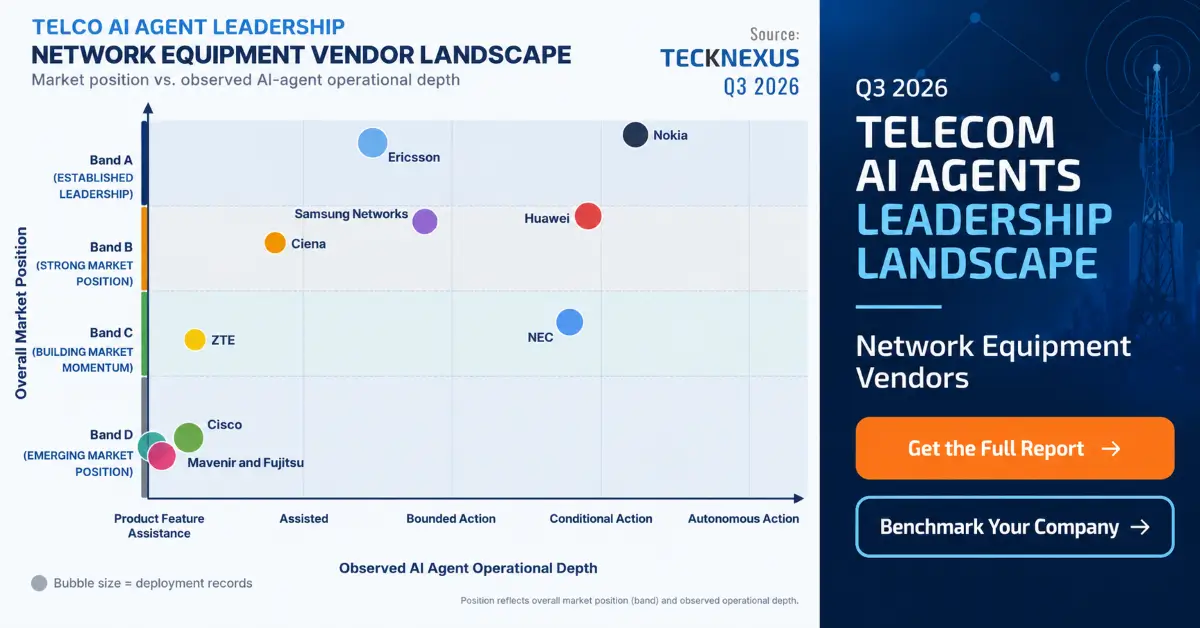
Telco AI Agent Leadership

Telco AI Agent Leadership Landscape - Network Equipment Vendors
Network Equipment Vendor Report
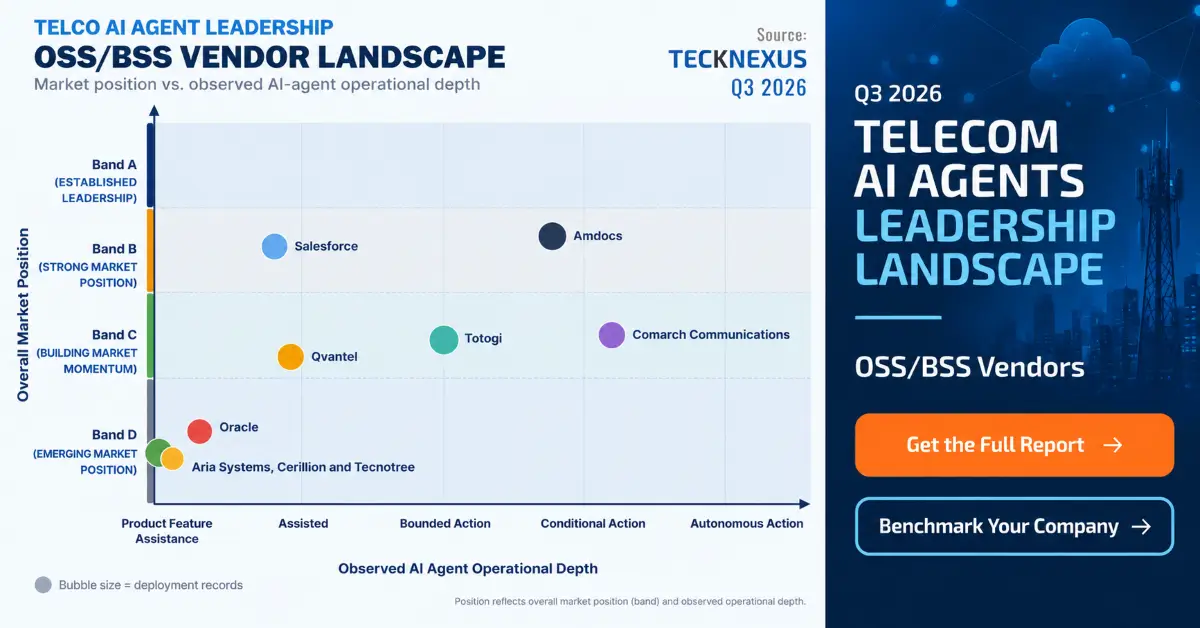
Telco AI Agent Leadership Landscape - OSS/BSS Vendors
OSS/BSS Vendor Report
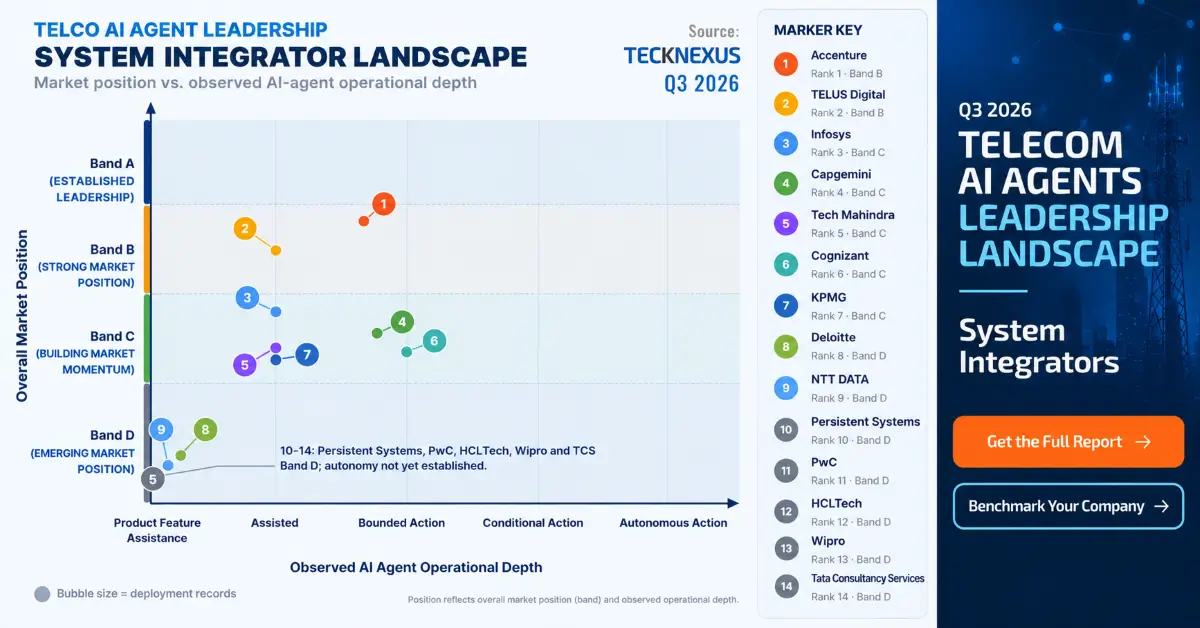
Telco AI Agent Leadership Landscape - System Integrators
System Integrator Report
Scroll to Top
TELECOM AI AGENTS Q3 2026 · Available Now

Explore the Telecom AI Agents Leadership Landscapes

Explore market positioning, deployment momentum and operator validation across the telecom AI agent ecosystem.

Explore Leadership Landscapes
Independent · Evidence-based · Telecom-focused