

API

Network APIs expose telecom capabilities — such as quality of service, location, device status, and authentication — to developers and enterprises through standardized programmable interfaces. Industry initiatives including GSMA Open Gateway and the CAMARA project aim to make these capabilities consistent across operators, turning the network into a platform that applications can call directly. For operators, APIs represent a route to revenue beyond connectivity; for enterprises and developers, they offer programmable access to network features once locked inside carrier systems. Standards bodies including TM Forum and 3GPP continue to shape how these interfaces are defined and monetized. This channel tracks network API standards, operator and hyperscaler partnerships, monetization models, and real deployments, with analysis of where programmable networks are gaining commercial traction and where adoption still lags behind the ambition.

Uncover how satellites are redefining the role of traditional cell towers, enhancing mobile communication, and bridging the gap in global connectivity.
Explore how 5G and Fixed Wireless Access (FWA) are transforming high-speed internet connectivity, addressing capacity crunch challenges.
Rajant Corporation's launches Cowbell, edge AI platform and Q-Stat wearable device at MODEX 2024. Experience the future of distributed computing and personal health insights with Rajant's Kinetic Mesh® technology, offering a unique ecosystem for enterprise and personal data management and analysis.
Delve into Apple's strategy for the upcoming iPhone 16 series, featuring Qualcomm's Snapdragon X75 modem exclusively in the Pro models. Discover the significance of this decision and what it means for the future of 5G technology.
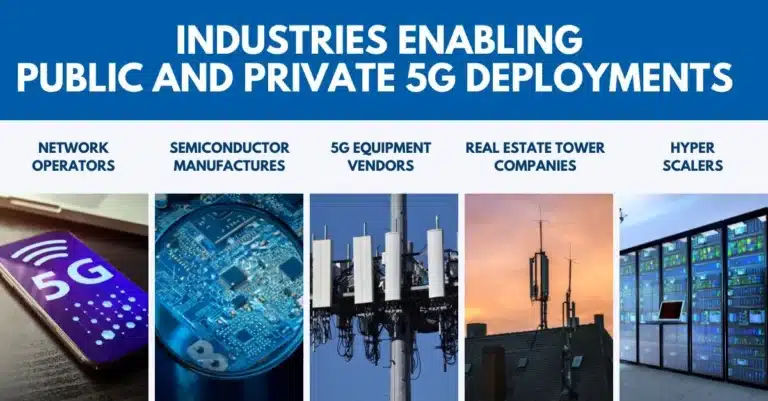
Investors seeking to maximize their profits from the potential of 5G should consider a multi-pronged approach and invest in companies that provide 5G network equipment, tower infrastructure, semiconductors, and hyperscalers as well as 5G mobile network operators. Here are the top companies across the sectors that are leading global public/private network rollouts.
Discover Iridium Communications' Project Stardust, an initiative offering standards-based IoT and Direct-to-Device service via its operational LEO satellite network. Learn about its impact on 5G and IoT sectors.
Delve into the practical application of private 5G technology in the metallurgical industry through the collaboration of Ericsson, Mugler, and SMS Group, focusing on efficiency and innovation at the Hilchenbach site.
Innovative solutions are shaping the future of connectivity, and today's featured company tackles things like enhancing RF awareness and tackling challenges in private wireless optimization and dynamic spectrum sharing. In this episode of 5G Talent Talk, host Carrie Charles sits down with the visionary Fernando Murias, Chairman and CEO of Digital Global Systems. Fernando takes us on a captivating journey through his 30+ years of experience in high-tech telecom and government contracting, sharing valuable insights into the evolution of wireless communications. Discover how DGS, under Fernando's leadership, has become a trailblazer in developing technology critical for the rollout of 5G. Don't miss the opportunity to gain firsthand knowledge from a leader at the forefront of driving positive change in the industry.
Watch John Deere's innovative shift to private 5G networks in an interview with Jason Wallin. Learn about their strategies to overcome connectivity challenges in manufacturing, enhance operational efficiency, and implement robust security measures.
Explore how Amantya Technologies is reshaping education with private 5G networks, enhancing learning experiences & bridging digital divides.
Explore how John Deere is systematically adopting private 5G networks, addressing challenges arising from rapid growth of industrial IoT and network limitations.
While some industry participants argue that we are not yet close to a fully realized metaverse, proponents will highlight the multitude of virtual reality (VR) and mixed reality (XR) use cases to support the claim that the metaverse is already here.

Frequently Asked Questions

What is GSMA Open Gateway, and why was it created?
GSMA Open Gateway is an industry-wide initiative, backed by the GSMA, the trade body representing mobile operators globally, and dozens of major carriers, designed to standardize network APIs across operators and countries. Before this initiative, a company wanting to use a SIM swap detection API to prevent account-takeover fraud would typically need separate technical integrations and commercial agreements with every carrier in every market it operated in, an approach that didn’t scale well for global digital businesses like banks or ride-sharing platforms. Open Gateway defines a common technical specification for these APIs so a single integration works consistently across participating operators worldwide, dramatically reducing the engineering and business development overhead for any company wanting to build services on top of carrier network data.
Why do telecom companies want to expose network APIs to outside developers?
Exposing network APIs gives carriers a new revenue stream that doesn’t depend on selling more raw data or voice minutes, an increasingly commoditized, low-margin business. Instead, operators can charge for premium, differentiated capabilities, like verified caller identity for fraud prevention, real-time network quality guarantees for a specific application, or device location data for logistics and delivery tracking, turning the network itself into a monetizable platform. This mirrors a broader strategic shift across the industry, often summarized as moving from selling bandwidth to selling outcomes, where operators position themselves as infrastructure partners for other industries’ digital products rather than purely as connectivity providers competing on price. It also opens partnerships with software companies that wouldn’t otherwise have a direct commercial relationship with an operator at all.
What are some real-world examples of telecom network APIs in use today?
Some of the most established use cases include number verification, used heavily by banking and fintech apps to confirm a user genuinely controls the phone number tied to their account before allowing a transaction; SIM swap detection, which flags when a phone number has recently been transferred to a new SIM, a common signal of an account-takeover attempt; and location APIs, used by logistics and delivery companies for real-time tracking, or by other services for geofencing-based features. Newer, more specialized examples are emerging too, including quality-on-demand APIs that let an application request guaranteed network performance for a specific session, useful for video calls or cloud gaming, effectively giving developers programmatic access to capabilities like network slicing without negotiating a direct deal with the underlying carrier.
How do network APIs relate to network slicing and monetization?
Network slicing creates the actual underlying capability, a dedicated, performance-guaranteed virtual network for a specific purpose, while network APIs are often the mechanism by which a third-party developer actually requests and uses that capability programmatically, without needing to understand or manage the underlying slicing infrastructure directly. A quality-on-demand API, for example, might let a video conferencing app request guaranteed low latency for an important call, with that request fulfilled behind the scenes by the operator’s slicing infrastructure. This pairing is central to how operators are trying to monetize their 5G Standalone investments: slicing creates differentiated network capabilities, and APIs are the commercial and technical interface that makes those capabilities accessible and billable to outside developers.
What’s stopping network APIs from being adopted faster?
Adoption has been slower than initial industry enthusiasm suggested, for a few recurring reasons. Developers building global products need consistent behavior across operators and countries, and while standardization initiatives like Open Gateway aim to solve this, achieving true consistency across dozens of carriers, each with their own legacy systems and commercial priorities, takes time. There’s also a chicken-and-egg dynamic: developers are hesitant to build products around APIs that aren’t yet universally available, while operators are cautious about investing heavily in API infrastructure without proven developer demand. Pricing adds another layer of friction, since operators are still experimenting with how to price access in a way that’s attractive to developers while still generating meaningful revenue relative to infrastructure cost.
Who are the typical customers building on top of telecom network APIs?
Customers span a range of industries, but financial services and fraud prevention have been the earliest and most consistent adopters, using number verification and SIM swap detection to reduce account-takeover and transaction fraud. Logistics, delivery, and ride-sharing companies are major users of location-based APIs for real-time tracking and route optimization. Gaming and entertainment companies are increasingly interested in quality-on-demand APIs to guarantee performance for latency-sensitive applications like cloud gaming. Beyond individual companies, aggregator platforms have emerged specifically to combine APIs from multiple operators into a single access point, letting developers integrate once and reach users across many carriers and countries without managing separate relationships with each one.
Are network APIs secure, and who controls access to sensitive data like location?
Security and access control are central design considerations for network APIs, given the sensitive nature of data like location or SIM status. Access is generally tightly controlled through authentication and authorization systems, and most operators only expose specific, limited capabilities through these APIs rather than raw access to underlying network or subscriber data. Consent mechanisms are also typically built in, particularly for anything involving an individual’s location or personal data, often requiring an explicit user opt-in before that data can be shared with a third-party application. This remains an evolving area, and as more operators expose more capabilities through these interfaces, regulators and privacy advocates are paying closer attention to how consent is obtained across different countries with different privacy law standards.

Your Brand. Our Intelligence Tools.

Capture leads at the point of evaluation. Talk to Us →

Sponsored by Palo Alto Networks
⚡ Utilities ⏱ 8 min ✓ Free
This tool is built and hosted by TeckNexus.
Launch Tool →
Whitepaper
This whitepaper explains how utilities can use secure AI-enabled private mobile networks to modernize operations, support distributed intelligence, improve resilience, and strengthen cybersecurity across critical infrastructure. It covers AI applications, private network advantages, zero trust principles, multilayered security architecture, and governance considerations for AI-ready utility environments....
Whitepaper
Non-terrestrial networks are rapidly evolving from experimental satellite systems into an increasingly important part of the global 5G connectivity landscape. This eBook, developed by Radisys in collaboration with TeckNexus, explores how 3GPP standardization, satellite architecture innovation, and software-driven network design are reshaping NTN deployment models. It examines the transition from...
Whitepaper
Private cellular networks are transforming industrial operations, but securing private 5G, LTE, and CBRS infrastructure requires more than legacy IT/OT tools. This whitepaper by TeckNexus and sponsored by OneLayer outlines a 4-pillar framework to protect critical systems, offering clear guidance for evaluating security vendors, deploying zero trust, and integrating IT,...
Scroll to Top