Private Network
Intelligence
Intelligence Journeys
Utilities Private Broadband Planning
AI Use Case Planning for Utilities

5G

5G is the fifth generation of cellular technology and the current global standard, succeeding 4G LTE with faster speeds, lower latency, and the capacity to connect far more devices per cell. Standardized by 3GPP from around 2017 and launched commercially in 2019, it has become the dominant connectivity technology across most major markets. 5G spans low-, mid-, and high-band (mmWave) spectrum and two architectures — non-standalone, which runs on a 4G core, and standalone, which unlocks network slicing and the lowest latency. The standard continues to evolve through 5G-Advanced, adding AI-native management and tighter satellite integration. For enterprises and operators, the questions have shifted from coverage to monetization, private deployments, and standalone migration. This channel tracks 5G developments across vendors, operators, and enterprise verticals, with analysis and decision tools for teams evaluating real deployments.

Intellian Technologies and Marlink have extended their strategic alliance for an additional five year. Intellian is set to persist in providing Marlink's end users with hybrid connectivity terminals. This collaboration will encompass the co-development of products for hybrid connectivity, utilizing Geostationary Orbit (GEO), Medium-Earth Orbit (MEO), and Low-Earth Orbit (LEO) networks. Additionally, Marlink will maintain access to necessary capacity.
This edition dives into the evolving world of satellite technology and its synergy with modern communication networks, highlighting key developments and challenges. Seraphim opens the discussion with a detailed look at the global race in satellite connectivity, emphasizing its impact on the mobile phone industry. Astrocast then explores the economic aspects of Satellite IoT, underlining its growing importance in global connectivity.
Non-Terrestrial Networks (NTN), including satellite and related platforms, amplify the reach of 5G IoT, providing connectivity in remote or disaster-hit areas. With potential applications ranging from remote industrial monitoring to precision farming, the combination of 5G and IoT is ushering in a new era of digital transformation. Yet, challenges like scalability, energy efficiency, and security remain to be addressed, and innovations in edge computing, AI, and advanced communication technologies pave the way forward.
The emergence of 5G New Radio NTN is set to revolutionize the satellite communication market by bridging the gap between terrestrial and non-terrestrial networks. Offering improved speeds, lower latency, and enhanced reliability, 5G NR unlocks new transformative use cases from smart cities to augmented reality. With 5G NR's potential to beam signals from space, satellite communication will gain a competitive edge, providing powerful, seamless connectivity globally. Additionally, the unification of 5G standardization for both types of technologies promises heightened interoperability, allowing users to switch between networks effortlessly. This synergy presents a lucrative opportunity for businesses in both sectors, even as technical challenges persist.
The space industry should reach $1 trillion in annual revenue by 2040, according to a report by Citibank analysts. At the same time, a recent report from Inmarsat and Globant estimates the world could reach net zero up to ten years ahead of the 2050 target if industries make the most of existing and emerging space-based satellite technology. Suffice to say, space can offer an array of solutions for sustainability, security and connectivity. Mobile communications have evolved from generation to generation, adding better capabilities, and the trend is far from being over. The sixth generation is already in the making, and the core driving factors for 6G will revolve around enhancing human communication, including immersive experience, telepresence, multimodal collaboration and interaction. 6G will also aim to enhance machine communication, with the focus on autonomous machines and vehicles capable of sensing their surrounding environment in real time (network as a sensor). This article expands on how small satellites will augment the future of communications that starts already today.
The rise of smart vehicles, projected to surpass 470 million connected cars by 2025, is rapidly transforming the transportation landscape. Enabled by IoT, these vehicles offer real-time communication with infrastructure, on-the-go diagnostics, and advanced safety features. Yet, challenges like patchy cellular network coverage persist. From facilitating autonomous driving and vehicle-to-vehicle communication to enhancing safety and sustainability, satellite-powered IoT is set to accelerate the connected vehicles revolution, optimizing transportation efficiency and environmental impact.
The mobile phone industry is undergoing a transformation, with emerging technology enabling direct communication between standard mobile phones and satellites. With regulatory changes, international partnerships, and new technological standards, mobile devices will soon boast enhanced satellite connectivity. Companies like SpaceX and Apple are diving deep into the race to provide extensive satellite communication, partnering with T-Mobile and Globalstar, respectively. As the competition intensifies, companies are pushed to innovate or risk becoming obsolete.
The age of connectivity we live in is marked by an explosion in smart devices and data consumption, underpinned by rapid urbanization and technological innovations. This necessitates superior communication infrastructure, especially with the rise of 4K/8K video streaming, online gaming, VR/AR, and shifts in work culture prompted by COVID-19. Despite 4G/LTE networks serving us till now, they lack in terms of speed and latency for present needs. Ensuring low-latency is paramount for real-time communications, particularly in sectors like autonomous vehicles, healthcare, and finance. Integrating terrestrial networks (like 5G) with non-terrestrial networks (like satellites) presents a solution, but is challenged by technical, regulatory, and economic factors. Future advancements in satellite communication, including improved payloads and next-gen constellations, look promising. The synergy between 5G and satellite networks will shape the future of global connectivity.
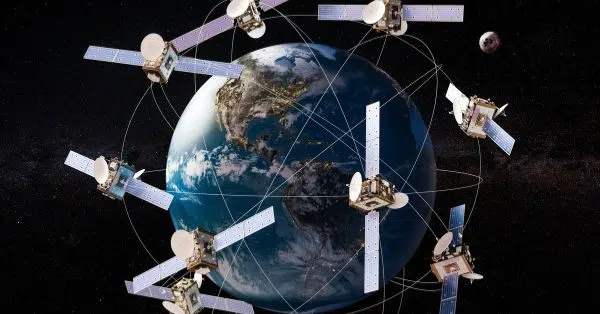
Satellite constellations are advanced networks of strategically placed satellites designed to offer extensive global coverage, overcoming the limitations of single satellite systems. They're pivotal in global communications, particularly in the era of 5G, enabling high-speed, low-latency connections. Different constellations operate at varying altitudes - Geostationary Earth Orbit (GEO), Medium Earth Orbit (MEO), and Low Earth Orbit (LEO) - each with unique benefits and challenges. As 5G emerges, these constellations will not only provide ultra-fast connectivity but will also bridge the digital divide, ensuring all corners of the world have access. Companies like SpaceX's Starlink and Amazon's Project Kuiper are pioneering efforts in this realm. However, while the opportunities are vast, challenges like interference management, space debris, and regulatory hurdles remain.
The emergence of 5G Non-Terrestrial Networks (NTN) presents a revolutionary step in global digital connectivity, but it brings with it intricate regulatory and policy challenges. These directives play a pivotal role, influencing the design, services, and the very integrity of these networks. Key issues range from spectrum allocation and licensing to operational standards and the potential cyber threats these networks might face. Given the global nature of 5G NTN, coordinating regulations across international boundaries becomes paramount, as does addressing the growing concerns of space debris. Moreover, with the vast amount of data these networks handle, policies ensuring data privacy and cybersecurity are of utmost importance. Ultimately, understanding and navigating this complex regulatory landscape is crucial for the successful deployment and operation of 5G NTN.
5G Non-Terrestrial Networks (NTN) promise a new horizon in global communication with high-speed, low-latency features. Yet, as they usher in this new era, they also introduce significant security and privacy challenges. Key vulnerabilities, such as signal jamming, spoofing, and eavesdropping, pose risks to data integrity and user privacy. Addressing these threats demands a layered approach, utilizing advanced cryptographic methods, intrusion detection systems, and innovative AI/ML techniques. As we navigate the future of 5G NTN, it's crucial to prioritize user security and privacy, balancing the immense potential of these networks with the inherent risks they present.

Frequently Asked Questions

What actually makes 5G different from 4G LTE?
5G introduces three core technical improvements over 4G LTE: significantly higher peak data speeds, in some cases multiple gigabits per second under ideal conditions compared to 4G’s typical tens to low hundreds of megabits per second; substantially lower latency, the delay between sending and receiving data, which matters for applications like gaming, video calls, and industrial automation where responsiveness is critical; and far greater device density support, allowing a single cell site to maintain reliable connections with a much larger number of simultaneous devices, which matters increasingly as IoT sensors and connected devices proliferate. These improvements come from a combination of new radio technology, additional spectrum bands made available for 5G use, and a redesigned network architecture that’s considerably more flexible and software-driven than 4G’s architecture was.
What’s the difference between low-band, mid-band, and high-band (mmWave) 5G?
Low-band 5G uses similar frequencies to 4G LTE, offering wide coverage area and good building penetration but speeds not dramatically faster than good 4G performance, making it most useful for extending broad geographic coverage rather than delivering 5G’s headline speed improvements. Mid-band 5G offers a more balanced tradeoff between coverage and speed, generally delivering meaningfully faster performance than 4G across a reasonably wide area, and has become the most common band used for mainstream 5G deployment in most markets globally. High-band 5G, often called mmWave, delivers by far the fastest possible speeds, but its very short range and poor ability to penetrate walls means it’s typically deployed only in dense, high-traffic urban areas like stadiums, rather than for broad area coverage.
What’s the difference between 5G NSA (non-standalone) and 5G SA (standalone)?
5G non-standalone, or NSA, runs 5G radio technology on top of an existing 4G core network, meaning certain control functions still rely on 4G infrastructure even though the actual data connection itself uses 5G radio technology; this was the faster, easier path many operators took for their initial 5G launches, since it could be deployed by upgrading existing 4G infrastructure rather than building an entirely new core network from scratch. 5G standalone, or SA, uses an entirely new, independently functioning 5G core network rather than relying on 4G at all, unlocking more of 5G’s distinctive advanced capabilities, including network slicing and the lowest possible latency, that NSA architecture generally can’t fully support. Many operators have been gradually transitioning from NSA to SA, though this migration has generally taken longer than initially anticipated.
How widespread is 5G coverage and adoption globally in 2026?
5G has become genuinely widespread rather than experimental. Global subscriptions surpassed 3.1 billion in early 2026, with another 162 million subscriptions added in just the first quarter of the year, reflecting continued strong growth even years after 5G’s initial 2019 commercial launch. Coverage varies considerably by region and band: low and mid-band 5G now reaches the substantial majority of the population in most major markets including the U.S., much of Europe, China, and South Korea, while high-band mmWave coverage remains considerably more limited and concentrated in dense urban areas given its short range. Adoption has progressed furthest in markets with aggressive early infrastructure investment, particularly China and South Korea, while other regions, especially parts of the developing world, continue working through earlier stages of 5G buildout.
What is ‘5G-Advanced,’ and how is it different from regular 5G?
5G-Advanced, sometimes marketed by certain vendors and operators, particularly in China, as 5.5G, refers to the next phase of 5G standards development beyond the original 2019 specification, formalized starting with 3GPP Release 18 and continuing through subsequent releases. It introduces capabilities including better support for reduced-capability IoT devices that don’t need full 5G performance, tighter integration with non-terrestrial satellite networks, more sophisticated AI-native network management built directly into the standard, and further uplink and capacity improvements beyond the original 5G specification. Rather than representing a completely new generation the way 5G itself was relative to 4G, 5G-Advanced is best understood as a substantial, ongoing evolution and refinement of the existing 5G standard, extending its useful commercial life well beyond what the original 2019 specification alone delivered.
Why do real-world 5G speeds vary so much between users and locations?
Real-world 5G speeds vary considerably because of the fundamental tradeoffs between different frequency bands: a user connected to low-band 5G in a rural area will experience meaningfully slower speeds than someone connected to mid-band 5G in a well-covered urban area, who in turn will experience slower speeds than someone briefly connected to high-band mmWave near a stadium or dense downtown location. Network congestion also plays a significant role, since a cell site serving many simultaneous users, particularly during peak usage periods, will generally deliver lower per-user speeds than the same site serving fewer users. Device capability matters too, since a phone’s specific modem chip determines which frequency bands and 5G features it can actually access, meaning even within the same coverage area, different devices can experience meaningfully different real-world performance.
Is 5G actually necessary, or is 4G still ‘good enough’ for most uses?
For many everyday tasks like browsing, messaging, and standard video streaming, 4G genuinely remains adequate, and many consumers report not noticing a dramatic difference in daily use compared to a well-performing 4G connection, which is part of why 5G monetization has proven harder than the industry initially expected. However, 5G’s advantages become considerably more apparent for specific use cases: dense urban areas with heavy simultaneous network usage benefit meaningfully from 5G’s greater capacity, fixed wireless access using 5G can deliver genuinely faster home broadband than many alternatives, and emerging applications like cloud gaming, AR and VR, and industrial automation benefit directly from 5G’s lower latency and higher reliability in ways 4G generally can’t match. Whether 5G feels necessary depends heavily on a specific user’s actual usage patterns and location rather than being a universal yes or no answer.
How does 5G relate to other technologies like network slicing, private networks, and FWA covered elsewhere in this reference?
5G is the foundational technology underlying many of the more specific capabilities covered elsewhere in this reference. Network slicing depends specifically on 5G standalone’s more flexible core network architecture to create multiple differentiated virtual networks on shared infrastructure. Private networks increasingly use 5G rather than 4G LTE as their core technology for new deployments, given 5G’s superior capacity and lower latency for industrial use cases. Fixed wireless access has become one of 5G’s clearest commercial monetization successes, using 5G’s speed and capacity to deliver home broadband as an alternative to cable or fiber. Open RAN’s disaggregated, multi-vendor approach to radio equipment is increasingly being applied specifically to 5G network deployments, making 5G the underlying connectivity layer most other categories in this reference build upon.

TECKNEXUS PRIVATE NETWORKS
Congratulations to the 2026 Award Winners
Explore the Winners →

Partner Hubs

Telco AI Agent Leadership

Telco AI Agent Leadership Landscape - Network Equipment Vendors
Network Equipment Vendor Report
How are Amdocs, Salesforce, Comarch, Totogi, Qvantel, Oracle and other OSS/BSS vendors deploying telecom AI agents?
OSS/BSS Vendor Report
How are Amdocs, Salesforce, Comarch, Totogi, Qvantel, Oracle and other OSS/BSS vendors deploying telecom AI agents?
System Integrator Report
Scroll to Top