Industry Intelligence
Intelligence Journeys
AI Use Cases for Utilities
Private Broadband for Utilities
Intelligence Tools
By Tool Type
▼
By Industry
▼
Access Type
▼
Tool Source
▼
Intelligence PlatformPaid
▼
Monthly Tracker
▼
Resources
▼
Technology Hubs
▼
Partner Hubs
▼

Edge/MEC
Edge computing and multi-access edge computing (MEC) place processing close to where data is generated — at the network edge rather than in distant centralized clouds — to cut latency and reduce backhaul. For applications that demand fast, local responses, such as industrial automation, computer vision, AR, and autonomous systems, the edge is often what makes them viable. Edge is tightly linked to 5G standalone, private networks, and AI inference, and is a key area where operators, hyperscalers, and enterprises both compete and partner. For decision-makers, the questions are where edge genuinely beats centralized cloud and how to balance on-premises, network-edge, and public-cloud processing. This channel covers edge and MEC across operator, hyperscaler, and enterprise deployments — architectures, partnerships, and use cases — with analysis of where moving compute to the edge actually pays off.
- Podcast
- November 17, 2021
- 5G Guys

Wireless is an important tool for First Responders to do their jobs and do so safely and efficiently Police, Fire, EMS, and other first responders rely on radio networks for communications and dispatch when they’re in the heat of the moment. Our...
- Article & Insights
- October 24, 2021
- Nida Sahar
What is the current state of edge computing in Asia? What are the challenges? What are the solutions? Get and in-depth the perspective.
- Podcast
- September 22, 2021
- 5G Guys
Disclaimer: This episode of 5G Guys was recorded with the sole purpose to educate and inform. The opinions and thoughts are not licensed, doctors and nothing in the show should be deemed as medical advice. If you have any specific questions regarding...
- Podcast
- September 15, 2021
- 5G Guys
If you’ve been listening to our show recently, or if you’ve been around any tech talk, you’ve probably heard AI, IoT, and even Edge thrown around. But what does it all actually mean? How do they all connect and what exactly are they doing to...
- Article & Insights
- August 31, 2021
- Hema Kadia
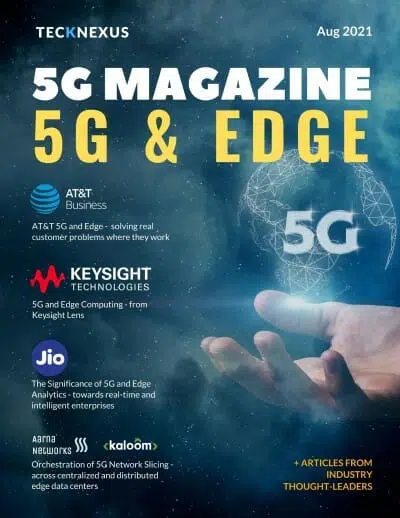
Get an in-depth view of the 5G and Edge from industry thought leaders, including 5G and edge enterprise use cases. What are the challenges? What are the solutions? What are the benefits? What are the security concerns and how to address them? What are the different technical aspects...and more?
Featured articles/interviews from AT&T, Keysight Technologies, Reliance Jio, Kaloom, and Aarna Networks.
- Article & Insights
- August 30, 2021
- Hema Kadia

This article covers AT&T edge offerings- ANE and MEC with detailed use case scenarios across industry verticals and key partnerships.
- Article & Insights
- August 30, 2021
- Hema Kadia

This article covers multi-access edge computing, related testing challenges, Keysight's KORA (Keysight Open RAN Architect) Portfolio, and the process of transitioning from Lab to Live production environment.
- Article & Insights
- August 30, 2021
- Hema Kadia

An Interview with Hitentra Sonny Soni - SVP, Head of sales and marketing at Kaloom and Amar Kapadia - CEO and Co-founder at Aarna Networks. This interview focuses on 5G, edge computing, and network slicing - with related use cases, benefits, technical readiness, the joint solution from Aarna Networks and Kaloom, and more.
- Article & Insights
- August 30, 2021
- Hema Kadia

This article covers the edge promises and security needs, complexities in edge application architecture, security challenges in edge application and the way forward in securing 5G+ edge applications.
- Article & Insights
- August 30, 2021
- Hema Kadia

This article covers edge computing, edge-native applications, edge infrastructure clouds, edge platforms, edge analytics, edge artificial intelligence, cloud-native edge computing, and serverless edge computing, in addition to 5G and Edge Computing combination.
- Article & Insights
- August 28, 2021
- Hema Kadia

Application Infrastructure for Multi-Cloud and Edge Computing covers perspective on 5G and edge computing, the challenges for edge computing, how to build the application environment, what options are available with open source, solutions from cloud providers, and more.
Frequently Asked Questions
What’s the difference between ‘the cloud’ and ‘the edge’ in telecom?
Cloud computing typically runs in a relatively small number of large, centralized data centers, often located far from any individual user, which is efficient for many workloads but introduces unavoidable physical distance, and therefore latency, between where data is generated and where it’s processed. Edge computing, specifically MEC, places computing resources much closer to where data actually originates, at cell towers, base stations, or local facilities, cutting the round-trip delay for applications where that distance meaningfully matters. The tradeoff is that edge sites generally have far less raw computing capacity than a massive centralized data center, so edge deployments tend to handle specific, latency-sensitive workloads locally while still relying on the broader cloud for less time-critical processing and coordination.
Is MEC mainly a telecom-specific concept, or does it apply more broadly?
It started as a mobile-network-specific concept, originally called Mobile Edge Computing when ETSI introduced it in the mid-2010s, focused on placing computing resources within mobile radio access network infrastructure. ETSI broadened the concept to Multi-access Edge Computing in 2017 specifically to extend it beyond cellular networks to also cover fixed-line broadband and Wi-Fi access, recognizing that the underlying need, computing resources close to the point of data generation, applies regardless of access technology. Current standards work is extending the concept further still, with ETSI’s MEC group releasing Phase 4 specifications in late 2025 focused on developer-friendly APIs for vertical industries and explicit alignment with emerging 6G requirements.
What applications actually benefit from edge computing?
The clearest use cases are ones where milliseconds genuinely matter, or where large amounts of locally generated data would otherwise need to travel back to a distant data center unnecessarily. Autonomous vehicles need to process sensor data and make navigation decisions in near real time, where even modest added latency could be meaningful for safety. Industrial automation and predictive maintenance benefit from edge processing of sensor data from factory equipment. AR and VR applications need responsive, low-latency rendering support. Smart city video analytics, like traffic monitoring, generates enormous volumes of video data far more efficient to process locally. Increasingly, running AI inference closer to users for real-time applications is becoming one of the most significant edge use cases of all.
Why are telecom operators excited about edge computing as a revenue source?
Beyond reducing backhaul costs, edge sites give telecom operators something cloud hyperscalers don’t have by default: physical proximity and direct integration with the radio network across thousands of locations nationwide. This positions operators uniquely to offer latency-sensitive computing services that a centralized cloud data center simply can’t match on responsiveness, regardless of raw computing power. Operators are increasingly positioning these edge locations specifically as AI inference points, sometimes described as compact ‘AI factories,’ capable of running real-time AI workloads close to users. This opens a genuinely new monetization path beyond selling connectivity itself, letting operators compete in the broader computing and AI infrastructure market using distributed physical infrastructure cloud-only providers would need years to replicate.
How mature is MEC deployment in 2026?
By 2026, MEC has moved well past the concept or early-pilot stage into active, expanding commercial deployment. ETSI’s MEC group has produced more than 50 technical specifications covering reference architectures, service enablers, and deployment guidelines, and released its Phase 4 work in late 2025, focused on developer-friendly APIs and explicit alignment with open-source projects and 6G preparation. Telecom operators worldwide are actively pairing MEC deployments with private 5G networks, AI workloads, and Open RAN integration in live commercial deployments rather than isolated trials. The technology continues to mature rather than being fully settled; convergence between MEC and Open RAN architectures remains an active area of development.
How does edge computing relate to private 5G networks?
Edge computing and private 5G networks are frequently deployed together because they solve complementary problems for the same enterprise use cases. A private 5G network provides dedicated, reliable, high-performance wireless connectivity across a facility like a factory or port, while edge computing provides the local processing power needed to actually act on the data that connectivity carries, without sending everything back to a distant cloud data center. A manufacturing facility, for example, might use private 5G to connect cameras and sensors across the factory floor, with an edge deployment at that same facility processing video analytics or controlling automated machinery in near real time. This pairing is one of the most common patterns in enterprise digital transformation projects today.
What’s the difference between edge computing and Open RAN’s ‘Cloud RAN’ concept?
Edge computing and Cloud RAN address related but distinct parts of the network. Cloud RAN refers specifically to running radio access network functions, the software controlling how a cell site transmits and receives wireless signals, on cloud-based, software-defined infrastructure rather than dedicated radio hardware. Edge computing, particularly MEC, refers more broadly to running general-purpose application workloads, not just radio network functions, close to the network edge, things like video analytics, AI inference, or industrial automation software. In practice, the two concepts increasingly converge physically, since the same edge infrastructure supporting Cloud RAN’s virtualized radio functions can often also host MEC application workloads on shared hardware.
What are the biggest technical challenges in deploying edge computing at scale?
Deploying edge computing at scale introduces several persistent technical challenges. Managing and orchestrating computing resources across potentially thousands of geographically distributed edge sites is meaningfully more complex than managing a small number of centralized data centers, since each edge location has limited physical space, power, and cooling capacity. Ensuring consistent security across so many distributed locations, each a potential point of vulnerability, requires more extensive security architecture than securing a handful of centralized facilities. There’s also a workload placement challenge: deciding which tasks genuinely benefit from edge processing versus which are better handled centrally, since over-provisioning edge capacity for workloads that don’t truly require it can be an inefficient use of limited, expensive infrastructure.