WiFi

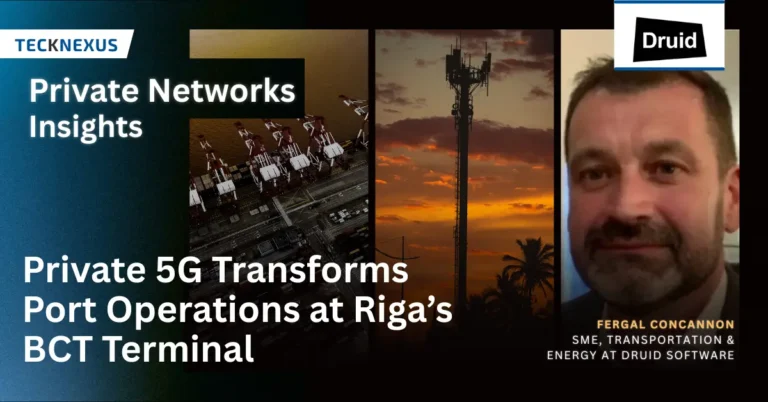
Winner – Private Network Excellence in Ports, Druid Software and LMT, deployed Latvia’s first private 5G network at the Baltic Container Terminal (BCT) in Riga. Powered by Druid’s Raemis™ core, the network delivers ultra-reliable, low-latency connectivity for real-time operations, automation, and safety systems. This landmark 5G rollout improves productivity, enables green port initiatives, and sets a new global standard for smart port infrastructure.
At the Baltic Container Terminal, Wi-Fi coverage black spots caused downtime for operators and equipment. LMT’s private 5G network resolved these challenges, ensuring seamless connectivity across the 50-hectare port.
LMT and Druid Software joined forces to launch Latvia’s first private 5G network at the Freeport of Riga, addressing real operational challenges faced by the Baltic Container Terminal and laying the foundation for future automation.
Hospitals are turning to a dual-network model that pairs neutral host coverage with private 5G to handle surging data, device density, and distinct user groups across large clinical campuses. Healthcare networks are stressed by electronic health records, telehealth, connected medical equipment, and higher patient expectations for always-on mobile service. A combined neutral host and private 5G architecture lets IT leaders segment traffic and policy by role and use case, align with data sovereignty requirements, and scale capacity as device fleets and AI-driven workflows grow. The model separates public cellular access for general users from dedicated private 5G for clinical and operational workloads.
Verizon is transforming healthcare infrastructure with a dual-network approach that combines private 5G and neutral host connectivity. Hospitals like AdventHealth and Tampa General are enhancing AI-powered diagnostics, real-time telemetry, and secure staff communications—while ensuring strong public mobile coverage for patients and visitors. This hybrid model, built on Ericsson’s platform, supports HIPAA compliance, device density, and future scalability for smart hospitals.
Connectivity is transforming aviation from the ground up. Airports are deploying private 5G, Wi-Fi 6, edge computing, and IoT to deliver two major outcomes: smoother passenger experiences and lower operating costs. Travelers enjoy real-time updates, biometric check-in, and AR wayfinding — while operators benefit from predictive maintenance, smarter gate usage, and energy optimization. This dual-value framework positions connectivity as more than infrastructure, it’s a strategic differentiator that enhances revenue, reduces OPEX, and elevates the brand.
Aviation is no longer a siloed industry - it’s a globally connected ecosystem where airports, airlines, regulators, telecom operators, and tech vendors must work in sync. As digital transformation accelerates, connectivity becomes a critical layer for collaboration, enabling real-time decision-making, safety, operational alignment, and a seamless passenger experience. From private 5G and edge computing to biometric boarding and IoT, the aviation industry must co-invest, co-develop, and co-govern digital infrastructure. Case studies from Heathrow, Changi, and DFW show that stakeholder alignment leads to measurable gains in efficiency, innovation, and trust. Connectivity is the enabler, but collaboration is what makes it scalable and sustainable.

Airport ground operations — from baggage handling and fueling to aircraft turnaround - are undergoing rapid digital transformation. Powered by IoT, automation, private 5G, and edge computing, airside workflows are becoming more predictive, efficient, and sustainable. Sensors track assets, optimize vehicle dispatch, and enhance worker safety. Autonomous tugs, computer vision, and AI-driven maintenance cut delays and reduce manual errors. Private networks and edge computing provide the real-time connectivity needed for mission-critical applications. Leading airports like Schiphol, Changi, and DFW are already adopting these technologies, proving that digital transformation on the ground isn't just possible, it's essential for next-gen airport performance.
Airports are shifting from physical-first to connectivity-first infrastructure. Legacy systems are no longer enough to manage modern expectations for speed, safety, and digital experience. Leading airports are deploying Wi-Fi 6, 5G, private mobile networks, and edge computing — not as standalone upgrades but as a hybrid network foundation. Each technology serves a purpose: Wi-Fi 6 supports high-density passenger areas; public 5G offers mobile bandwidth for travelers; private networks ensure operational reliability; and edge computing enables real-time decision-making. Together, they form a resilient architecture built for scalability, cybersecurity, and future growth. Airports like Heathrow, Changi, and DFW are already implementing these layers, proving that connectivity is now core infrastructure, just like runways or terminals.
Airport terminals are evolving into connected, intelligent environments powered by biometrics, IoT, and scalable infrastructure. These technologies are helping airports manage increasing passenger volumes, improve security, and deliver seamless experiences. From facial recognition at check-in to IoT-based baggage tracking and AR navigation, the connected terminal offers faster processing, predictive safety, and energy-efficient operations. Scalable, cloud-native systems future-proof infrastructure for demand surges and enable rapid integration of emerging tech like AI, digital twins, and virtual queuing. As global air travel rebounds, the connected terminal represents a blueprint for smarter, safer, and more sustainable airport growth.
Nokia and Boldyn Networks have launched a private 5G network at Callio FutureMINE in Finland, addressing underground mining’s toughest connectivity issues. The network supports autonomous vehicles, real-time visualization, and tele-remote operations, transforming safety, efficiency, and sustainability in mining. This deployment sets a global benchmark for industrial 5G use in extreme environments.
A multi-hour outage in the Dallas–Fort Worth airspace tied to legacy telecom services triggered cascading delays and cancellations, spotlighting urgent modernization needs for U.S. air traffic networks. On Friday afternoon, a telecommunications failure forced a ground stop across Dallas Fort Worth International (DFW) and Dallas Love Field, with ripple effects at several regional airports. The FAA attributed the incident to multiple failures in TDM-based data services delivered by a local telecom provider, compounded by redundancy gaps overseen by a prime contractor. Initial field reports tied the outage to fiber damage that simultaneously knocked out primary and backup data paths.

Partner Hubs

Download content, access intelligence tools, and hear from executives.

Partner Events

  • M360 ASEAN
  • FutureNet Asia 2026
  • Network X Vienna 2026
Scroll to Top