Private Network
Intelligence
Intelligence Journeys
Utilities Private Broadband Planning
AI Use Case Planning for Utilities

Spectrum

Fresh polling signals rising public concern that AI could upend employment, destabilize politics, and strain social and energy systems. A recent Reuters/Ipsos survey of 4,446 U.S. adults found that 71% worry AI will permanently displace too many workers. Seventy-seven percent of respondents fear AI will fuel political instability if hostile actors exploit the technology. The poll also shows broad worry about AIs indirect costs: 66% are concerned about AI companions displacing human relationships, and 61% are concerned about the technology's energy footprint. Bottom line: Public concern is high, and that increases the cost of missteps.
Deutsche Telekom will roll out a free 5G+ Gaming option for eligible Magenta Mobil customers starting autumn 2025, integrating GeForce NOW for on-the-go cloud gaming with consistent responsiveness and stability. The service runs over Telekom's 5G Standalone (SA) network using network slicing and L4S, with initial device support including Samsung's Galaxy S24 Ultra and the S25 series, and more handsets to follow. GeForce NOW brings access to a catalog of 2,300+ supported titles spanning major game stores, with additional install-to-play titles being added, and day passes available (Performance and Ultimate tiers) for short-term access.
Virgin Media O2 is partnering with neutral host provider Freshwave to strengthen mobile coverage across 22 Haven holiday parks, aligning seasonal demand with targeted network investment. The project is part of O2s Mobile Transformation Plan, a multi-year program focused on improving capacity and coverage where traffic spikes. The upgrades span popular UK staycation destinations, including coastal and rural parks where coverage can be patchy and demand is highly seasonal. Four parks are live now, with the remaining sites phased over the peak travel window to improve both outdoor and indoor experience for guests, staff, and nearby communities.
The 4.44.94 GHz range offers the cleanest mix of technical performance, policy feasibility, and global alignment to move the U.S. ahead in 6G. Midband is where 6G will scale, and 4 GHz sits in the sweet spot. A contiguous 500 MHz block supports wide channels (100 MHz+), strong uplink, and macro coverage comparable to C-Band, but with more spectrum headroom. That translates into better spectral efficiency and a lower total cost per bit for nationwide deployments while still enabling dense enterprise and edge use cases.
Beijing's first World Humanoid Robot Games is more than a spectacle. It is a live systems trial for embodied AI, connectivity, and edge operations at scale. Over three days at the Beijing National Speed Skating Oval, more than 500 humanoid robots from roughly 280 teams representing 16 countries are competing in 26 events that span athletics and applied tasks, from soccer and boxing to medicine sorting and venue cleanup. The games double as a staging ground for 5G-Advanced (5G-A) capabilities designed for uplink-intensive, low-latency, high-reliability robotics traffic. Indoors, a digital system with 300 MHz of spectrum delivers multi-Gbps peaks and sustains uplink above 100 Mbps.
stc 5G powered the Esports World Cup with 1,295 antennas and 285 MHz spectrum, delivering broadcast-grade uplink, low latency, and reliable performance.
More than $14 billion has been invested across the CBRS stacklicenses, RAN, devices, infrastructure, sensors, and software. Over 420,000 CBRS radio nodes (CBSDs) are in service. The device ecosystem is broad: Apple and Samsung ship n48-capable handsets; industrial and FWA suppliers support n48 CPEs and routers; Ericsson, Nokia, Samsung, JMA Wireless and others provide radio and DAS. This is not a pilot; it is production infrastructure. Refarming would force replacement or retuning of hundreds of thousands of base stations and millions of end devices, plus upgrades to SAS integrations and enterprise control planes.
A leading power utility in EMEA has tapped Ceragon to refresh its nationwide missioncritical communications backbone with highpower microwave, signaling a broader acceleration in utility OT network upgrades. The multiphase program, initiated earlier in 2025, is expected to deliver approximately $8 million in revenue for Ceragon and centers on replacing endoflife systems and scaling capacity across a countrywide private network. Following a detailed technical assessment led by a regional solutions provider, the utility selected Ceragons radios over competing global vendors.
A new Ciena and Heavy Reading study signals that AI will become a primary source of metro and long-haul traffic within three years while most optical networks remain only partially prepared. AI training and inference are shifting from contained data center domains to distributed, edge-to-core workflows that stress transport capacity, latency, and automation end-to-end. Expectations are even higher for long-haul: 52% see AI surpassing 30% of traffic and 29% expect AI to account for more than half. Yet only 16% of respondents rate their optical networks as very ready for AI workloads, underscoring an execution gap that will shape capex priorities, service roadmaps, and partnership models through 2027.
A new joint solution from Rohde & Schwarz (R&S) and the Taiwan Space Agency (TASA) consolidates electromagnetic compatibility (EMC) and antenna measurements into a single, production-grade test chamber, signaling a shift in how satellite payloads will be validated for Non-Terrestrial Network (NTN) and mission-critical services. By integrating both disciplines in one chamber, TASA can validate RF performance, emissions, and immunity under consistent test conditions and configurations, improving time-to-launch and de-risking interoperability with terrestrial networks. The TASA deployment combines R&S hardware, software, and engineering with a locally built Compact Antenna Test Range (CATR) reflector to achieve dual-mode EMC and antenna measurements in one chamber.
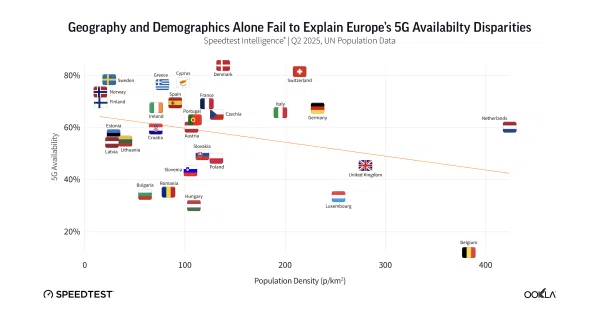
Europe’s 5G progress is accelerating but unevenly. Denmark, Sweden, and Spain lead with strong 5G availability and SA deployment, driven by early spectrum allocation and targeted policy. Meanwhile, the UK, Belgium, and Hungary trail due to regulatory delays, infrastructure bottlenecks, and weak investment. With the Digital Decade 2030 goal in sight, aligning on policy, spectrum, and subsidies will be key to closing the EU’s internal 5G divide.
5G-Advanced is redefining mobile networks through AI-native intelligence, sustainability, and advanced capabilities like XR support, NTN integration, and low-latency industrial IoT. Built on 3GPP Releases 18–20, it enables predictive automation, 30% energy savings, and sets the stage for 6G.

Partner Hubs

Telco AI Agent Leadership

Telco AI Agent Leadership Landscape - Network Equipment Vendors
Network Equipment Vendor Report
How are Amdocs, Salesforce, Comarch, Totogi, Qvantel, Oracle and other OSS/BSS vendors deploying telecom AI agents?
OSS/BSS Vendor Report
How are Amdocs, Salesforce, Comarch, Totogi, Qvantel, Oracle and other OSS/BSS vendors deploying telecom AI agents?
System Integrator Report
Scroll to Top