Private Network
Intelligence
Intelligence Journeys
Utilities Private Broadband Planning
AI Use Case Planning for Utilities

Meta

The Open Compute Project (OCP) has launched a centralized AI portal offering infrastructure tools, white papers, deployment blueprints, and open hardware standards. Designed to support scalable AI data centers, the portal features contributions from Meta, NVIDIA, and more, driving open innovation in AI cluster deployments.
OpenAI is developing a prototype social platform featuring an AI-powered content feed, potentially placing it in direct competition with Elon Musk's X and Meta’s AI initiatives. Spearheaded by Sam Altman, the project aims to harness user-generated content and real-time interaction to train advanced AI systems—an approach already used by rivals like Grok and Llama.
OpenAI and Meta are eyeing partnerships with Reliance Industries to bring AI tools like ChatGPT and Llama to millions in India. By integrating with Reliance’s telecom and digital networks, these tech giants aim to make AI more accessible and affordable. Reliance’s reach, infrastructure, and government ties make it an ideal partner to scale AI adoption across diverse markets—from cities to rural India.
Selective transparency in open-source AI is creating a false sense of openness. Many companies, like Meta, release only partial model details while branding their AI as open-source. This article dives into the risks of such practices, including erosion of trust, ethical lapses, and hindered innovation. Examples like LAION 5B and Meta’s Llama 3 show why true openness — including training data and configuration — is essential for responsible, collaborative AI development.
Recent advancements in artificial intelligence training methodologies are challenging traditional assumptions about computational requirements and efficiency. Researchers have discovered an "Occam's Razor" characteristic in neural network training, where models favor simpler solutions over complex ones, leading to superior generalization capabilities. This trend towards efficient training is expected to democratize AI development, reduce environmental impact, and lead to market restructuring, with a shift from hardware to software focus. The emergence of efficient training patterns and distributed training approaches is likely to have significant implications for companies like NVIDIA, which could face valuation adjustments despite strong fundamentals.
Alibaba Cloud’s Qwen2.5-Max is the latest AI model shaking up the industry, competing directly with GPT-4o, DeepSeek-V3, and Llama-3.1-405B. Featuring a cost-efficient Mixture-of-Experts (MoE) architecture, Qwen2.5-Max lowers AI infrastructure costs by up to 60% while excelling in reasoning, coding, and mathematical tasks. As China’s AI sector accelerates, this release highlights a shift from brute-force computing to efficiency-driven AI innovation, challenging U.S. and Chinese tech giants alike.

Nvidia’s Blackwell GB200 AI racks face overheating and connectivity challenges, prompting order adjustments from major customers like Microsoft, Amazon, and Google. While these delays impacted Nvidia’s stock price, demand for AI infrastructure remains strong, with Nvidia expected to address these issues and maintain its market leadership.
AWS has announced a $11 billion investment to expand its data center infrastructure in Georgia, supporting the rising demand for AI and cloud services. The project will create 550 high-skilled jobs and position Georgia as a tech hub. This move aligns with AWS’s strategy to meet growing AI workloads, following similar investments in Indiana and globally.
SLMs present an exciting opportunity for creating a more energy-efficient and sustainable approach to AI. They lower computational requirements, facilitate edge deployment, and maintain similar performance levels for certain tasks, which can help lessen the environmental footprint of AI while still providing essential advantages. Additionally, prioritizing data privacy and responsible data management can greatly reduce energy use in data centers. By encouraging ethical data practices, empowering users, and promoting energy efficiency through SLMs, we can pave the way for a greener and more privacy-aware digital landscape.
LG Uplus has launched ixi-GEN, a generative AI model designed specifically for telecommunications. Utilizing LG AI Research's Exaone, ixi-GEN offers high security and efficiency, positioning LG Uplus as a leader in the B2B generative AI market.
Meta Platforms is in negotiations with Magic Leap for a possible long-term collaboration. While this partnership could aid Meta's metaverse goals, Magic Leap's waveguide technology, despite its flaws, is regarded as valuable. This comes as Meta continues investing in the metaverse despite investor dissatisfaction, and as it strives to reduce reliance on Chinese manufacturing.
As part of its plan for broader cost cuts, Meta Platforms Inc., the parent company of Facebook, is contemplating different divestiture options for Kustomer, the customer service software firm it acquired for $1 billion in 2020. Meta has not yet finalized its decision but is considering either spinning off the business or attempting to sell it, according to a source familiar with the matter.

Partner Hubs

Telco AI Agent Leadership

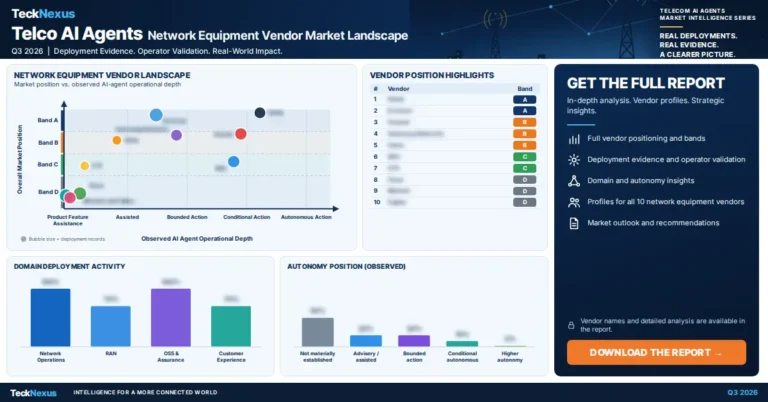
Telco AI Agent Leadership Landscape - Network Equipment Vendors
Network Equipment Vendor Report
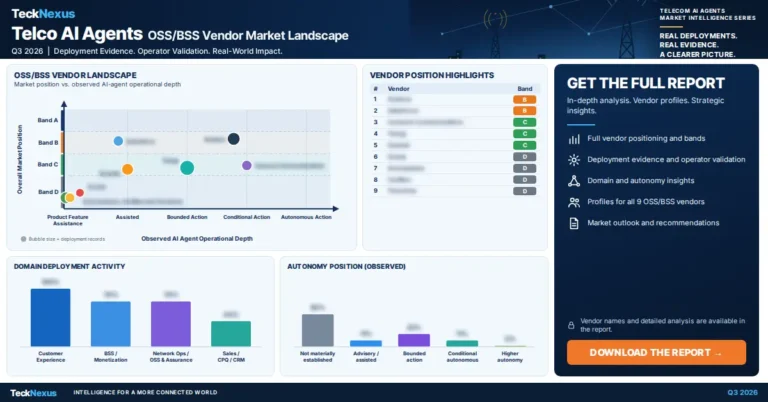
How are Amdocs, Salesforce, Comarch, Totogi, Qvantel, Oracle and other OSS/BSS vendors deploying telecom AI agents?
OSS/BSS Vendor Report
How are Amdocs, Salesforce, Comarch, Totogi, Qvantel, Oracle and other OSS/BSS vendors deploying telecom AI agents?
System Integrator Report
Scroll to Top