Private Network
Intelligence
Intelligence Journeys
AI Use Case Planning for Utilities
Utilities Private Broadband Planning
https://www.ciena.com/insights/blog/2026/rls-hyper-rail-solving-the-challenges-of-multi-rail-photonics?campaign=X1994626&channel=media-direct-buy&medium=display&source=tecknexus&ad-type=&campaign-type=&term=&region=&lid=D3JLmZ

LLM

Huawei’s new AI chip, the Ascend 910D, has raised concerns about Nvidia’s China business, but analysts say it lacks the global performance, ecosystem, and efficiency to compete with Nvidia’s H100 GPU. Built on 7nm technology with limited software support, Huawei’s chip may gain local traction but poses no major international threat—yet.
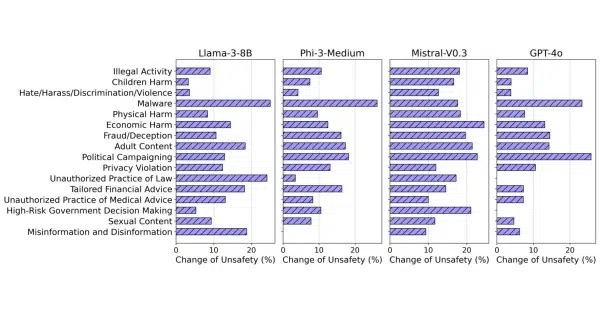
There's immense pressure for companies in every industry to adopt AI, but not everyone has the in-house expertise, tools, or resources to understand where and how to deploy AI responsibly. Bloomberg hopes this taxonomy – when combined with red teaming and guardrail systems – helps to responsibly enable the financial industry to develop safe and reliable GenAI systems, be compliant with evolving regulatory standards and expectations, as well as strengthen trust among clients.
Confidencial.io will unveil its unified AI data governance platform at RSAC 2025. Designed to secure unstructured data in AI workflows, the system applies object-level Zero Trust encryption and seamless compliance with NIST/ISO frameworks. It protects AI pipelines and agentic systems from sensitive data leakage while supporting safe, large-scale innovation.
NVIDIA has launched a major U.S. manufacturing expansion for its next-gen AI infrastructure. Blackwell chips will now be produced at TSMC’s Arizona facilities, with AI supercomputers assembled in Texas by Foxconn and Wistron. Backed by partners like Amkor and SPIL, NVIDIA is localizing its AI supply chain from silicon to system integration—laying the foundation for “AI factories” powered by robotics, Omniverse digital twins, and real-time automation. By 2029, NVIDIA aims to manufacture up to $500B in AI infrastructure domestically.
In AI in Telecom: Strategic Themes, Maturity, and the Road Ahead, we explore how AI has shifted from buzzword to backbone for global telecom leaders. From AI-native networks and edge inferencing, to domain-specific LLMs and behavioral cybersecurity, this article maps out the strategic pillars, real-world use cases, and monetization models driving the AI-powered telecom era. Featuring CxO insights from Telefónica, KDDI, MTN, Telstra, and Orange, it captures the voice of a sector transforming infrastructure into intelligence.

SK Telecom’s AI assistant, adot, now features Google’s Gemini 2.0 Flash, unlocking real-time Google search, source verification, and support for 12 large language models. The integration boosts user trust, expands adoption from 3.2M to 8M users, and sets a new standard in AI transparency and multi-model flexibility for digital assistants in the telecom sector.
SoftBank has launched the Large Telecom Model (LTM), a domain-specific, AI-powered foundation model built to automate telecom network operations. From base station optimization to RAN performance enhancement, LTM enables real-time decision-making across large-scale mobile networks. Developed with NVIDIA and trained on SoftBank’s operational data, the model supports rapid configuration, predictive insights, and integration with SoftBank’s AITRAS orchestration platform. LTM marks a major step in SoftBank’s AI-first strategy to build autonomous, scalable, and intelligent telecom infrastructure.
AI stirs both excitement and concern. While some companies rush to take advantage of it, many are cautious due to the challenges and costs. However, there may be a better approach: using Assistive Intelligence with small, specialized models instead of Large Language Models. This method is more affordable and can benefit businesses and society. Emphasizing open-source technology respects privacy and fosters true innovation. By focusing on solving real problems, we enable growth and empower people to explore Assistive AI without high costs.
The GSMA Foundry has launched Open-Telco LLM Benchmarks, an open-source AI evaluation framework designed to enhance telecom-specific large language models (LLMs). Supported by Hugging Face, The Linux Foundation, Deutsche Telekom, SK Telecom, and more, this initiative aims to improve AI efficiency, security, and compliance in 5G and 6G networks. Learn how this industry-wide benchmark is shaping the future of telecom AI innovation.
Recent advancements in artificial intelligence training methodologies are challenging traditional assumptions about computational requirements and efficiency. Researchers have discovered an "Occam's Razor" characteristic in neural network training, where models favor simpler solutions over complex ones, leading to superior generalization capabilities. This trend towards efficient training is expected to democratize AI development, reduce environmental impact, and lead to market restructuring, with a shift from hardware to software focus. The emergence of efficient training patterns and distributed training approaches is likely to have significant implications for companies like NVIDIA, which could face valuation adjustments despite strong fundamentals.
Rule-based AI agents operate on predefined rules, ensuring predictable and transparent decision-making, while LLM-based AI agents leverage deep learning for flexible, context-aware responses. This article compares their key features, advantages, and use cases to help you choose the best AI solution for your needs.
AI agents are transforming industries in 2025, but scaling them efficiently without Large Language Models (LLMs) is impossible. LLMs provide critical capabilities such as reasoning, knowledge retrieval, and contextual understanding that power AI automation. This detailed article explores why LLMs are essential for AI agents, the role of Retrieval-Augmented Generation (RAG), optimization strategies, and the best free resources to master LLMs.
https://www.ciena.com/insights/blog/2026/rls-hyper-rail-solving-the-challenges-of-multi-rail-photonics?campaign=X1994626&channel=media-direct-buy&medium=display&source=tecknexus&ad-type=&campaign-type=&term=&region=&lid=D3JLmZ

Partner Hubs

Telco AI Agent Leadership

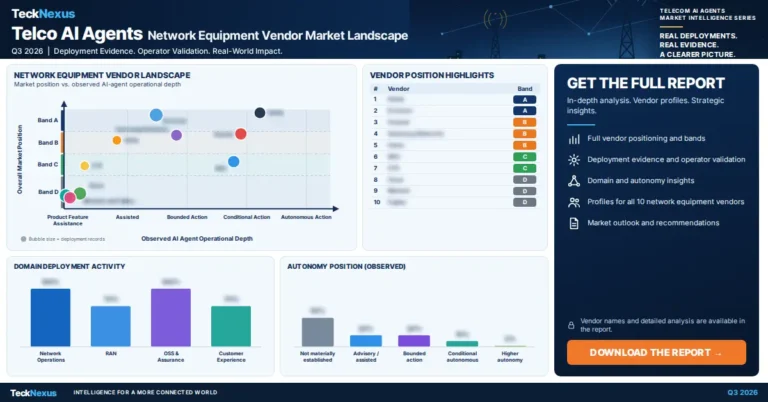
Telco AI Agent Leadership Landscape - Network Equipment Vendors
Network Equipment Vendor Report
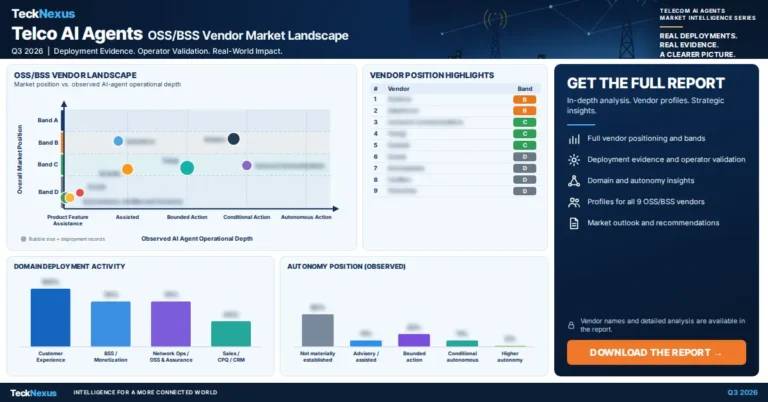
How are Amdocs, Salesforce, Comarch, Totogi, Qvantel, Oracle and other OSS/BSS vendors deploying telecom AI agents?
OSS/BSS Vendor Report
How are Amdocs, Salesforce, Comarch, Totogi, Qvantel, Oracle and other OSS/BSS vendors deploying telecom AI agents?
System Integrator Report
Scroll to Top