Private Network
Intelligence
Intelligence Journeys
Utilities Private Broadband Planning
AI Use Case Planning for Utilities

Google

OpenAI has signed a multi‑year, $38 billion capacity agreement with Amazon Web Services (AWS) to run and scale its core AI workloads on NVIDIA‑based infrastructure, signaling a decisive shift toward a multi‑cloud strategy and intensifying the hyperscaler battle for frontier AI. The agreement makes OpenAI a direct AWS customer for large‑scale compute, starting immediately on existing AWS data centers and expanding as new infrastructure comes online. AWS and OpenAI target the bulk of new capacity to be deployed by the end of 2026, with headroom to extend into 2027 and beyond.
NEC is moving to scale its cloud and SaaS business support capabilities with a $2.9 billion acquisition of CSG Systems International, positioning Netcracker at the center of the combined telecom monetization play. CSG brings a sizable recurring-revenue portfolio in digital BSS, billing, charging, and customer engagement used by communications, cable, media, and digital service providers, complementing Netcracker’s OSS/BSS, orchestration, and service automation strengths. The all-cash deal values CSG at approximately $2.9 billion on an enterprise value basis and has unanimous board approval, with closing targeted for 2026 pending CSG shareholder approval and customary antitrust and other regulatory reviews.
Meta, Alphabet, and Microsoft signaled that AI infrastructure is now a multi-year capital priority measured in tens of billions per year. In their latest results, Meta guided capital expenditures into the $70–72 billion range with an even larger step-up expected the following year. Alphabet raised its 2025 capex outlook to $91–93 billion, up sharply from prior estimates. Microsoft reported $34.9 billion of capex in the most recent quarter, materially above expectations and up strongly year over year. These figures point to the largest synchronized build-out of compute, storage, and networking capacity in the history of cloud.
MTN has launched StarEdge Horizon, a Layer 2 service over SpaceX’s Starlink designed to move enterprise traffic on a private path to MTN points of presence (PoPs), bypassing the public internet and reducing latency, jitter, and operational complexity. The service extends a private Layer 2 domain from remote sites over Starlink into MTN regional PoPs, where enterprises can centralize internet egress, security, and policy. QoS and segmentation protect prioritized traffic, while multi-link redundancy reduces site-level downtime risks. By bringing a private Layer 2 architecture to Starlink, MTN’s StarEdge Horizon turns LEO from best-effort internet into a controllable enterprise transport.
A renewed, three-year collaboration between Magic Leap and Google signals a pragmatic path to AI-capable AR glasses that prioritize visual quality, comfort, and manufacturability. Magic Leap is pivoting from building end-user headsets to becoming an ecosystem partner, offering waveguides, optics, device services, and manufacturing know-how to companies pursuing glasses form factors. The companies are aligning around Android XR, positioning the prototype showcased on stage at the Future Investment Initiative in Riyadh as a reference for future designs. The prototype highlights advances in see-through clarity, low-power displays, and an industrial design that approximates everyday eyewear.
Qualcomm is moving from mobile NPUs into rack-scale AI infrastructure, positioning its AI200 (2026) and AI250 (2027) to challenge Nvidia/AMD on the economics of large-scale inference. The company is translating its Hexagon neural processing unit heritage—refined across phones and PCs—into data center accelerators tuned for inferencing, not training. AI200 and AI250 will ship in liquid-cooled, rack-scale configurations designed to operate as a single logical system. Qualcomm is leaning into that constraint with a redesigned memory subsystem and high-capacity cards supporting up to 768 GB of onboard memory—positioning that as a differentiator versus current GPU offerings.
Vodafone is partnering with Irish firm Zinkworks on Rapid RIC, a central platform that blends secure data analytics, a visual low-code interface, and code-generating AI to create and operate RAN applications, or rApps. The goal is ambitious but specific: cut time-to-market from months to weeks, scale deployments across markets, and improve service quality, capacity, and energy use. The platform is slated for early 2026 availability and will run primarily on Vodafone’s private Google Cloud Platform environment. Rapid RIC uses GenAI to generate production-grade code from visual designs, enabling radio engineers to turn domain knowledge directly into software without deep AI or ML skills.
A new partnership between Palantir and Lumen Technologies signals a shift from internal AI pilots to packaged enterprise services delivered over a telecom-grade edge and network footprint. Palantir will provide its Foundry and Artificial Intelligence Platform (AIP) as the data and decisioning layer for Lumen’s enterprise AI offerings, which Lumen plans to deliver on top of its edge computing nodes, broadband infrastructure, and managed digital services. The companies position this as a multi-year, strategic collaboration focused on operational AI use cases, not just experimentation. While exact terms were not disclosed, multiple reports indicate Lumen’s total spend could exceed $200 million over several years.
The G4 family is built on NVIDIA RTX PRO 6000 Blackwell Server Edition GPUs and targets high-throughput inference, visual computing, and simulation. Each VM can be configured with 1, 2, 4, or 8 GPUs, delivering up to 768 GB of GDDR7 memory in total. Fifth-generation Tensor Cores introduce FP4 precision to drive efficient multimodal and LLM inference, while fourth-generation RT Cores double real-time ray-tracing performance over the prior generation for photorealistic rendering. Google cites up to 9x throughput over G2 instances, positioning G4 as a universal GPU platform spanning AI inference, content creation, CAD/CAE acceleration, and robotics simulation.
OpenAI has launched ChatGPT Atlas, a MacOS AI browser built around its chatbot, positioning agentic browsing and LLM-native search as the next front in the browser wars. Atlas reframes the browser as a conversational interface. It removes the traditional address bar and orients the experience around ChatGPT, with natural language as the primary way to navigate, retrieve, and summarize information. The initial release targets Apple’s MacOS, with OpenAI emphasizing a paid “agent mode” that can autonomously search, read, and act on the user’s behalf using the live browsing context. Agent mode will be available to paying ChatGPT subscribers, extending OpenAI’s monetization beyond API usage and premium chatbot tiers.
Google Cloud’s 2025 ROI of AI study signals a step-change: AI agents are now in production at scale and delivering measurable business outcomes. The study, fielded with National Research Group across 24 countries, finds 52% of executives report their organizations already use AI agents—specialized models that can plan, reason, and take actions. Momentum is material: 39% say their company has launched more than ten agents. Executives also report faster delivery cycles, with over half moving use cases from idea to production within three to six months, up from last year. Generative AI investment continues to climb as technology costs fall.
Unlike metaverse-era headsets that leaned on entertainment and novelty, Galaxy XR makes Google’s Gemini the front door to the interface. In demos, Gemini orchestrated windows in a spatial workspace, answered context-aware questions, and invoked creative tools like Veo for AI-generated video. That tight AI integration is the strategic wedge: Samsung and Google position XR as a bridge to slim, everyday AI glasses developed with eyewear brands Warby Parker and Gentle Monster. The message to developers and enterprises is clear—design for multimodal AI agents first; the form factor will shrink later.
TECKNEXUS PRIVATE NETWORKS
Congratulations to the 2026 Award Winners
Explore the Winners →

Partner Hubs

Telco AI Agent Leadership

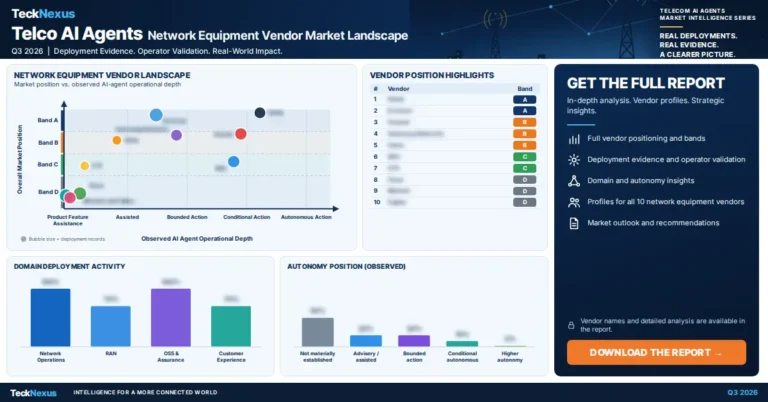
Telco AI Agent Leadership Landscape - Network Equipment Vendors
Network Equipment Vendor Report
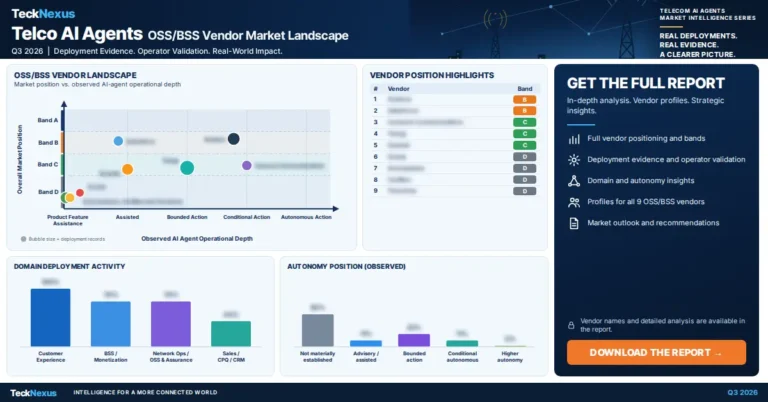
How are Amdocs, Salesforce, Comarch, Totogi, Qvantel, Oracle and other OSS/BSS vendors deploying telecom AI agents?
OSS/BSS Vendor Report
How are Amdocs, Salesforce, Comarch, Totogi, Qvantel, Oracle and other OSS/BSS vendors deploying telecom AI agents?
System Integrator Report
Scroll to Top