Private Network
Intelligence
Intelligence Journeys
Utilities Private Broadband Planning
AI Use Case Planning for Utilities

Fiber

New analysis from Bain & Company puts a stark number on AI’s economics: by 2030 the industry may face an $800 billion annual revenue shortfall against what it needs to fund compute growth. Bain estimates AI providers will require roughly $2 trillion in yearly revenue by 2030 to sustain data center capex, energy, and supply chain costs, yet current monetization trajectories leave a large gap. The report projects global incremental AI compute demand could reach 200 GW by 2030, colliding with grid interconnect queues, multiyear lead times for transformers, and rising energy prices.
Lumen is accelerating a multi-year, multi-billion-dollar expansion of its U.S. backbone to match the explosive rise of AI-driven traffic. The company plans to add 34 million new intercity fiber miles by the end of 2028, targeting a total of 47 million intercity fiber miles. In 2025, Lumen has already added more than 2.2 million intercity fiber miles across 2,500+ route miles, with a year-end target of 16.6 million intercity fiber miles. Network capacity grew by 5.9+ Pbps year-to-date, and Lumen earmarked more than $100 million to push 400Gbps connectivity across clouds, data centers, and metros—now covering over 100,000 route miles with 400G-enabled transport.
OpenAI and NVIDIA unveiled a multi‑year plan to deploy 10 gigawatts of NVIDIA systems, marking one of the largest single commitments to AI compute to date. The partners outlined an ambition to stand up AI “factories” totaling roughly 10GW of power, equating to several million GPUs across multiple sites and phases as capacity and supply chains mature. NVIDIA plans to invest up to $100 billion in OpenAI, with tranches released as milestones are met; the first $10 billion aligns to completion of the initial 1GW. The first waves will use NVIDIA’s next‑generation Vera Rubin systems beginning in the second half of 2026.
SoftBank has validated a multi‑cell, end‑to‑end 5G link via a high‑altitude platform payload, marking a concrete step toward stratospheric coverage that works with standard smartphones. In a June field trial over Hachijō Island, Japan, SoftBank mounted a newly developed payload on a light aircraft at 3,000 meters to emulate a High Altitude Platform Station (HAPS) operating around 20 kilometers. The system stitched a millimeter‑wave feeder link at 26 GHz from a ground gateway to the aircraft with a sub‑2 GHz service link at 1.7 GHz from the aircraft to handsets, completing an end‑to‑end path through the 5G core.
Campus AI is moving from pilots to production, and the bottlenecks are increasingly in the wired and wireless underlay that must feed models, sensors, and edge compute reliably and efficiently. Huawei’s F5G-A FTTO (Fiber-to-the-Office) push aligns with this shift: fiber as the default access medium, symmetrical bandwidth for uplink-heavy AI flows, and deterministic performance for time-sensitive applications in healthcare, education, hospitality, and manufacturing. With 50 Gbps to rooms and 10 Gbps to Wi‑Fi APs, the design targets uplink-intensive workloads—think whole-slide imaging uploads, multi-stream 4K conferencing, and XR labs—while lowering latency and jitter compared with legacy copper tiers.
A multi-hour outage in the Dallas–Fort Worth airspace tied to legacy telecom services triggered cascading delays and cancellations, spotlighting urgent modernization needs for U.S. air traffic networks. On Friday afternoon, a telecommunications failure forced a ground stop across Dallas Fort Worth International (DFW) and Dallas Love Field, with ripple effects at several regional airports. The FAA attributed the incident to multiple failures in TDM-based data services delivered by a local telecom provider, compounded by redundancy gaps overseen by a prime contractor. Initial field reports tied the outage to fiber damage that simultaneously knocked out primary and backup data paths.
African AI Compute Is Moving Local. Telecom operators and digital infrastructure players are racing to stand up AI-grade capacity on the continent as demand, latency, and data-sovereignty pressures converge. MTN Group is negotiating with US and European partners to co-invest in AI-ready facilities and offer capacity to enterprises across multiple African markets. Cassava Technologies is accelerating its sovereign cloud strategy with five AI-focused facilities slated across key African markets in the next 12 months. Earlier this year, Cassava partnered with Nvidia to launch an AI data centre in South Africa powered by the chipmaker’s GPUs, establishing a reference for accelerated infrastructure on the continent.
Argentina’s regulator ENACOM has created a new licensing framework and reserved spectrum to let enterprises run stand-alone private mobile networks across critical industries. ENACOM has designated the 2300–2400 MHz band for Private Wireless Broadband Systems, a category designed for on-premise, non-public LTE/5G networks serving operational technology and enterprise applications rather than consumer subscribers. The framework supports high-throughput, low-latency, and massive IoT use cases, enabling enhanced video, automation, and machine communications across industrial campuses and field operations; 2.3 GHz maps to widely supported 3GPP Band 40 (LTE TDD) and NR n40, giving enterprises access to a mature device and radio ecosystem.
Tens of billions in new US tech commitments are set to reshape the UK’s data center footprint, power needs, and network design over the next four years. Microsoft plans to deploy $30 billion into UK AI infrastructure, its largest commitment in the country, split between new-build capacity and financing via partners such as Nscale. Alphabet added roughly £5 billion for AI research and infrastructure over two years and opened a new data center campus in Hertfordshire. These moves sit under a broader US-UK “Tech Prosperity Deal” announced during a state visit, spanning AI, quantum, and nuclear cooperation. The overall vector is clear: more compute, closer to UK users, on a faster timeline.
SK Telecom has been named OpenAI’s exclusive B2C partner among Korean carriers as OpenAI opens its Korea office, signaling an aggressive push to scale consumer AI access and localize go-to-market in a strategically important market. The two companies unveiled a promotion for ChatGPT Plus, giving new or returning subscribers who purchase one month two additional months at no cost. While the immediate focus is consumer-facing, SK Telecom indicates the partnership will extend toward business services and potential collaborations across the broader SK Group.
Meril Life Sciences, headquartered in Vapi, Gujarat, has introduced the Mizzo Endo 4000, a soft tissue robotic platform engineered for general, urology, gynecology, thoracic, colorectal, bariatric, hepatobiliary, ENT, gastrointestinal, and oncology procedures. Built and designed in India, the system targets precision, access, and cost barriers that have historically limited adoption. It pairs AI-powered 3D anatomical mapping with an open console design and immersive visualization, while enabling remote collaboration and telesurgery over high-performance 5G networks. Strategically, this positions India to compete with incumbent systems from Intuitive Surgical, Medtronic, and CMR Surgical, while appealing to price-sensitive markets across Asia and Africa.
Telefónica is translating years of network automation into tangible Level 4 autonomous operations in targeted domains—an inflection point for service quality, cost, and speed at 5G scale. Under its Autonomous Network Journey (ANJ), Telefónica is aligning to the TM Forum Autonomous Networks framework and pushing selected processes to Level 4—closed-loop autonomy with minimal human oversight. The company reports a 70% reduction in flapping-related service impact and removal of manual work in these incidents, advancing this use case to Level 4 maturity. The operator cites 80% faster analyses for planning, operations, and optimization; a 40% drop in capacity issues; more than 90% reduction in sites experiencing high load with widespread customer impact; and a 5% latency improvement via virtual optimization prior to rollout.

Partner Hubs

Telco AI Agent Leadership

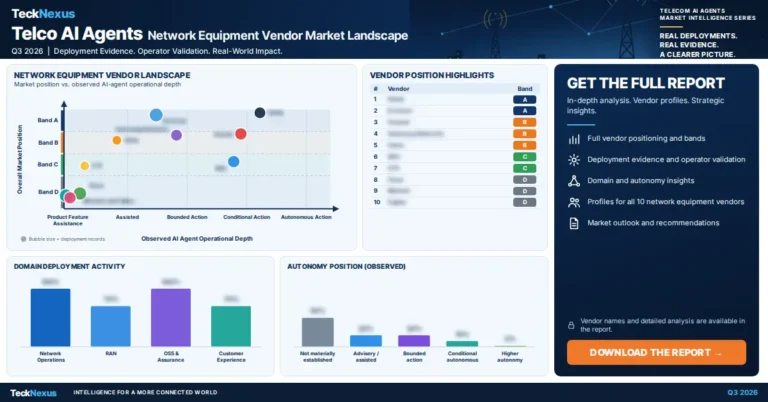
Telco AI Agent Leadership Landscape - Network Equipment Vendors
Network Equipment Vendor Report
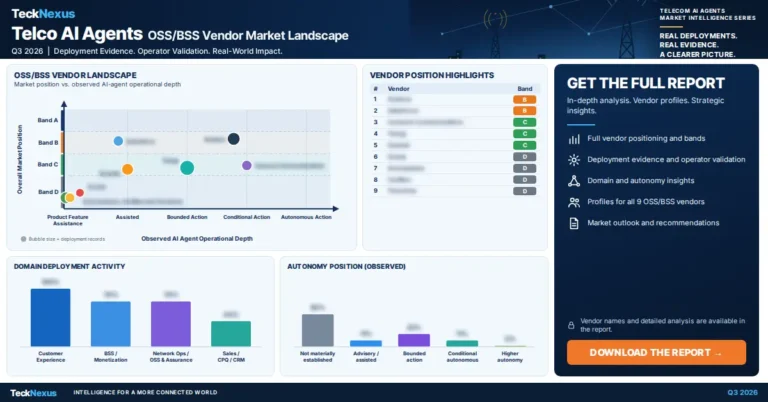
How are Amdocs, Salesforce, Comarch, Totogi, Qvantel, Oracle and other OSS/BSS vendors deploying telecom AI agents?
OSS/BSS Vendor Report
How are Amdocs, Salesforce, Comarch, Totogi, Qvantel, Oracle and other OSS/BSS vendors deploying telecom AI agents?
System Integrator Report
Scroll to Top