

Intelligence Journeys
AI Use Cases for Utilities
Private Broadband for Utilities

Europe

AI is shifting network design from throughput-first to data- and compute-aware architectures, where radios, baseband, and transport must expose telemetry for model training and inference at the edge. Consolidating 3GPP standardization, silicon design, radio development, lab verification, and New Product Introduction (NPI) in one campus shortens feedback loops between research, productization, and manufacturing. That is essential as the industry transitions through 5G-Advanced (3GPP Releases 18–19) to early 6G concepts such as joint communication and sensing, RAN compute offload, and AI-native control loops.
Telefonica is weighing a bid for Vodafone Spain from Zegona, setting up a pivotal consolidation moment in a four-player Spanish market under tight EU scrutiny. State-aligned and strategic investors appear open to a scaled Spain-centric strategy that leans into Europe while pruning Latin American exposure. Spain's market has shifted after the combination of Orange Spain and MasMvil (MasOrange), creating a heavyweight rival to Telefonica. A successful deal would reshape Spains operator landscape and signal how far EU policymakers will allow scale plays to go in mature markets. The European Commission has shown willingness to approve in-country consolidation with tough conditions.
Deutsche Telekom will roll out a free 5G+ Gaming option for eligible Magenta Mobil customers starting autumn 2025, integrating GeForce NOW for on-the-go cloud gaming with consistent responsiveness and stability. The service runs over Telekom's 5G Standalone (SA) network using network slicing and L4S, with initial device support including Samsung's Galaxy S24 Ultra and the S25 series, and more handsets to follow. GeForce NOW brings access to a catalog of 2,300+ supported titles spanning major game stores, with additional install-to-play titles being added, and day passes available (Performance and Ultimate tiers) for short-term access.
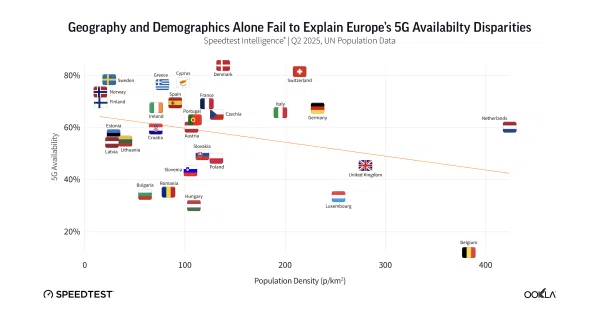
Europe’s 5G progress is accelerating but unevenly. Denmark, Sweden, and Spain lead with strong 5G availability and SA deployment, driven by early spectrum allocation and targeted policy. Meanwhile, the UK, Belgium, and Hungary trail due to regulatory delays, infrastructure bottlenecks, and weak investment. With the Digital Decade 2030 goal in sight, aligning on policy, spectrum, and subsidies will be key to closing the EU’s internal 5G divide.
Hrvatski Telekom’s NextGen 5G Airports project will deploy Private 5G Networks at Zagreb, Zadar, and Pula Airports to boost safety, efficiency, and airport automation. By combining 5G Standalone, Edge Computing, AI, and IoT, the initiative enables drones, smart cameras, and AI tablets to digitize inspections, secure perimeters, and streamline operations, redefining aviation connectivity in Croatia.
Fastweb+Vodafone has introduced the FastwebAI Suite, Italy’s first sovereign GenAI platform designed for both businesses and public institutions. Built on secure, in-country infrastructure and powered by MIIA, an Italian-trained LLM, the platform ensures regulatory compliance with EU AI laws. Early adopters include the Italian Senate, ISTAT, and top universities. With consulting via the FastwebAI Factory and upcoming modules for security and governance, this launch strengthens Vodafone’s role in Italy’s digital transformation.
Twelve major European telecom providers, including Vodafone and Deutsche Telekom, have jointly urged the EU to allocate the full upper 6GHz band (6.425–7.125 GHz) for mobile use, citing the spectrum’s critical role in future 6G deployment. With the U.S. and China already advancing in this area, operators warn that delays could jeopardize Europe’s digital leadership and hinder next-generation connectivity infrastructure.
The integration of tariffs and the EU AI Act creates a challenging environment for the advancement of AI and automation. Tariffs, by increasing the cost of essential hardware components, and the EU AI Act, by increasing compliance costs, can significantly raise the barrier to entry for new AI and automation ventures. European companies developing these technologies may face a double disadvantage: higher input costs due to tariffs and higher compliance costs due to the AI Act, making them less competitive globally. This combined pressure could discourage investment in AI and automation within the EU, hindering innovation and slowing adoption rates. The resulting slower adoption could limit the availability of crucial real-world data for training and improving AI algorithms, further impacting progress.
Nokia, Digita, and CoreGo have partnered to roll out private 5G networks and edge computing solutions at high-traffic event venues. Using Nokia's Digital Automation Cloud (DAC) and CoreGo’s payment and access tech, the trio delivers real-time data flow, reliable connectivity, and enhanced guest experience across Finland and international locations—serving over 2 million attendees to date.
AI Pulse: Telecom’s Next Frontier is a definitive guide to how AI is reshaping the telecom landscape — strategically, structurally, and commercially. Spanning over 130 pages, this MWC 2025 special edition explores AI’s growing maturity in telecom, offering a comprehensive look at the technologies and trends driving transformation.

Explore strategic AI pillars—from AI Ops and Edge AI to LLMs, AI-as-a-Service, and governance—and learn how telcos are building AI-native architectures and monetization models. Discover insights from 30+ global CxOs, unpacking shifts in leadership thinking around purpose, innovation, and competitive advantage.

The edition also examines connected industries at the intersection of Private 5G, AI, and Satellite—fueling transformation in smart manufacturing, mobility, fintech, ports, sports, and more. From fan engagement to digital finance, from smart cities to the industrial metaverse, this is the roadmap to telecom’s next era—where intelligence is the new infrastructure, and telcos become the enablers of everything connected.
In AI in Telecom: Strategic Themes, Maturity, and the Road Ahead, we explore how AI has shifted from buzzword to backbone for global telecom leaders. From AI-native networks and edge inferencing, to domain-specific LLMs and behavioral cybersecurity, this article maps out the strategic pillars, real-world use cases, and monetization models driving the AI-powered telecom era. Featuring CxO insights from Telefónica, KDDI, MTN, Telstra, and Orange, it captures the voice of a sector transforming infrastructure into intelligence.
In The Gateway to a New Future, top global telecom leaders—Marc Murtra (Telefónica), Vicki Brady (Telstra), Sunil Bharti Mittal (Airtel), Biao He (China Mobile), and Benedicte Schilbred Fasmer (Telenor)—share bold visions for reshaping the industry. From digital sovereignty and regulatory reform in Europe, to AI-powered smart cities in China and fintech platforms in Africa, these executives reveal how telecom is evolving into a driving force of global innovation, inclusion, and collaboration. The telco of tomorrow is not just a network—it’s a platform for economic and societal transformation.

Partner Hubs

Download content, access intelligence tools, and hear from executives.

Partner Events

  • M360 ASEAN
  • FutureNet Asia 2026
  • Network X Vienna 2026
Scroll to Top