Deutsche Telekom

Iridium Communications and Deutsche Telekom (DT) are collaborating to integrate Iridium NTN Direct with DT’s global IoT footprint, enabling DT customers to roam onto Iridium’s low Earth orbit (LEO) network for narrowband IoT. The service targets 3GPP-compliant 5G NTN for NB-IoT, bringing satellite reach to sensors, machines, and vehicles. Commercial launch is slated for 2026, pending integration, testing, and a roaming agreement. DT is among the first major mobile operators to pursue a standards-based NTN IoT integration, aligning with its broad NB-IoT/LTE-M roaming strategy. The pairing aims to offer seamless terrestrial-satellite service without proprietary devices or walled gardens.
Deutsche Telekom is formalizing a sovereignty-first cloud strategy with the launch of T Cloud and new leadership roles that aim to reduce European dependence on non-EU technology stacks. At Digital X in Cologne, Deutsche Telekom’s enterprise arm T-Systems introduced T Cloud, an independent, multi-cloud offering positioned around “levels of sovereignty.” For telcos, public-sector buyers, and regulated enterprises, the message is clear—data location, jurisdiction, and operational control are now first-class design choices, not afterthoughts. T Cloud is pitched as a seamless partner ecosystem spanning public and private cloud, with services tailored to workload criticality and data classifications.
Deutsche Telekom will roll out a free 5G+ Gaming option for eligible Magenta Mobil customers starting autumn 2025, integrating GeForce NOW for on-the-go cloud gaming with consistent responsiveness and stability. The service runs over Telekom's 5G Standalone (SA) network using network slicing and L4S, with initial device support including Samsung's Galaxy S24 Ultra and the S25 series, and more handsets to follow. GeForce NOW brings access to a catalog of 2,300+ supported titles spanning major game stores, with additional install-to-play titles being added, and day passes available (Performance and Ultimate tiers) for short-term access.
Deutsche Telekom is using hardware, pricing, and partnerships to make AI a mainstream feature set across mass-market smartphones and tablets. Deutsche Telekom introduced the T Phone 3 and T Tablet 2, branded as the AI-phone and AI-tablet, with Perplexity as the embedded assistant and a dedicated magenta button for instant access. In Germany, the AI-phone starts at 149 and the AI-tablet at 199, or one euro each when bundled with a tariff, positioning AI features at entry-level price points and shifting value to services and connectivity. The bundle includes an 18-month Perplexity Pro subscription in addition to the embedded assistant, plus three months of Picsart Pro with monthly credits, which lowers the barrier to adopting AI-powered creation and search.
Deutsche Telekom, Orange, and the Linux Foundation outline their 2025 cloud-native telecom roadmap, highlighting Kubernetes-native workloads, AI integration, observability, and zero-trust security models. Learn how open-source tooling, GitOps automation, and cultural transformation are reshaping next-gen telco operations.
Twelve major European telecom providers, including Vodafone and Deutsche Telekom, have jointly urged the EU to allocate the full upper 6GHz band (6.425–7.125 GHz) for mobile use, citing the spectrum’s critical role in future 6G deployment. With the U.S. and China already advancing in this area, operators warn that delays could jeopardize Europe’s digital leadership and hinder next-generation connectivity infrastructure.
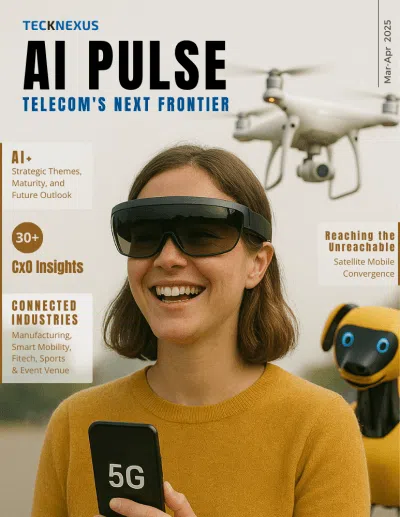
AI Pulse: Telecom’s Next Frontier is a definitive guide to how AI is reshaping the telecom landscape — strategically, structurally, and commercially. Spanning over 130 pages, this MWC 2025 special edition explores AI’s growing maturity in telecom, offering a comprehensive look at the technologies and trends driving transformation.

Explore strategic AI pillars—from AI Ops and Edge AI to LLMs, AI-as-a-Service, and governance—and learn how telcos are building AI-native architectures and monetization models. Discover insights from 30+ global CxOs, unpacking shifts in leadership thinking around purpose, innovation, and competitive advantage.

The edition also examines connected industries at the intersection of Private 5G, AI, and Satellite—fueling transformation in smart manufacturing, mobility, fintech, ports, sports, and more. From fan engagement to digital finance, from smart cities to the industrial metaverse, this is the roadmap to telecom’s next era—where intelligence is the new infrastructure, and telcos become the enablers of everything connected.
In Driving Europe’s Digital Future, telecom leaders Margherita Della Valle (Vodafone), Christel Heydemann (Orange), and Tim Höttges (Deutsche Telekom) deliver a unified message: Europe must reform telecom regulation, invest in AI and infrastructure, and scale operations to remain globally competitive. From lagging 5G rollout to emerging AI-at-the-edge opportunities, they urge policymakers to embrace consolidation, cut red tape, and drive fair investment frameworks. Europe’s path to digital sovereignty hinges on bold leadership, collaborative policy, and future-ready infrastructure.
At MWC Barcelona 2025, the O-RAN ALLIANCE showcased significant progress in AI-driven Radio Access Network (RAN) technologies and strategies for 6G standardization. Their approach focuses on interoperability, enhanced security measures, and fostering global collaboration for future mobile networks.
As Europe accelerates its digital transformation, industry leaders from Vodafone, Orange, Deutsche Telekom, and Telefónica will explore strategies to enhance 5G and fiber networks, AI-driven innovation, and regulatory coherence. With growing global competition, Europe must balance connectivity expansion, fair competition, and sustainability to remain a leader in the digital economy. Join MWC 2025 to discover how Europe’s telecom vision is shaping the future.
The GSMA Foundry has launched Open-Telco LLM Benchmarks, an open-source AI evaluation framework designed to enhance telecom-specific large language models (LLMs). Supported by Hugging Face, The Linux Foundation, Deutsche Telekom, SK Telecom, and more, this initiative aims to improve AI efficiency, security, and compliance in 5G and 6G networks. Learn how this industry-wide benchmark is shaping the future of telecom AI innovation.
The telecom industry is rapidly evolving through the adoption of AI and a culture of continuous innovation. High-performing companies are leveraging technologies like 5G, AI-driven automation, and network slicing to improve efficiency and reduce costs. A recent Upwork Research Institute study reveals that companies focusing on workforce upskilling and aligning technology with business goals are better positioned for long-term success in a competitive market. These strategies are transforming telecom operations, making them more agile, cost-effective, and prepared for future challenges.

Your Brand. Our Intelligence Tools.

Capture leads at the point of evaluation. Talk to Us →

Sponsored by Palo Alto Networks
⚡ Utilities ⏱ 8 min ✓ Free
This tool is built and hosted by TeckNexus.
Launch Tool →
Whitepaper
This whitepaper explains how utilities can use secure AI-enabled private mobile networks to modernize operations, support distributed intelligence, improve resilience, and strengthen cybersecurity across critical infrastructure. It covers AI applications, private network advantages, zero trust principles, multilayered security architecture, and governance considerations for AI-ready utility environments....
Whitepaper
Non-terrestrial networks are rapidly evolving from experimental satellite systems into an increasingly important part of the global 5G connectivity landscape. This eBook, developed by Radisys in collaboration with TeckNexus, explores how 3GPP standardization, satellite architecture innovation, and software-driven network design are reshaping NTN deployment models. It examines the transition from...
Whitepaper
Private cellular networks are transforming industrial operations, but securing private 5G, LTE, and CBRS infrastructure requires more than legacy IT/OT tools. This whitepaper by TeckNexus and sponsored by OneLayer outlines a 4-pillar framework to protect critical systems, offering clear guidance for evaluating security vendors, deploying zero trust, and integrating IT,...

It seems we can't find what you're looking for.

Scroll to Top

Map your security gaps to real threat scenarios – including Salt Typhoon, Volt Typhoon, AI data poisoning, rogue devices, and unencrypted OT traffic.

Take the free 8-minute assessment built for utility operators evaluating AI-enabled private mobile networks. Get a readiness score across five critical domains, see where your gaps are, and receive a prioritized action plan for what to fix first.

Free • 8 minutes • Built for private network security