AI Agent Competitive
Intelligence
Intelligence Journeys
AI Use Cases for Utilities
Private Broadband for Utilities

Airtel

Indian telecom companies, including Bharti Airtel, Reliance Jio, and Vodafone Idea, are struggling to raise tariffs amid the 5G rollout, with average revenue per user (ARPU) increasing only 1-3% sequentially in the December quarter. Significant capital expenditures and a competitive landscape contribute to the delay in tariff hikes, which impacts investors' concerns. Revenue growth is expected to moderate, while limited 5G use-cases and monetization opportunities also hinder ARPU growth.
The adoption of 5G services in India's subscriber base is expected to boost data consumption as they upgrade to higher data packages to access faster speeds. This increase in data usage is anticipated to result in higher average revenue per user (ARPU) and better return metrics for telecommunication companies (telcos).
The GSMA announced a new industry-wide initiative called GSMA Open Gateway, a framework of universal network Application Programmable Interfaces (APIs), designed to provide universal access to operator networks for developers. Launched with the support of 21 mobile network operators, the move is aimed at changing the way the telecoms industry designs and delivers services in an API economy world.
To unlock a world of possibilities, including new business models and jobs for the future, 100 labs will be established in India's engineering institutions to create applications using 5G services.
BSNL has joined forces with IT product development and solution provider Echelon Edge to deliver Private 5G Networks for its customers. This strategic agreement permits the Gurgaon-based company to offer private LTE and 5G services on the BSNL spectrum designated solely for captive networks.
Bharti Airtel and Apollo Hospitals claimed that they have successfully conducted a 5G-driven Artificial Intelligence (AI) aided Colonoscopy trial in India. This trial was able to detect colon cancer more rapidly and precisely. HealthNet Global, AWS, and Avesha also collaborated to make this trial successful.
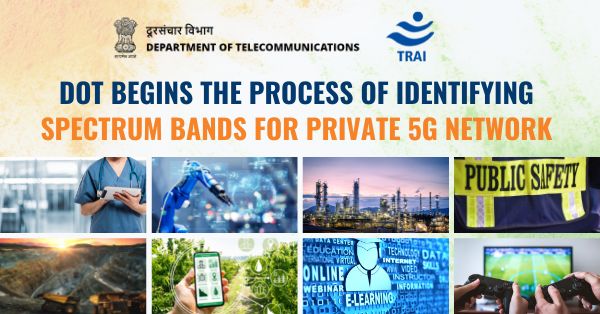
DoT has started a procedure to identify the 5G spectrum bands, especially those with less commercial prospects for mobile operators for captive private networks. In its recommendations for the 5G auction, Trai suggested that at least 40 MHz blocks can be carved out in the 3700-3800 MHz and 4800-4990 MHz bands for captive private networks. It was also of the view that at least 400 MHz be earmarked in the 28.5-29.5 GHz band for private networks as well as satellite earth stations.
Indian mobile phone operators are expected to at least double their investments in network security, with the 5G rollout expected to spark a surge in network vulnerabilities, which assume critical importance, especially for enterprises
Out of India's three biggest telecom companies, only two offer 5G services to their customers. These are Jio and Airtel. While Jios'True 5G network is a standalone (SA), Airtel uses a non-standalone (NSA) that leverages the current 4G infrastructure.
The Indian government believes that locally designed and developed 5G gear, including core and radio network components, could be commercially available by March 2023.
Department of Telecommunications (DoT) and the Ministry of Electronics and Information Technology (MeitY) representatives met with mobile operators and smartphone manufacturers and gave them a deadline of three months to switch over to 5G services with 5G smartphones.

Partner Hubs

Download content, access intelligence tools, and hear from executives.

Partner Events

  • FutureNet Asia 2026
  • Network X Vienna 2026
Scroll to Top