IoT

The Internet of Things connects sensors, machines, and devices to networks so they can report data and be controlled remotely, underpinning applications from smart metering and asset tracking to industrial automation. Cellular IoT spans technologies from low-power NB-IoT and LTE-M to higher-bandwidth 5G, with new reduced-capability (RedCap) devices filling the gap between them. As deployments scale, the focus has shifted from connectivity alone to managing fleets of devices, securing them, and turning their data into value. For operators, IoT is a connectivity-plus-platform opportunity; for enterprises, it’s the foundation of connected operations. This channel covers IoT across cellular technologies, platforms, and industry verticals — including device classes, security, and data — with analysis of where connected-device deployments deliver measurable outcomes rather than stalling at the pilot stage.

Skyfora and LMT demonstrated a real-time, kilometer-scale GNSS meteorology grid running on LMT’s 5G network at NATO’s Digital Backbone Experimentation (DiBaX), signaling a new class of “network-as-a-sensor” capability for Europe. At DiBaX in Latvia, LMT’s 5G sites equipped with Skyfora’s Weather Engine streamed continuous atmospheric measurements derived from small, measurable delays in GNSS signals as they traverse humid air. The result was a rapid-update observation grid delivering near real-time insights into the evolution of storms, extreme rainfall, flood risk, and heat stress across large areas, without deploying new physical weather stations.
Ericsson’s latest Mobility Report points to a clear shift: operators are turning 5G capabilities into differentiated, SLA-backed services rather than just selling more data at higher speeds. After years of building coverage and capacity, 5G networks are mature enough to commercialize features like guaranteed latency, uplink boosts, and application-aware prioritization. The catalysts are in place: more 5G Standalone (SA) cores, rising traffic from video creation and immersive apps, and enterprise demand for predictable performance across sites and clouds. The net result is momentum behind premium, differentiated connectivity that can be priced, assured, and exposed to partners.
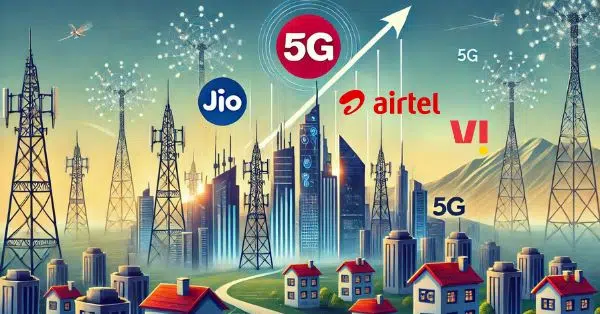
India’s 5G market has entered a scale phase, with momentum pointing to more than a billion subscribers and deeper network modernization over the next six years. Ericsson’s latest Mobility Report projects over 1 billion 5G subscriptions in India by end-2031, representing about 79% of the country’s mobile base. Average mobile data usage per active smartphone in India stands near 36 GB per month and is forecast to approach 65 GB per month by 2031. Two demand-side levers stand out: affordable 5G devices and expanding Fixed Wireless Access (FWA), accelerating mainstream adoption and opening a credible substitute to wired broadband in underserved areas.
Airbus Defence and Space has introduced Agnet Direct, a multi-mode extension to its 3GPP-based Agnet portfolio that keeps teams connected when commercial or private 4G/5G coverage is compromised. Agnet Direct has been validated within France’s Réseau Radio du Futur (RRF), the nationwide secure broadband network for domestic security and emergency services. The solution combines a smartphone running the Agnet application with a smart remote speaker microphone (RSM) to deliver resilient communications across four operational modes. Agnet integrates with existing TETRA and Tetrapol estates, enabling hybrid operations where radio users and smartphone users communicate across shared talkgroups.
Orange is moving to commercialize direct-to-device satellite connectivity in Europe with a carrier-branded SMS service that extends coverage beyond terrestrial reach. Orange will launch “Message Satellite,” an SMS and location-sharing service that lets smartphones connect directly to satellites when mobile or Wi‑Fi coverage is unavailable. The consumer launch in mainland France is slated for 11 December 2025, with professional and enterprise availability following in 2026. At launch, the service will be offered to Orange 5G and 5G+ customers using Google Pixel 9 or Pixel 10 devices, with additional handsets expected over time. Pricing is set at €5 per month after a six‑month free introductory period.
S&P Global Ratings has upgraded Bharti Airtel on the back of stronger earnings quality, healthier free cash flow, and a clearer deleveraging path, signaling a maturing Indian mobile market. The action reflects rising confidence that India’s tariff repair is sticking after mid-2024 hikes, with average revenue per user moving up and a larger share of premium 4G/5G subscribers. Airtel’s fiscal Q2 (India) showed operating momentum and cash discipline—key ingredients behind the rating move. Tariff increases and a richer subscriber mix pushed ARPU above the psychologically important INR 200 threshold, aided by postpaid gains, 4G/5G migration, and bundled content.
5G standalone networks change the service model. Operators can carve the network into slices with distinct latency, reliability, and throughput characteristics validated by 3GPP standards. That enables ultra-reliable low-latency communications for factory automation, connected vehicles, remote operations, and mission-critical services. It also enables differentiated quality for cloud gaming, broadcast-like video, and IoT control loops when combined with edge computing and time-sensitive networking. Jio’s position is that treating all traffic identically under a single “internet access” umbrella can inhibit these new uses. A ruleset that preserves open internet principles for consumers yet explicitly allows specialized services with assured QoS for enterprises is what the company seeks.
Amazon has moved its low Earth orbit broadband effort out of code-name mode and into a market-facing brand with strategic implications for telecom and enterprise buyers. Project Kuiper is now Amazon Leo, a direct reference to the low Earth orbit constellation underpinning the service. The rebrand signals a transition from R&D to commercial execution. Amazon reports more than 150 satellites in orbit today—roughly 153 by recent counts—following a string of successful launches and a completed prototype mission. The company says it will light up service as it adds coverage and capacity.
Private cellular networks are transforming industrial operations, but securing private 5G, LTE, and CBRS infrastructure requires more than legacy IT/OT tools. This whitepaper by TeckNexus and sponsored by OneLayer outlines a 4-pillar framework to protect critical systems, offering clear guidance for evaluating security vendors, deploying zero trust, and integrating IT, OT, and IoT under a unified, secure-by-design architecture.
A new neutral host 5G deployment at 10 World Trade in Boston’s Seaport sets a practical blueprint for scalable, multi-operator indoor connectivity in Class A commercial real estate. Most mobile traffic is generated indoors, yet macro networks struggle to penetrate dense, energy-efficient buildings. The 10 World Trade deployment—delivered by Boston Global Investors (BGI) with Aspen Venue Partners and Ericsson - addresses all three pressures with a small-cell-based, neutral host design that multiple operators can share while also supporting private 5G and future network slicing. The model aligns with broader industry trends: 3GPP-based indoor systems, shared infrastructure economics, and spectrum agility that includes CBRS in the U.S.
Hewlett Packard Enterprise and seven partners have formed a global consortium to accelerate fault-tolerant, hybrid quantum computing that can be deployed alongside today’s high performance computing and semiconductor ecosystems. Dr. Masoud Mohseni of HPE Labs serves as quantum system architect, coordinating a full-stack effort to design a practically useful, cost-effective “quantum supercomputer,” with the near-term emphasis on hybrid integration, error-correction maturity, and manufacturability. The Alliance is structuring work around the most stubborn barriers to scale: error correction, orchestration with classical systems, and semiconductor-grade design and manufacturing. Aligning supercomputing and semiconductor leaders around a single roadmap increases the odds of reaching fault tolerance on economically viable timelines.

Frequently Asked Questions

What’s the difference between regular IoT and ‘massive IoT’?
Regular IoT typically refers to a moderate number of connected devices with meaningful data needs, like security cameras streaming video, smart home hubs, or connected vehicles transmitting diagnostic and location data continuously. Massive IoT refers to a fundamentally different scale: enormous numbers, potentially millions, of simple, low-power, low-data sensors, like utility meters, environmental monitors, or asset trackers, that each transmit only small amounts of data infrequently but need to remain connected reliably and cheaply across very large device populations. The distinction matters because massive IoT requires network technology specifically optimized for extremely low power consumption and the ability to support enormous device density per cell, priorities that differ from the higher bandwidth and lower latency priorities of more data-intensive regular IoT applications.
Why does 5G matter for IoT specifically?
5G matters for IoT in several specific ways beyond simply being a faster network. It’s designed to support a far greater density of connected devices per square kilometer than 4G, which matters enormously for massive IoT deployments involving huge numbers of sensors in a concentrated area. It also offers specialized operating modes tailored to different IoT needs: extremely low-power modes for simple sensors that need to run for years on a single battery, and ultra-reliable, low-latency modes for mission-critical applications like industrial robotics or autonomous systems where a delayed connection could cause real operational problems. This flexibility, supporting both massive numbers of simple devices and demanding, latency-sensitive applications on the same network, is a meaningful architectural advance over earlier cellular generations.
What are the biggest barriers to wider IoT adoption?
Several recurring barriers continue to limit how quickly IoT adoption scales. Device and connectivity costs, while falling steadily, still need to make economic sense across potentially millions of deployed units for many proposed use cases, and even small per-device costs add up quickly at that scale. Security concerns are significant, since managing the security of huge numbers of distributed, often physically unattended endpoints is meaningfully harder than securing a smaller number of centrally managed devices. Fragmented standards across different IoT use cases can complicate interoperability between devices and platforms from different manufacturers. Integrating the resulting flood of IoT data into existing business systems and deriving useful insight from it remains a genuine organizational challenge even after connectivity itself is solved.
How do cellular IoT connections compare to alternatives like Wi-Fi or LoRaWAN?
Cellular IoT, using carrier networks like 4G, 5G, NB-IoT, or LTE-M, offers wide-area mobility and carrier-grade reliability without requiring an organization to build its own local wireless infrastructure, making it well suited for devices that move across large areas or are deployed in remote locations without existing local coverage. Wi-Fi can be cheaper for localized deployments within a single building where infrastructure already exists, but doesn’t provide the same wide-area mobility without significant additional infrastructure. LoRaWAN and similar low-power wide-area technologies offer very long battery life and decent range at low cost, attractive for simple, infrequent-data sensors, but typically can’t support the data rates or mobility that cellular IoT can, and often require organizations to deploy their own gateway infrastructure.
What industries are the biggest users of IoT technology today?
Manufacturing has been one of the most active adopters of industrial IoT, using sensors throughout production lines for predictive maintenance, quality control, and real-time process monitoring. Logistics and supply chain companies rely heavily on IoT for asset tracking, monitoring shipment location and condition, like temperature for perishable goods, throughout transit. Agriculture uses IoT sensors to monitor soil conditions, irrigation needs, and livestock health across large rural areas where cellular IoT’s wide coverage is particularly valuable. Utilities use IoT extensively for smart metering and grid monitoring. Healthcare is an increasingly significant adopter too, using connected medical devices and wearables for remote patient monitoring, an application where reliability and security carry particularly high stakes.
How is AI changing what IoT devices and networks can do?
AI is increasingly applied directly to the enormous volumes of data IoT devices generate, since manually analyzing data from potentially millions of sensors isn’t practically possible without automated analysis. AI models are used to detect anomalies in sensor data that might indicate equipment about to fail, to optimize complex systems like energy grids or supply chains based on real-time data from many distributed sensors, and increasingly, to run directly on IoT devices themselves through on-device or edge AI, allowing analysis and decision-making to happen locally rather than requiring every piece of raw data to be transmitted back to a central system. This local processing is particularly valuable where bandwidth is limited or sending all raw data back centrally would be impractical given the volume involved.
What is ‘NB-IoT’ and ‘LTE-M,’ and how do they differ from regular cellular connections?
NB-IoT, short for Narrowband IoT, and LTE-M, short for LTE Machine-Type Communication, are specialized cellular technologies designed specifically for IoT use cases rather than general smartphone-style connectivity. They prioritize extremely low power consumption, allowing devices to run for years on a single battery, and excellent coverage, including reaching devices in challenging locations like deep indoors or underground, over the higher data speeds standard cellular connections prioritize. The two differ in their tradeoffs: NB-IoT generally supports even lower power consumption and better extreme-condition coverage, suited for simple, infrequent-data sensors, while LTE-M supports somewhat higher data rates and mobility, making it better suited for applications like asset tracking that need to maintain a connection while moving.
What security risks are specific to IoT devices, and why are they considered higher risk?
IoT devices are often considered higher security risk for several specific reasons. Many are deployed in huge numbers across physically unattended or hard-to-access locations, making it impractical to manually monitor or service the security of each individual unit. Cost pressures in massive IoT deployments can lead manufacturers to cut corners on security to keep per-unit costs low, sometimes resulting in weak default passwords, infrequent software updates, or limited encryption. Because IoT devices are often deployed for many years without replacement, vulnerabilities discovered after deployment can remain unpatched for extended periods if devices lack reliable update mechanisms. The sheer scale of many deployments also means a single vulnerability could potentially compromise an unusually large number of devices simultaneously.


Your Brand. Our Intelligence Tools.

Capture leads at the point of evaluation. Talk to Us →

Sponsored by Palo Alto Networks
⚡ Utilities ⏱ 8 min ✓ Free
This tool is built and hosted by TeckNexus.
Launch Tool →
Whitepaper
This whitepaper explains how utilities can use secure AI-enabled private mobile networks to modernize operations, support distributed intelligence, improve resilience, and strengthen cybersecurity across critical infrastructure. It covers AI applications, private network advantages, zero trust principles, multilayered security architecture, and governance considerations for AI-ready utility environments....
Whitepaper
Non-terrestrial networks are rapidly evolving from experimental satellite systems into an increasingly important part of the global 5G connectivity landscape. This eBook, developed by Radisys in collaboration with TeckNexus, explores how 3GPP standardization, satellite architecture innovation, and software-driven network design are reshaping NTN deployment models. It examines the transition from...
Whitepaper
Private cellular networks are transforming industrial operations, but securing private 5G, LTE, and CBRS infrastructure requires more than legacy IT/OT tools. This whitepaper by TeckNexus and sponsored by OneLayer outlines a 4-pillar framework to protect critical systems, offering clear guidance for evaluating security vendors, deploying zero trust, and integrating IT,...
Scroll to Top