AR

Augmented reality overlays digital content onto the physical world through glasses, headsets, or mobile devices, and depends heavily on connectivity for low-latency, high-bandwidth experiences. In telecom and enterprise contexts, AR is moving past consumer novelty toward practical industrial uses — remote assistance, maintenance guidance, training, and field operations — where it intersects directly with private networks, edge computing, and 5G. The technology’s network demands make it a recurring test case for low-latency connectivity and edge processing, and a driver of interest in standalone 5G and on-premises deployments. For operators and enterprises, the question is which AR use cases justify their connectivity and infrastructure requirements. This channel covers augmented reality where it meets networks: enterprise and industrial deployments, device developments, and the connectivity and edge requirements that make immersive experiences viable at scale.

Merseburg University of Applied Sciences, in collaboration with Deutsche Telekom, has introduced the region's first 5G campus network. This high-performance, low-latency network supports advanced research in areas like autonomous driving, logistics, and AR. With exclusive access to industrial frequencies and 5G technology, the university is at the forefront of digital innovation in Saxony-Anhalt, driving regional transformation and fostering academic-industry collaboration.
Nokia and Rockwell Automation have partnered to enable private 5G standalone networks, driving industrial transformation through enhanced connectivity, real-time data, and automation. By leveraging CBRS spectrum, industries can now access secure, high-speed 5G solutions that improve operational efficiency and support cutting-edge technologies like AI, IIoT, and AR.
In the latest edition of TeckNexus Magazine, explore how Generative AI is transforming the telecom industry. Dive into Jio’s JioBrain platform, the Supermicro-Nvidia partnership for scaling AI infrastructure, and Generative AI use cases for operators with insights from RADCOM. In an exclusive interview, Hardik Jain of GXC discusses integrating Generative AI with private 5G networks. Plus, gain insights from Eugina Jordan on Generative AI for business, Fiducia’s 5G and AI-driven stadium innovations, and strategies from 12 global operators on harnessing Generative AI for growth.
Discover the future of stadium experiences with 5G and AI-powered digital mascots. From real-time interactions to personalized content, these innovative technologies are revolutionizing fan engagement in sports venues, creating immersive, multi-dimensional events that deepen brand connections and enhance the live event atmosphere.
PETRONAS, in partnership with Telekom Malaysia, has launched a Private 5G network at its Bintulu LNG Complex in Sarawak. This deployment aims to enhance operational efficiency and safety by integrating advanced technologies such as industrial IoT, AI, and robotics. The initiative is part of PETRONAS' broader strategy to modernize its operations and lead the digital transformation in the energy sector. The successful launch has received strong government support and sets a new standard for energy companies globally, as they increasingly adopt digital solutions to meet industry demands.
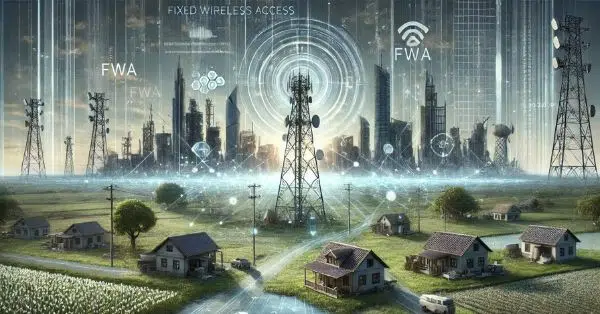
Fixed Wireless Access (FWA) is transforming the telecommunications landscape by offering cost-effective, high-speed internet solutions. Mobile Network Operators (MNOs) are leveraging FWA to extend broadband reach, especially in rural and underserved areas. This article examines the rise of FWA, the challenges MNOs face in its implementation, and future prospects.
Vodafone's Generative AI strategy is transforming customer experiences and operational efficiency. Key highlights include:

SuperTOBi - Virtual Assistant: Vodafone's SuperTOBi, powered by Microsoft Azure OpenAI, enhances customer service by providing faster, accurate responses and supporting multiple languages. It significantly improves customer satisfaction rates.

Hotel Experience Transformation: Vodafone's virtual assistant, unveiled at FiturTechY, serves as a virtual receptionist, improving guest interactions and operational efficiency in hotels. Additionally, REM Data helps manage high-traffic areas and TechYRoom streamlines hotel maintenance tasks with voice-controlled automation.

VOXI AI Chatbot: VOXI's chatbot, developed with Accenture, offers human-like interactions and personalized support, significantly enhancing the customer service experience with faster resolutions and higher accuracy.

Microsoft Partnership: Vodafone's 10-year strategic partnership with Microsoft focuses on delivering hyper-personalized customer experiences, scaling IoT and digital services, and modernizing data centers, driving digital transformation and sustainability.

AI-Onboard in Automotive: Vodafone and Infinite Reality introduce AI-Onboard, merging Generative AI with AR and VR for an immersive automotive retail experience. This platform supports innovative payment systems and enhances customer engagement.

Vodafone's innovative use of Generative AI demonstrates its leadership in customer service, digital transformation, and operational efficiency.
Ericsson's smart factory based in Texas, US builts 5G and advanced antenna systems radios. The smart factory is 25% more energy-efficient, produces 17% of required power on-site via solar panels, uses 40,000-gallon tanks to collect & reuse rainwater, and reduces shipping distance up to 5 times.
Explore the major announcements from Google I/O 2024, featuring AI-driven advancements, new Android security features, Google Maps AR, Wear OS 5 improvements, and the latest on Google Play and Tensor Processing Units. Learn about Google's new AI models for learning, enhanced search filters, and innovative tools for developers.
In a rapidly evolving business landscape, enterprises across different sectors are increasingly turning to customized connectivity solutions to address unique challenges. This article delves into how tailored IT strategies are essential in driving business performance amidst cybersecurity risks and sector-specific regulations.
What did Insight Research conclude during its coverage of AI in the RAN in its report "AI and RAN - How fast will they run?
1. AI intersects the RAN at numerous angles - the principal end-applications for AI in RAN are traffic optimization, caching, coding and energy management.
2. The impact of AI on these applications is on technical, commercial and competitive fronts.
3. There are numerous AI, ML and DL algorithms that are being used to improve the above end-applications.
4. Thanks to the penchant of AI in dealing with complexity, each of these end-applications will enjoy high CAGRs.
5. AI has democratized the RAN vendor landscape

Frequently Asked Questions

What’s the difference between AR and VR, and where does ‘mixed reality’ fit in?
Augmented Reality overlays digital content onto a person’s existing view of the real world, like navigation arrows appearing through a phone camera, while Virtual Reality replaces a person’s entire field of view with a fully simulated digital environment, typically through a headset that blocks out physical surroundings. Mixed Reality sits conceptually between the two, generally referring to experiences where digital objects don’t just sit on top of the real world but actually interact with it, responding to physical surfaces, objects, and lighting in ways that make them feel genuinely present in the room. In practice, the terms are sometimes used loosely, but whether the real world remains visible and primary, or is replaced entirely, is the most reliable way to tell them apart.
Why does AR specifically need fast, low-latency networks to work well?
AR applications work by continuously analyzing a live camera feed and rendering digital content that appears to exist within that real-world view, often updating dozens of times per second as a user moves their phone or head. Any meaningful network delay between capturing real-world data and rendering the corresponding digital overlay causes a visible, often disorienting mismatch, where a virtual object appears to lag behind or drift away from the real-world surface it’s supposed to be anchored to. This sensitivity to latency becomes more pronounced as AR experiences offload heavy processing, like advanced object recognition, to cloud or edge servers, since that offloading only works smoothly if the round-trip network delay stays low enough to feel instantaneous.
What industries are using AR seriously, beyond consumer gaming and filters?
Beyond consumer gaming and social media filters, AR has found genuinely practical traction in several enterprise contexts. Manufacturing and field service use AR to guide technicians through complex repairs, often overlaying step-by-step instructions directly onto the equipment being worked on, or connecting a technician with a remote expert who can annotate what they see in real time. Retail uses AR for virtual try-on experiences. Healthcare uses AR for surgical visualization, overlaying imaging data directly onto a patient during a procedure, and for medical training. Logistics and warehousing use AR for picking and inventory tasks, highlighting correct item locations directly in a worker’s field of view.
Do I need special hardware for AR, or does it work on a regular phone?
Basic AR functionality works on most modern smartphones and tablets, using the device’s camera, screen, and onboard processing to render overlays without any additional hardware, which is how the vast majority of consumer AR experiences are delivered today. More immersive, hands-free AR, where digital content appears directly in a person’s field of view without holding up a phone, generally requires dedicated smart glasses or AR headsets. This category remains considerably less mature than VR headsets, facing ongoing challenges around battery life, display quality, weight and comfort for all-day wear, and price, which is part of why most AR adoption to date has happened through smartphones.
How does 5G specifically improve AR experiences compared to 4G?
5G improves AR primarily through lower latency and higher, more consistent bandwidth compared to 4G, both directly addressing AR’s core technical requirements. Lower latency means digital overlays stay more accurately anchored to the real world, even as more processing work gets offloaded to cloud or edge servers rather than handled entirely on the device. Higher bandwidth supports richer, higher-resolution AR content and makes multi-user, shared AR experiences more technically feasible. 5G’s support for network slicing adds another potential benefit, allowing an AR application to request a dedicated, guaranteed-performance connection rather than competing for capacity with all other network traffic.
What’s ‘AR cloud’ or ‘edge-assisted AR,’ and why does it matter?
AR cloud and edge-assisted AR both refer to the practice of offloading some of AR’s heavy computational work, like recognizing objects in a scene or rendering complex digital content, from the user’s device to more powerful servers, either in the cloud or, increasingly, at the network edge closer to the user. This matters because lightweight AR devices, particularly smart glasses, generally don’t have the processing power or battery capacity to handle sophisticated AR experiences entirely on their own. By offloading that work to nearby edge servers, AR applications can deliver more advanced experiences on lighter, cheaper hardware, provided the network connection is fast and low-latency enough to make that round trip feel instantaneous.
What’s holding back widespread adoption of dedicated AR hardware like smart glasses?
Several practical barriers continue to slow adoption of dedicated AR hardware. Battery life remains a persistent constraint, since the combination of cameras, displays, and processing needed for compelling AR experiences draws significant power in a form factor expected to be lightweight and comfortable for extended wear. Display technology capable of producing bright, high-resolution overlays in a glasses-sized form factor is still maturing and expensive to manufacture at scale. Social acceptance is another factor, since wearing a visibly camera-equipped device in public raises privacy concerns for the people around the wearer. Price also remains a barrier for mainstream consumers.
How is AR different from the broader ‘metaverse’ concept?
AR and the broader metaverse concept are related but not synonymous. AR specifically refers to overlaying digital content onto the real world, typically through a phone, tablet, or AR glasses, while the metaverse concept describes persistent, often fully virtual or mixed-reality environments that people can inhabit and interact with, more commonly associated with VR headsets and fully simulated 3D worlds. AR can be one piece of a broader metaverse vision, letting someone see virtual objects or avatars overlaid onto their actual surroundings rather than requiring a fully immersive headset, but AR itself doesn’t require the persistent, shared, virtual-world framing that defines metaverse discussions.


Partner Hubs

Download content, access intelligence tools, and hear from executives.

Partner Events

  • M360 ASEAN
  • FutureNet Asia 2026
  • Network X Vienna 2026
Scroll to Top