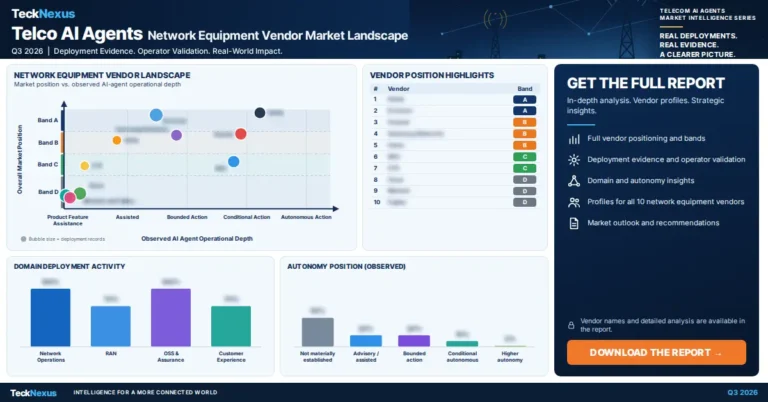
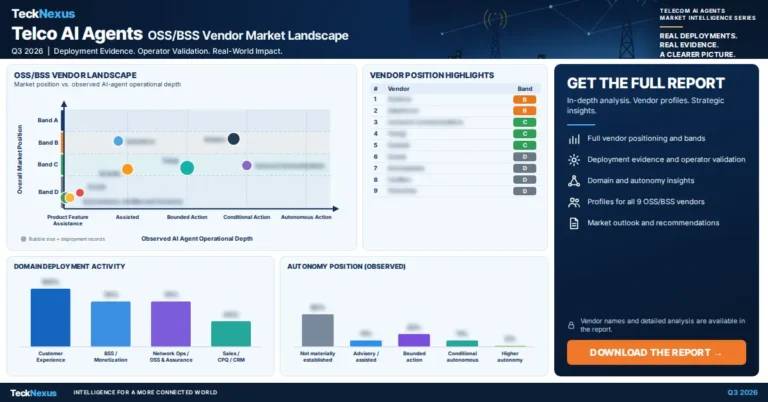
AI Agent Competitive
Intelligence
Intelligence
Private Network
Intelligence
Intelligence
Intelligence Journeys
Utilities Private Broadband Planning
AI Use Case Planning for Utilities
Intelligence Tools
By Tool Type
▼
By Industry
▼
Access Type
▼
Monthly Trackers
▼
Resources
▼
Technology Hubs
▼
Partner Hubs
▼


AR
Augmented reality overlays digital content onto the physical world through glasses, headsets, or mobile devices, and depends heavily on connectivity for low-latency, high-bandwidth experiences. In telecom and enterprise contexts, AR is moving past consumer novelty toward practical industrial uses — remote assistance, maintenance guidance, training, and field operations — where it intersects directly with private networks, edge computing, and 5G. The technology’s network demands make it a recurring test case for low-latency connectivity and edge processing, and a driver of interest in standalone 5G and on-premises deployments. For operators and enterprises, the question is which AR use cases justify their connectivity and infrastructure requirements. This channel covers augmented reality where it meets networks: enterprise and industrial deployments, device developments, and the connectivity and edge requirements that make immersive experiences viable at scale.
- Tech News & Insight
- January 4, 2025
- omnichannel commerce

Explore the evolution of industrial revolutions from Industry 4.0 to Industry 5.0. Learn how smart factories and predictive maintenance redefine manufacturing in Industry 4.0, while Industry 5.0 emphasizes human-centric collaboration and sustainable practices. Discover their key differences, benefits, and implications for the future of manufacturing.
- Tech News & Insight
- January 3, 2025
- News Feed

RoboSense, a leader in AI-driven robotics, unveiled groundbreaking innovations at its 2025 "Hello Robot" Global Online Launch Event. Key highlights include a humanoid robotic prototype and three cutting-edge digital LiDAR products, revolutionizing automotive and robotics applications. RoboSense also introduced advanced components like the Papert 2.0 dexterous hand and Robo FSD mobility solution. These innovations will debut at CES 2025, showcasing the company's vision for a smarter, safer future.
- News
- January 2, 2025
- Hema Kadia

India's telecom industry is advancing rapidly, driven by 5G expansion, AI-powered innovations, and the ambitious Bharat 6G Vision. With 460,592 5G BTS sites deployed and 125 million users already connected, the sector is set to lead global telecom innovation. However, challenges like regulatory disparities and spectrum allocation need urgent attention to sustain this growth and realize its full potential.
- Podcast
- December 26, 2024
- Hema Kadia

Private networks are transforming industries like smart cities, manufacturing, and utilities by enhancing connectivity, automation, and data utilization. NTT Data and Nokia are leading this transformation, offering advanced private 5G solutions that improve operational efficiency, security, and sustainability. Private networks enable real-time decision-making through technologies like Edge AI and digital twins while addressing deployment challenges with models like Network as a Service (NaaS). In smart cities, these networks optimize traffic management, energy monitoring, and public safety, delivering citizen-centric value. Learn how private networks drive digital transformation and operational excellence across sectors.
- Podcast
- December 26, 2024
- Hema Kadia

Ericsson’s private 5G networks revolutionize smart factory operations by enabling automation, AR/VR training, real-time quality control, and sustainable production practices. Learn how 5G’s low latency, scalability, and adaptability empower Industry 4.0 technologies and enhance human-machine collaboration for optimized manufacturing workflows.
- News
- December 20, 2024
- Hema Kadia
Verizon teams up with NVIDIA to bring AI to the edge on 5G private networks. Leveraging Mobile Edge Compute and NVIDIA AI technology, enterprises can deploy real-time AI applications securely and efficiently. Discover the benefits of this groundbreaking collaboration for industries like robotics, AR, and IoT.
- Usecase
- December 20, 2024
- Hema Kadia
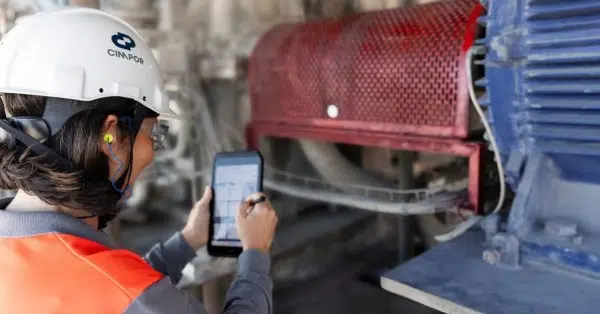
Ericsson and Vodafone Portugal pioneer 5G Standalone Private Networks at CIMPOR’s cement plant, enabling IoT, drone inspections, and smart devices for enhanced efficiency, safety, and sustainability in industrial operations.
- Article & Insights
- December 19, 2024
- Hema Kadia

Private 5G/LTE and CBRS networks are revolutionizing industries by enabling smarter cities, safer workplaces, and more efficient factories. This edition celebrates award-winning deployments and insights from industry leaders who are driving digital transformation. Explore real-world examples of how these networks optimize manufacturing operations, enhance supply chain visibility, and promote sustainable practices, making grids resilient and industries future-ready.
- Article & Insights
- November 14, 2024
- Hema Kadia

Award Category: Private Network Excellence in Innovation
Winner: Fiducia Sports AI
Fiducia Sports AI has been recognized with the TeckNexus 2024 Award for "Private Network Excellence in Innovation" for transforming fan engagement in the sports and entertainment industry. By leveraging artificial intelligence (AI), augmented reality (AR), and the power of public and private 5G networks, Fiducia's innovative platform delivers real-time player stats, immersive AR experiences, and interactive content. This seamless and personalized connection enhances fan interaction with sports events across diverse platforms, redefining the fan experience and transforming how audiences engage with sports content, regardless of their location.
- Article & Insights
- November 14, 2024
- Hema Kadia

Award Category: Private Network Excellence in Sports and Events Venue
Winner: NTT DATA
Partner: Cisco
NTT DATA, in partnership with Cisco, has transformed RAI Amsterdam into a smart, connected venue with the deployment of a private 5G network, earning the 2024 TeckNexus "Private Network Excellence in Sports and Events Venue" award. This smart venue innovation project optimizes visitor engagement, enhances operational efficiency, and supports RAI Amsterdam’s sustainability goals.
As a result, RAI Amsterdam has set a new benchmark for connected venues across Europe, delivering enriched visitor experiences, real-time analytics, and comprehensive event management capabilities.
- Tech News & Insight
- October 25, 2024
- News Feed

Levita Magnetics pioneers the world's first AR-assisted robotic surgeries, combining the Meta Quest 3 headset and 3D visualization in Santiago, Chile. This breakthrough in surgical tech enhances precision and efficiency, setting a new standard in patient outcomes and offering future potential for telesurgery and AI integration.
Frequently Asked Questions
What’s the difference between AR and VR, and where does ‘mixed reality’ fit in?
Augmented Reality overlays digital content onto a person’s existing view of the real world, like navigation arrows appearing through a phone camera, while Virtual Reality replaces a person’s entire field of view with a fully simulated digital environment, typically through a headset that blocks out physical surroundings. Mixed Reality sits conceptually between the two, generally referring to experiences where digital objects don’t just sit on top of the real world but actually interact with it, responding to physical surfaces, objects, and lighting in ways that make them feel genuinely present in the room. In practice, the terms are sometimes used loosely, but whether the real world remains visible and primary, or is replaced entirely, is the most reliable way to tell them apart.
Why does AR specifically need fast, low-latency networks to work well?
AR applications work by continuously analyzing a live camera feed and rendering digital content that appears to exist within that real-world view, often updating dozens of times per second as a user moves their phone or head. Any meaningful network delay between capturing real-world data and rendering the corresponding digital overlay causes a visible, often disorienting mismatch, where a virtual object appears to lag behind or drift away from the real-world surface it’s supposed to be anchored to. This sensitivity to latency becomes more pronounced as AR experiences offload heavy processing, like advanced object recognition, to cloud or edge servers, since that offloading only works smoothly if the round-trip network delay stays low enough to feel instantaneous.
What industries are using AR seriously, beyond consumer gaming and filters?
Beyond consumer gaming and social media filters, AR has found genuinely practical traction in several enterprise contexts. Manufacturing and field service use AR to guide technicians through complex repairs, often overlaying step-by-step instructions directly onto the equipment being worked on, or connecting a technician with a remote expert who can annotate what they see in real time. Retail uses AR for virtual try-on experiences. Healthcare uses AR for surgical visualization, overlaying imaging data directly onto a patient during a procedure, and for medical training. Logistics and warehousing use AR for picking and inventory tasks, highlighting correct item locations directly in a worker’s field of view.
Do I need special hardware for AR, or does it work on a regular phone?
Basic AR functionality works on most modern smartphones and tablets, using the device’s camera, screen, and onboard processing to render overlays without any additional hardware, which is how the vast majority of consumer AR experiences are delivered today. More immersive, hands-free AR, where digital content appears directly in a person’s field of view without holding up a phone, generally requires dedicated smart glasses or AR headsets. This category remains considerably less mature than VR headsets, facing ongoing challenges around battery life, display quality, weight and comfort for all-day wear, and price, which is part of why most AR adoption to date has happened through smartphones.
How does 5G specifically improve AR experiences compared to 4G?
5G improves AR primarily through lower latency and higher, more consistent bandwidth compared to 4G, both directly addressing AR’s core technical requirements. Lower latency means digital overlays stay more accurately anchored to the real world, even as more processing work gets offloaded to cloud or edge servers rather than handled entirely on the device. Higher bandwidth supports richer, higher-resolution AR content and makes multi-user, shared AR experiences more technically feasible. 5G’s support for network slicing adds another potential benefit, allowing an AR application to request a dedicated, guaranteed-performance connection rather than competing for capacity with all other network traffic.
What’s ‘AR cloud’ or ‘edge-assisted AR,’ and why does it matter?
AR cloud and edge-assisted AR both refer to the practice of offloading some of AR’s heavy computational work, like recognizing objects in a scene or rendering complex digital content, from the user’s device to more powerful servers, either in the cloud or, increasingly, at the network edge closer to the user. This matters because lightweight AR devices, particularly smart glasses, generally don’t have the processing power or battery capacity to handle sophisticated AR experiences entirely on their own. By offloading that work to nearby edge servers, AR applications can deliver more advanced experiences on lighter, cheaper hardware, provided the network connection is fast and low-latency enough to make that round trip feel instantaneous.
What’s holding back widespread adoption of dedicated AR hardware like smart glasses?
Several practical barriers continue to slow adoption of dedicated AR hardware. Battery life remains a persistent constraint, since the combination of cameras, displays, and processing needed for compelling AR experiences draws significant power in a form factor expected to be lightweight and comfortable for extended wear. Display technology capable of producing bright, high-resolution overlays in a glasses-sized form factor is still maturing and expensive to manufacture at scale. Social acceptance is another factor, since wearing a visibly camera-equipped device in public raises privacy concerns for the people around the wearer. Price also remains a barrier for mainstream consumers.
How is AR different from the broader ‘metaverse’ concept?
AR and the broader metaverse concept are related but not synonymous. AR specifically refers to overlaying digital content onto the real world, typically through a phone, tablet, or AR glasses, while the metaverse concept describes persistent, often fully virtual or mixed-reality environments that people can inhabit and interact with, more commonly associated with VR headsets and fully simulated 3D worlds. AR can be one piece of a broader metaverse vision, letting someone see virtual objects or avatars overlaid onto their actual surroundings rather than requiring a fully immersive headset, but AR itself doesn’t require the persistent, shared, virtual-world framing that defines metaverse discussions.




Telco AI Agent Leadership