Private Network
Intelligence
Intelligence Journeys
Utilities Private Broadband Planning
AI Use Case Planning for Utilities

5G

5G is the fifth generation of cellular technology and the current global standard, succeeding 4G LTE with faster speeds, lower latency, and the capacity to connect far more devices per cell. Standardized by 3GPP from around 2017 and launched commercially in 2019, it has become the dominant connectivity technology across most major markets. 5G spans low-, mid-, and high-band (mmWave) spectrum and two architectures — non-standalone, which runs on a 4G core, and standalone, which unlocks network slicing and the lowest latency. The standard continues to evolve through 5G-Advanced, adding AI-native management and tighter satellite integration. For enterprises and operators, the questions have shifted from coverage to monetization, private deployments, and standalone migration. This channel tracks 5G developments across vendors, operators, and enterprise verticals, with analysis and decision tools for teams evaluating real deployments.

Multiple media reports say Verizon plans to cut roughly 15,000 jobs and shift about 180–200 company-owned stores to franchise operators, marking its most significant restructuring to date. According to reports citing unnamed sources, Verizon is preparing layoffs equal to about 15% of its workforce, with some estimates suggesting cuts could reach up to 20,000 roles when store conversions are included. Verizon ended 2024 with roughly 100,000 U.S. employees after several years of incremental reductions. Leadership has signaled the need to simplify operations and reset the expense base following heavy 5G investment and a more promotional market.
Group revenue reached about €28.9 billion, up 3.3% on an organic basis, with service revenue and adjusted EBITDA AL growing despite currency pressure from a weaker U.S. dollar; adjusted EBITDA AL was roughly €11.1 billion on an organic basis, and full-year 2025 EBITDA AL guidance rose to around €45.3 billion alongside a stronger free cash flow after leases outlook near €20.1 billion. Adjusted net profit increased to approximately €2.7 billion (+14% year-on-year), while reported net profit was €2.4 billion (-18% year-on-year) due to lapping prior-year one-offs in financial activities—an accounting effect rather than a signal of operating weakness.
Amazon has moved its low Earth orbit broadband effort out of code-name mode and into a market-facing brand with strategic implications for telecom and enterprise buyers. Project Kuiper is now Amazon Leo, a direct reference to the low Earth orbit constellation underpinning the service. The rebrand signals a transition from R&D to commercial execution. Amazon reports more than 150 satellites in orbit today—roughly 153 by recent counts—following a string of successful launches and a completed prototype mission. The company says it will light up service as it adds coverage and capacity.
Invisible infrastructure is costing telecom operators more than they realize. Hidden fibers, circuits, and equipment continue using power and budget without generating revenue, all because they slip out of inventory and operational records. This article explains how these blind spots form, why they persist, and how VC4’s Service2Create helps operators regain full visibility so they can cut waste, speed up delivery, and protect revenue.
Private cellular networks are transforming industrial operations, but securing private 5G, LTE, and CBRS infrastructure requires more than legacy IT/OT tools. This whitepaper by TeckNexus and sponsored by OneLayer outlines a 4-pillar framework to protect critical systems, offering clear guidance for evaluating security vendors, deploying zero trust, and integrating IT, OT, and IoT under a unified, secure-by-design architecture.
CAF’s signalling division and Cellnex demonstrated that OPTIO, a modular and multi-bearer CBTC platform, operates reliably on a private 5G network in both lab and field conditions, including challenging scenarios such as tunnels. The system already supports Wi‑Fi and LTE; adding 5G confirms a multi-access design that lets operators choose the right bearer per line, phase, or location. Private 5G brings ultra-low latency, higher capacity, stronger QoS control, and end-to-end security under the operator’s domain. The project received European co-financing via the Recovery and Resilience Facility under Spain’s UNICO Sectorial 2023 program, underscoring public support for digital rail modernization.
AST SpaceMobile is signaling a pivotal year ahead as it moves from demonstrations to commercial direct-to-device coverage with major operators and an aggressive launch schedule. The company’s plan to begin “intermittent nationwide” service in early 2026, followed by continuous coverage later in the year, is also a forcing function for device vendors, standards work, and MNO network integration. As AST scales to 45–60 BlueBird satellites by end-2026, pass frequency and overlap increase to support “continuous” service across the U.S., Europe, Japan, and other priority markets. AST reports over $3.2 billion in cash and liquidity.
A new pilot in Spain shows that the upper 6 GHz band can deliver 5G-class coverage with far higher capacity, positioning it as a prime spectrum option for 5G-Advanced and 6G. The 6.425–7.125 GHz range (3GPP Band n104) is the last sizable mid-band window that is not tied to legacy mobile use in Europe. The trial found that with higher-order massive MIMO and active antennas, the upper 6 GHz layer can match the practical coverage of 3.5 GHz from existing macro sites. European regulatory clarity, device support and refined coexistence rules are the next critical catalysts for scale.
A new neutral host 5G deployment at 10 World Trade in Boston’s Seaport sets a practical blueprint for scalable, multi-operator indoor connectivity in Class A commercial real estate. Most mobile traffic is generated indoors, yet macro networks struggle to penetrate dense, energy-efficient buildings. The 10 World Trade deployment—delivered by Boston Global Investors (BGI) with Aspen Venue Partners and Ericsson - addresses all three pressures with a small-cell-based, neutral host design that multiple operators can share while also supporting private 5G and future network slicing. The model aligns with broader industry trends: 3GPP-based indoor systems, shared infrastructure economics, and spectrum agility that includes CBRS in the U.S.
SoftBank has exited Nvidia and is redirecting billions into AI platforms and infrastructure, signaling where it believes the next phase of value will concentrate. SoftBank sold its remaining 32.1 million Nvidia shares in October for approximately $5.83 billion, and also disclosed a separate $9.17 billion sale of T-Mobile US shares as part of a broader reallocation into artificial intelligence. The proceeds are earmarked for a significant expansion of SoftBank’s AI portfolio, including a major investment in OpenAI and potential participation in “Stargate,” a next-generation AI data center initiative co-developed by OpenAI and Oracle. Despite exiting Nvidia’s equity, SoftBank retains about 90% ownership of Arm.
Reliance Jio’s six-plan lineup for November 2025 blends low entry pricing with AI, cloud, and OTT hooks, signaling how prepaid is evolving from pure connectivity to service-led bundles. Starting at Rs 189, Jio is segmenting prepaid users by usage intensity (voice-first, balanced data, and long-validity) while nudging them into its digital stack: JioTV for content, JioAICloud for storage, and on select offers, Google Gemini Pro for AI. As 5G coverage and usage expand, Jio’s add-ons are designed to create reasons to stay on-network and upgrade. AI benefits in prepaid are rare globally; anchoring them to eligibility criteria and higher-tier 5G plans suggests an upsell path that can improve monetization without headline tariff hikes.
Nokia will remain TNN’s sole 5G RAN and managed services supplier for four more years, underpinning Denmark’s next phase of high-performance, energy-efficient, and increasingly autonomous mobile networks. The renewed agreement modernizes TNN’s nationwide 5G footprint with Nokia’s AirScale Radio Access Network portfolio and AI-driven MantaRay solutions to improve speed, capacity, and customer experience for more than three million users. Deployment highlights include Habrok Massive MIMO radios for mid-band capacity, Pandion multi-band remote radio heads for broad coverage, and AI-ready AirScale basebands (Ponente, Lodos, Levante) powered by ReefShark system-on-chip silicon to scale throughput while reducing power consumption.

Frequently Asked Questions

What actually makes 5G different from 4G LTE?
5G introduces three core technical improvements over 4G LTE: significantly higher peak data speeds, in some cases multiple gigabits per second under ideal conditions compared to 4G’s typical tens to low hundreds of megabits per second; substantially lower latency, the delay between sending and receiving data, which matters for applications like gaming, video calls, and industrial automation where responsiveness is critical; and far greater device density support, allowing a single cell site to maintain reliable connections with a much larger number of simultaneous devices, which matters increasingly as IoT sensors and connected devices proliferate. These improvements come from a combination of new radio technology, additional spectrum bands made available for 5G use, and a redesigned network architecture that’s considerably more flexible and software-driven than 4G’s architecture was.
What’s the difference between low-band, mid-band, and high-band (mmWave) 5G?
Low-band 5G uses similar frequencies to 4G LTE, offering wide coverage area and good building penetration but speeds not dramatically faster than good 4G performance, making it most useful for extending broad geographic coverage rather than delivering 5G’s headline speed improvements. Mid-band 5G offers a more balanced tradeoff between coverage and speed, generally delivering meaningfully faster performance than 4G across a reasonably wide area, and has become the most common band used for mainstream 5G deployment in most markets globally. High-band 5G, often called mmWave, delivers by far the fastest possible speeds, but its very short range and poor ability to penetrate walls means it’s typically deployed only in dense, high-traffic urban areas like stadiums, rather than for broad area coverage.
What’s the difference between 5G NSA (non-standalone) and 5G SA (standalone)?
5G non-standalone, or NSA, runs 5G radio technology on top of an existing 4G core network, meaning certain control functions still rely on 4G infrastructure even though the actual data connection itself uses 5G radio technology; this was the faster, easier path many operators took for their initial 5G launches, since it could be deployed by upgrading existing 4G infrastructure rather than building an entirely new core network from scratch. 5G standalone, or SA, uses an entirely new, independently functioning 5G core network rather than relying on 4G at all, unlocking more of 5G’s distinctive advanced capabilities, including network slicing and the lowest possible latency, that NSA architecture generally can’t fully support. Many operators have been gradually transitioning from NSA to SA, though this migration has generally taken longer than initially anticipated.
How widespread is 5G coverage and adoption globally in 2026?
5G has become genuinely widespread rather than experimental. Global subscriptions surpassed 3.1 billion in early 2026, with another 162 million subscriptions added in just the first quarter of the year, reflecting continued strong growth even years after 5G’s initial 2019 commercial launch. Coverage varies considerably by region and band: low and mid-band 5G now reaches the substantial majority of the population in most major markets including the U.S., much of Europe, China, and South Korea, while high-band mmWave coverage remains considerably more limited and concentrated in dense urban areas given its short range. Adoption has progressed furthest in markets with aggressive early infrastructure investment, particularly China and South Korea, while other regions, especially parts of the developing world, continue working through earlier stages of 5G buildout.
What is ‘5G-Advanced,’ and how is it different from regular 5G?
5G-Advanced, sometimes marketed by certain vendors and operators, particularly in China, as 5.5G, refers to the next phase of 5G standards development beyond the original 2019 specification, formalized starting with 3GPP Release 18 and continuing through subsequent releases. It introduces capabilities including better support for reduced-capability IoT devices that don’t need full 5G performance, tighter integration with non-terrestrial satellite networks, more sophisticated AI-native network management built directly into the standard, and further uplink and capacity improvements beyond the original 5G specification. Rather than representing a completely new generation the way 5G itself was relative to 4G, 5G-Advanced is best understood as a substantial, ongoing evolution and refinement of the existing 5G standard, extending its useful commercial life well beyond what the original 2019 specification alone delivered.
Why do real-world 5G speeds vary so much between users and locations?
Real-world 5G speeds vary considerably because of the fundamental tradeoffs between different frequency bands: a user connected to low-band 5G in a rural area will experience meaningfully slower speeds than someone connected to mid-band 5G in a well-covered urban area, who in turn will experience slower speeds than someone briefly connected to high-band mmWave near a stadium or dense downtown location. Network congestion also plays a significant role, since a cell site serving many simultaneous users, particularly during peak usage periods, will generally deliver lower per-user speeds than the same site serving fewer users. Device capability matters too, since a phone’s specific modem chip determines which frequency bands and 5G features it can actually access, meaning even within the same coverage area, different devices can experience meaningfully different real-world performance.
Is 5G actually necessary, or is 4G still ‘good enough’ for most uses?
For many everyday tasks like browsing, messaging, and standard video streaming, 4G genuinely remains adequate, and many consumers report not noticing a dramatic difference in daily use compared to a well-performing 4G connection, which is part of why 5G monetization has proven harder than the industry initially expected. However, 5G’s advantages become considerably more apparent for specific use cases: dense urban areas with heavy simultaneous network usage benefit meaningfully from 5G’s greater capacity, fixed wireless access using 5G can deliver genuinely faster home broadband than many alternatives, and emerging applications like cloud gaming, AR and VR, and industrial automation benefit directly from 5G’s lower latency and higher reliability in ways 4G generally can’t match. Whether 5G feels necessary depends heavily on a specific user’s actual usage patterns and location rather than being a universal yes or no answer.
How does 5G relate to other technologies like network slicing, private networks, and FWA covered elsewhere in this reference?
5G is the foundational technology underlying many of the more specific capabilities covered elsewhere in this reference. Network slicing depends specifically on 5G standalone’s more flexible core network architecture to create multiple differentiated virtual networks on shared infrastructure. Private networks increasingly use 5G rather than 4G LTE as their core technology for new deployments, given 5G’s superior capacity and lower latency for industrial use cases. Fixed wireless access has become one of 5G’s clearest commercial monetization successes, using 5G’s speed and capacity to deliver home broadband as an alternative to cable or fiber. Open RAN’s disaggregated, multi-vendor approach to radio equipment is increasingly being applied specifically to 5G network deployments, making 5G the underlying connectivity layer most other categories in this reference build upon.


Partner Hubs

Telco AI Agent Leadership

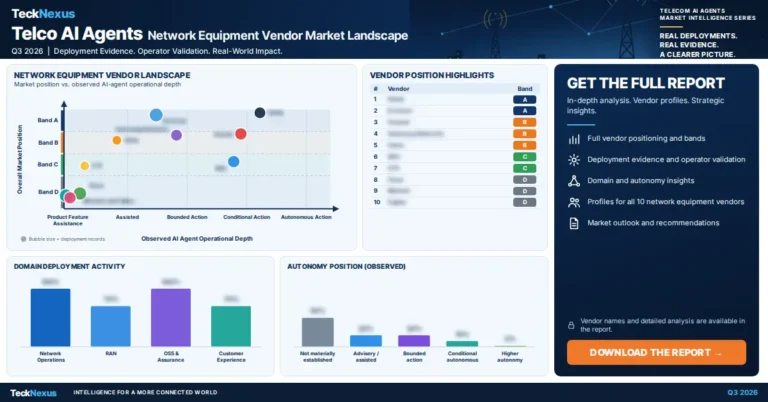
Telco AI Agent Leadership Landscape - Network Equipment Vendors
Network Equipment Vendor Report
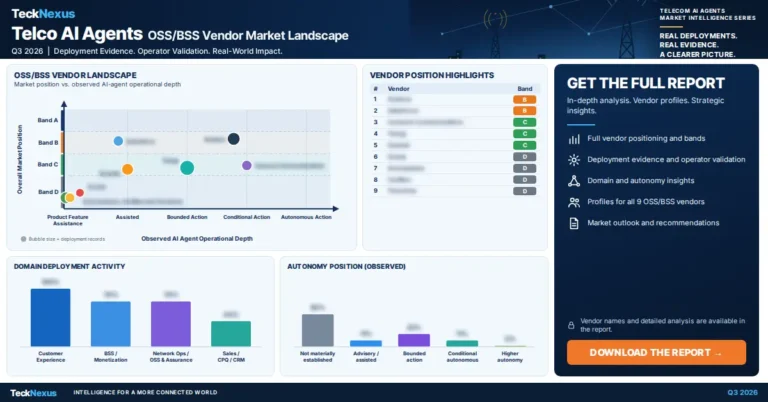
How are Amdocs, Salesforce, Comarch, Totogi, Qvantel, Oracle and other OSS/BSS vendors deploying telecom AI agents?
OSS/BSS Vendor Report
How are Amdocs, Salesforce, Comarch, Totogi, Qvantel, Oracle and other OSS/BSS vendors deploying telecom AI agents?
System Integrator Report
Scroll to Top