Private Network
Intelligence
Intelligence Journeys
Utilities Private Broadband Planning
AI Use Case Planning for Utilities

5G

5G is the fifth generation of cellular technology and the current global standard, succeeding 4G LTE with faster speeds, lower latency, and the capacity to connect far more devices per cell. Standardized by 3GPP from around 2017 and launched commercially in 2019, it has become the dominant connectivity technology across most major markets. 5G spans low-, mid-, and high-band (mmWave) spectrum and two architectures — non-standalone, which runs on a 4G core, and standalone, which unlocks network slicing and the lowest latency. The standard continues to evolve through 5G-Advanced, adding AI-native management and tighter satellite integration. For enterprises and operators, the questions have shifted from coverage to monetization, private deployments, and standalone migration. This channel tracks 5G developments across vendors, operators, and enterprise verticals, with analysis and decision tools for teams evaluating real deployments.

Nokia and Latvia’s LMT are aligning 5G radio and defense capabilities to deliver a field-ready, private tactical communications system for Baltic and coalition forces. Nokia will integrate its 5G radio portfolio with LMT’s defense solutions to build a secure, high-capacity, and resilient tactical network tailored to Baltic military needs. The joint system is designed for dedicated use cases, enabling real-time data exchange across uncrewed platforms, sensors, and dismounted teams. The goal is improved situational awareness, faster decision cycles, and assured interoperability for collective defense.
Reports indicate SK Group will reduce executive ranks by up to 30%, a move that would reshape decision-making across affiliates including SK Telecom (SKT). For SKT, which sits at the nexus of the group’s AI, cloud, and connectivity ambitions, executive trims would concentrate authority and compress approval chains at a sensitive time for 5G monetization and AI platform bets. Executive consolidation at a Tier-1 operator tends to reset priorities, procurement rhythms, and partner engagement models.
BT Group and its consumer brand EE plan to offer a Starlink-powered home broadband product focused on underserved locations where fixed-line build is constrained by terrain, sparsity, or cost. The service targets “ultrafast” downlink performance, with Starlink capable of delivering up to roughly 280 Mbps and latency in the low tens of milliseconds. Commercial availability is slated for the second half of 2026, giving BT time to industrialise ordering, installation, support, and integration into its existing product catalogue and systems. LEO fills the last 1–5% gap where full fibre is slow or uneconomic to reach.
BT is pressing ahead with cost-cutting as it confronts sharper broadband competition, softer device demand, and structural declines in legacy services. BT reduced its total workforce by about 6% in the first half of its financial year, down to roughly 111,000 employees from 116,000 at the start of the period. The group reported around £250 million in additional annualized cost savings, bringing cumulative savings to about £1.2 billion across the first 18 months of the program and reaffirming a target of £3 billion in annual savings. Group revenue for the six months to September 30 declined about 3% year over year to £9.8 billion. Openreach’s broadband base contracted, with approximately 242,000 fewer broadband customers in Q2 FY25.
New data from the Car Connectivity Consortium’s 2025 Future of Vehicle Connectivity Report signals how OEMs, suppliers, and mobile platforms will prioritize standards, security, and interoperability to scale the next phase of software-defined vehicles. The market is past pilots: executives are moving budget into customer experience and fleet productivity where ROI is visible within a year, but only if solutions are secure, easy to use, and proven to interoperate across brands, devices, and regions. The CCC’s data provides a directional roadmap for where to invest in the in-vehicle wireless stack and the edge-to-cloud controls that make those experiences trustworthy.
Telefónica delivered modest organic growth and wider 5G and fiber reach in Q3, while resetting free cash flow expectations amid operational and macro headwinds. Group revenue reached €8,958 million in Q3, with organic growth of 0.4%, and EBITDA rose organically by 1.2% to €3,071 million. 5G coverage reached 78% across core markets, while FTTH passings rose 9% to 82.6 million premises. Telefónica now expects 2025 free cash flow of €1.5–€1.9 billion. The company reaffirmed 2025 guidance for growth in revenue, EBITDA, and EBITDA minus CapEx.
SkyMirr’s Sky5G Wireless Router being named a CES 2026 Innovation Awards Honoree signals that antenna-first design is emerging as a decisive lever for 5G customer-premises equipment performance and reliability. The Consumer Technology Association’s awards program recognizes design and engineering that materially advances user outcomes, and SkyMirr’s selection draws attention to a core differentiator: its MuLCAT (Multi-Layer Coupling Controlled Antenna Technology) architecture. Rather than treating the antenna as a downstream component, MuLCAT integrates a multi-layer coupling approach to increase isolation, broaden usable bandwidth, and suppress interference in compact enclosures.
A fresh technical report from Broadband Forum details how a single outdoor 5G Fixed Wireless Access connection can deliver gigabit broadband to multiple apartments by reusing a building’s existing wiring. The document defines an architecture where one high-capacity 5G FWA modem—preferably operating on mmWave (3GPP FR2, roughly 24–40 GHz)—is installed on the roof or exterior of a multi‑dwelling unit (MDU) and then shared across many tenants. Instead of running new fiber to every unit, the approach leverages in‑place infrastructure such as coaxial cabling, twisted pair, or legacy telephone wiring to distribute service from a centralized point (attic, basement, or telecom closet) to apartments.
Nokia’s tie-up with OneLayer brings carrier-grade security and OT-aware visibility into one stack, addressing the core adoption barrier for private 5G/LTE in utilities: protecting highly distributed, mission-critical operations at scale. Together, the companies deliver a zero-trust model that spans radio to application: authenticated device identity, continuous posture assessment, role-based segmentation at the cellular (DNN/QoS flow) and IP layers, and orchestrated mitigation. Bottom line: With utilities accelerating private LTE/5G rollouts, Nokia and OneLayer are packaging the controls that regulators, insurers, and boards now expect—bringing OT-aware zero trust into the cellular domain without adding operational complexity.
Telefónica has launched a 2026–2030 plan to accelerate growth, simplify operations, and unlock up to €3 billion in savings while doubling down on its core markets and technology investments. Revenue is guided to a 1.5%–2.5% CAGR from 2025–2028, accelerating to 2.5%–3.5% in 2028–2030; adjusted EBITDA is guided to the same ranges across the two periods. Telefónica targets a gross impact of up to €2.3 billion in 2028 and €3 billion by 2030, driven by technology and operational excellence, process simplification, digital transformation, and monetization of legacy network assets as shutdowns progress.
LG Uplus is working with AWS on agentic AI that automates installation of cloud‑native network software, with early claims of up to 80% faster turn‑ups versus manual methods. LG Uplus and AWS partnered to develop an AI-driven approach that installs complex network software stacks without human intervention. The system uses Amazon Bedrock alongside AWS’s Strands-Agents SDK to orchestrate multiple cooperating AI agents. These agents are pre-trained on network design and implementation documents so they can execute the full workflow - provisioning cloud infrastructure, collecting device and network parameters, generating configurations, performing installation, and troubleshooting.
OECD data shows fixed and mobile broadband have shifted from build-out to scale-up, with fibre and 5G underpinning a new phase of digital infrastructure. Fixed broadband penetration across the OECD rose to 36.5 subscriptions per 100 inhabitants by end-2024, up from 32 in 2019, while the fibre share of fixed lines jumped from 28 percent to 47 percent over the same period. Gigabit-tier offers (≥1 Gbps) moved from 4 percent of subscriptions in 2019 to 19 percent in 2024, signaling both wider availability and growing appetite for very high throughput. On mobile, average monthly data consumption per subscription increased 2.5x—from 6 GB at end-2019 to 15 GB in 2024, aligned with more video, cloud, and AI-assisted applications shifting to handhelds and connected devices.

Frequently Asked Questions

What actually makes 5G different from 4G LTE?
5G introduces three core technical improvements over 4G LTE: significantly higher peak data speeds, in some cases multiple gigabits per second under ideal conditions compared to 4G’s typical tens to low hundreds of megabits per second; substantially lower latency, the delay between sending and receiving data, which matters for applications like gaming, video calls, and industrial automation where responsiveness is critical; and far greater device density support, allowing a single cell site to maintain reliable connections with a much larger number of simultaneous devices, which matters increasingly as IoT sensors and connected devices proliferate. These improvements come from a combination of new radio technology, additional spectrum bands made available for 5G use, and a redesigned network architecture that’s considerably more flexible and software-driven than 4G’s architecture was.
What’s the difference between low-band, mid-band, and high-band (mmWave) 5G?
Low-band 5G uses similar frequencies to 4G LTE, offering wide coverage area and good building penetration but speeds not dramatically faster than good 4G performance, making it most useful for extending broad geographic coverage rather than delivering 5G’s headline speed improvements. Mid-band 5G offers a more balanced tradeoff between coverage and speed, generally delivering meaningfully faster performance than 4G across a reasonably wide area, and has become the most common band used for mainstream 5G deployment in most markets globally. High-band 5G, often called mmWave, delivers by far the fastest possible speeds, but its very short range and poor ability to penetrate walls means it’s typically deployed only in dense, high-traffic urban areas like stadiums, rather than for broad area coverage.
What’s the difference between 5G NSA (non-standalone) and 5G SA (standalone)?
5G non-standalone, or NSA, runs 5G radio technology on top of an existing 4G core network, meaning certain control functions still rely on 4G infrastructure even though the actual data connection itself uses 5G radio technology; this was the faster, easier path many operators took for their initial 5G launches, since it could be deployed by upgrading existing 4G infrastructure rather than building an entirely new core network from scratch. 5G standalone, or SA, uses an entirely new, independently functioning 5G core network rather than relying on 4G at all, unlocking more of 5G’s distinctive advanced capabilities, including network slicing and the lowest possible latency, that NSA architecture generally can’t fully support. Many operators have been gradually transitioning from NSA to SA, though this migration has generally taken longer than initially anticipated.
How widespread is 5G coverage and adoption globally in 2026?
5G has become genuinely widespread rather than experimental. Global subscriptions surpassed 3.1 billion in early 2026, with another 162 million subscriptions added in just the first quarter of the year, reflecting continued strong growth even years after 5G’s initial 2019 commercial launch. Coverage varies considerably by region and band: low and mid-band 5G now reaches the substantial majority of the population in most major markets including the U.S., much of Europe, China, and South Korea, while high-band mmWave coverage remains considerably more limited and concentrated in dense urban areas given its short range. Adoption has progressed furthest in markets with aggressive early infrastructure investment, particularly China and South Korea, while other regions, especially parts of the developing world, continue working through earlier stages of 5G buildout.
What is ‘5G-Advanced,’ and how is it different from regular 5G?
5G-Advanced, sometimes marketed by certain vendors and operators, particularly in China, as 5.5G, refers to the next phase of 5G standards development beyond the original 2019 specification, formalized starting with 3GPP Release 18 and continuing through subsequent releases. It introduces capabilities including better support for reduced-capability IoT devices that don’t need full 5G performance, tighter integration with non-terrestrial satellite networks, more sophisticated AI-native network management built directly into the standard, and further uplink and capacity improvements beyond the original 5G specification. Rather than representing a completely new generation the way 5G itself was relative to 4G, 5G-Advanced is best understood as a substantial, ongoing evolution and refinement of the existing 5G standard, extending its useful commercial life well beyond what the original 2019 specification alone delivered.
Why do real-world 5G speeds vary so much between users and locations?
Real-world 5G speeds vary considerably because of the fundamental tradeoffs between different frequency bands: a user connected to low-band 5G in a rural area will experience meaningfully slower speeds than someone connected to mid-band 5G in a well-covered urban area, who in turn will experience slower speeds than someone briefly connected to high-band mmWave near a stadium or dense downtown location. Network congestion also plays a significant role, since a cell site serving many simultaneous users, particularly during peak usage periods, will generally deliver lower per-user speeds than the same site serving fewer users. Device capability matters too, since a phone’s specific modem chip determines which frequency bands and 5G features it can actually access, meaning even within the same coverage area, different devices can experience meaningfully different real-world performance.
Is 5G actually necessary, or is 4G still ‘good enough’ for most uses?
For many everyday tasks like browsing, messaging, and standard video streaming, 4G genuinely remains adequate, and many consumers report not noticing a dramatic difference in daily use compared to a well-performing 4G connection, which is part of why 5G monetization has proven harder than the industry initially expected. However, 5G’s advantages become considerably more apparent for specific use cases: dense urban areas with heavy simultaneous network usage benefit meaningfully from 5G’s greater capacity, fixed wireless access using 5G can deliver genuinely faster home broadband than many alternatives, and emerging applications like cloud gaming, AR and VR, and industrial automation benefit directly from 5G’s lower latency and higher reliability in ways 4G generally can’t match. Whether 5G feels necessary depends heavily on a specific user’s actual usage patterns and location rather than being a universal yes or no answer.
How does 5G relate to other technologies like network slicing, private networks, and FWA covered elsewhere in this reference?
5G is the foundational technology underlying many of the more specific capabilities covered elsewhere in this reference. Network slicing depends specifically on 5G standalone’s more flexible core network architecture to create multiple differentiated virtual networks on shared infrastructure. Private networks increasingly use 5G rather than 4G LTE as their core technology for new deployments, given 5G’s superior capacity and lower latency for industrial use cases. Fixed wireless access has become one of 5G’s clearest commercial monetization successes, using 5G’s speed and capacity to deliver home broadband as an alternative to cable or fiber. Open RAN’s disaggregated, multi-vendor approach to radio equipment is increasingly being applied specifically to 5G network deployments, making 5G the underlying connectivity layer most other categories in this reference build upon.


Partner Hubs

Telco AI Agent Leadership

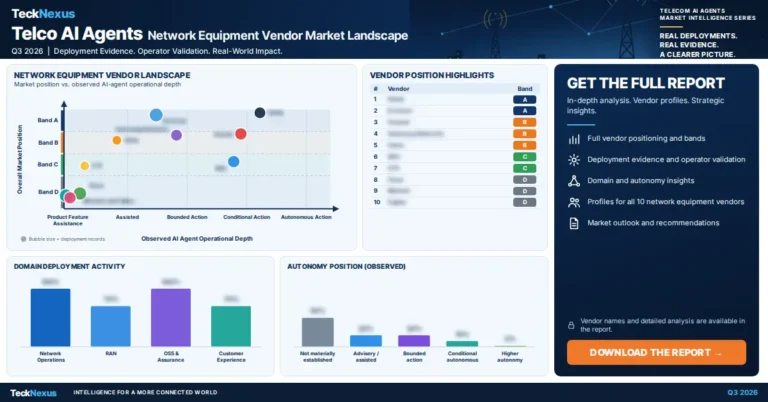
Telco AI Agent Leadership Landscape - Network Equipment Vendors
Network Equipment Vendor Report
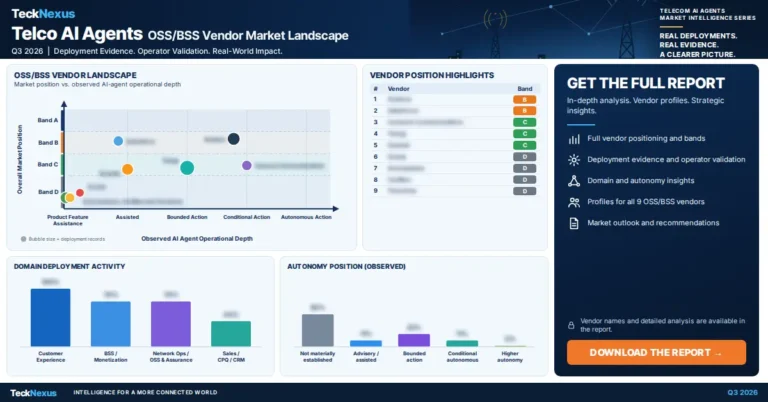
How are Amdocs, Salesforce, Comarch, Totogi, Qvantel, Oracle and other OSS/BSS vendors deploying telecom AI agents?
OSS/BSS Vendor Report
How are Amdocs, Salesforce, Comarch, Totogi, Qvantel, Oracle and other OSS/BSS vendors deploying telecom AI agents?
System Integrator Report
Scroll to Top