Intelligence Journeys
AI Use Cases for Utilities
Private Broadband for Utilities

Edge/MEC

Edge computing and multi-access edge computing (MEC) place processing close to where data is generated — at the network edge rather than in distant centralized clouds — to cut latency and reduce backhaul. For applications that demand fast, local responses, such as industrial automation, computer vision, AR, and autonomous systems, the edge is often what makes them viable. Edge is tightly linked to 5G standalone, private networks, and AI inference, and is a key area where operators, hyperscalers, and enterprises both compete and partner. For decision-makers, the questions are where edge genuinely beats centralized cloud and how to balance on-premises, network-edge, and public-cloud processing. This channel covers edge and MEC across operator, hyperscaler, and enterprise deployments — architectures, partnerships, and use cases — with analysis of where moving compute to the edge actually pays off.

Mobile Private Networks (MPNs) have reached a critical juncture, evolving from niche deployments to scalable, production-ready solutions. Enterprises are now embracing MPN-as-a-Service, combining edge computing, AI-driven operations, and hybrid spectrum strategies to deliver low-latency, secure, and flexible connectivity. Discover how Wi-Fi integration, automation, and vendor-agnostic deployment models are accelerating MPN adoption across industries.

GMR Energy's private 5G journey showcases how industrial operators are solving real-world connectivity challenges. In a 3–4 sq. km energy plant, traditional networks fell short. GMR adopted private 5G and edge computing to deliver ultra-reliable, low-latency connectivity across EMI-heavy and safety-critical zones — enabling drones, AI, and real-time command centers. This case study explores both operator and integrator perspectives to show how private 5G becomes a scalable platform, not a point solution.
This article highlights the top 10 private 5G and LTE deployments transforming energy and utility operations globally. From U.S. electric utilities to offshore rigs and oilfields in Africa and Asia, these real-world examples show how private networks deliver secure, resilient communications that improve reliability, safety, and operational intelligence—laying the foundation for scalable grid modernization, edge analytics, and automation.
Verizon Business has officially launched the Edge Transportation Exchange, a 5G and mobile edge computing-powered vehicle-to-everything (V2X) platform. Already in use by partners like Volkswagen, the Arizona Commerce Authority, and DelDOT, the platform enables real-time data sharing between vehicles, infrastructure, and road users. It supports critical use cases like pedestrian detection, traffic signal data, and weather alerts—without relying on expensive roadside hardware.
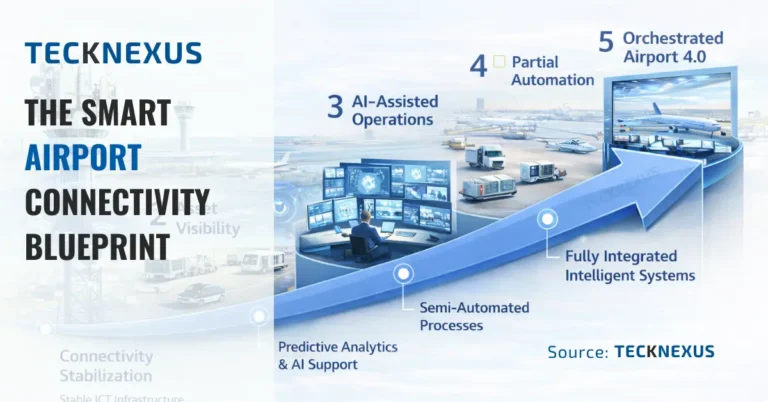
From Singapore to Schiphol, airports are embracing private networks for airports alongside AI and digital twins to drive operational efficiency, predictive maintenance, sustainability, and smarter passenger flows. This article explores 12 real-world deployments showcasing how private network deployments for aviation are shaping the future of Airport 4.0 globally.
The telecom industry is evolving fast, driven by the rise of AI and real-time data demands. Telcos are moving from legacy connectivity models toward becoming AI-powered intelligence infrastructure providers. This transformation spans infrastructure modernization, distributed AI, operational automation, and monetization shifts, from selling bandwidth to delivering tailored digital experiences.
Private cellular networks are transforming industrial operations, but securing private 5G, LTE, and CBRS infrastructure requires more than legacy IT/OT tools. This whitepaper by TeckNexus and sponsored by OneLayer outlines a 4-pillar framework to protect critical systems, offering clear guidance for evaluating security vendors, deploying zero trust, and integrating IT, OT, and IoT under a unified, secure-by-design architecture.
Enterprises adopting private 5G, LTE, or CBRS networks need more than encryption to stay secure. This article explains the 4 pillars of private network security: core controls, device visibility, real-time threat detection, and orchestration. Learn how to protect SIM and device identities, isolate traffic, secure OT and IoT, and choose the right vendors for a robust private network security strategy.
Verizon is transforming healthcare infrastructure with a dual-network approach that combines private 5G and neutral host connectivity. Hospitals like AdventHealth and Tampa General are enhancing AI-powered diagnostics, real-time telemetry, and secure staff communications—while ensuring strong public mobile coverage for patients and visitors. This hybrid model, built on Ericsson’s platform, supports HIPAA compliance, device density, and future scalability for smart hospitals.
BMW has launched a private 5G- and AI-powered EV plant in Debrecen, Hungary, its first fully AI-controlled automotive factory. With over 1,000 robots, autonomous vehicles, and digital twins integrated across a hybrid 5G network, the site sets new standards for real-time quality control, low-carbon manufacturing, and scalable production of next-gen EVs like the iX3. Operated by Magyar Telekom, the facility is a model for smart, sustainable automotive production.
Connectivity is transforming aviation from the ground up. Airports are deploying private 5G, Wi-Fi 6, edge computing, and IoT to deliver two major outcomes: smoother passenger experiences and lower operating costs. Travelers enjoy real-time updates, biometric check-in, and AR wayfinding — while operators benefit from predictive maintenance, smarter gate usage, and energy optimization. This dual-value framework positions connectivity as more than infrastructure, it’s a strategic differentiator that enhances revenue, reduces OPEX, and elevates the brand.

Frequently Asked Questions

What’s the difference between ‘the cloud’ and ‘the edge’ in telecom?
Cloud computing typically runs in a relatively small number of large, centralized data centers, often located far from any individual user, which is efficient for many workloads but introduces unavoidable physical distance, and therefore latency, between where data is generated and where it’s processed. Edge computing, specifically MEC, places computing resources much closer to where data actually originates, at cell towers, base stations, or local facilities, cutting the round-trip delay for applications where that distance meaningfully matters. The tradeoff is that edge sites generally have far less raw computing capacity than a massive centralized data center, so edge deployments tend to handle specific, latency-sensitive workloads locally while still relying on the broader cloud for less time-critical processing and coordination.
Is MEC mainly a telecom-specific concept, or does it apply more broadly?
It started as a mobile-network-specific concept, originally called Mobile Edge Computing when ETSI introduced it in the mid-2010s, focused on placing computing resources within mobile radio access network infrastructure. ETSI broadened the concept to Multi-access Edge Computing in 2017 specifically to extend it beyond cellular networks to also cover fixed-line broadband and Wi-Fi access, recognizing that the underlying need, computing resources close to the point of data generation, applies regardless of access technology. Current standards work is extending the concept further still, with ETSI’s MEC group releasing Phase 4 specifications in late 2025 focused on developer-friendly APIs for vertical industries and explicit alignment with emerging 6G requirements.
What applications actually benefit from edge computing?
The clearest use cases are ones where milliseconds genuinely matter, or where large amounts of locally generated data would otherwise need to travel back to a distant data center unnecessarily. Autonomous vehicles need to process sensor data and make navigation decisions in near real time, where even modest added latency could be meaningful for safety. Industrial automation and predictive maintenance benefit from edge processing of sensor data from factory equipment. AR and VR applications need responsive, low-latency rendering support. Smart city video analytics, like traffic monitoring, generates enormous volumes of video data far more efficient to process locally. Increasingly, running AI inference closer to users for real-time applications is becoming one of the most significant edge use cases of all.
Why are telecom operators excited about edge computing as a revenue source?
Beyond reducing backhaul costs, edge sites give telecom operators something cloud hyperscalers don’t have by default: physical proximity and direct integration with the radio network across thousands of locations nationwide. This positions operators uniquely to offer latency-sensitive computing services that a centralized cloud data center simply can’t match on responsiveness, regardless of raw computing power. Operators are increasingly positioning these edge locations specifically as AI inference points, sometimes described as compact ‘AI factories,’ capable of running real-time AI workloads close to users. This opens a genuinely new monetization path beyond selling connectivity itself, letting operators compete in the broader computing and AI infrastructure market using distributed physical infrastructure cloud-only providers would need years to replicate.
How mature is MEC deployment in 2026?
By 2026, MEC has moved well past the concept or early-pilot stage into active, expanding commercial deployment. ETSI’s MEC group has produced more than 50 technical specifications covering reference architectures, service enablers, and deployment guidelines, and released its Phase 4 work in late 2025, focused on developer-friendly APIs and explicit alignment with open-source projects and 6G preparation. Telecom operators worldwide are actively pairing MEC deployments with private 5G networks, AI workloads, and Open RAN integration in live commercial deployments rather than isolated trials. The technology continues to mature rather than being fully settled; convergence between MEC and Open RAN architectures remains an active area of development.
How does edge computing relate to private 5G networks?
Edge computing and private 5G networks are frequently deployed together because they solve complementary problems for the same enterprise use cases. A private 5G network provides dedicated, reliable, high-performance wireless connectivity across a facility like a factory or port, while edge computing provides the local processing power needed to actually act on the data that connectivity carries, without sending everything back to a distant cloud data center. A manufacturing facility, for example, might use private 5G to connect cameras and sensors across the factory floor, with an edge deployment at that same facility processing video analytics or controlling automated machinery in near real time. This pairing is one of the most common patterns in enterprise digital transformation projects today.
What’s the difference between edge computing and Open RAN’s ‘Cloud RAN’ concept?
Edge computing and Cloud RAN address related but distinct parts of the network. Cloud RAN refers specifically to running radio access network functions, the software controlling how a cell site transmits and receives wireless signals, on cloud-based, software-defined infrastructure rather than dedicated radio hardware. Edge computing, particularly MEC, refers more broadly to running general-purpose application workloads, not just radio network functions, close to the network edge, things like video analytics, AI inference, or industrial automation software. In practice, the two concepts increasingly converge physically, since the same edge infrastructure supporting Cloud RAN’s virtualized radio functions can often also host MEC application workloads on shared hardware.
What are the biggest technical challenges in deploying edge computing at scale?
Deploying edge computing at scale introduces several persistent technical challenges. Managing and orchestrating computing resources across potentially thousands of geographically distributed edge sites is meaningfully more complex than managing a small number of centralized data centers, since each edge location has limited physical space, power, and cooling capacity. Ensuring consistent security across so many distributed locations, each a potential point of vulnerability, requires more extensive security architecture than securing a handful of centralized facilities. There’s also a workload placement challenge: deciding which tasks genuinely benefit from edge processing versus which are better handled centrally, since over-provisioning edge capacity for workloads that don’t truly require it can be an inefficient use of limited, expensive infrastructure.

Partner Hubs

Download content, access intelligence tools, and hear from executives.

Partner Events

  • M360 ASEAN
  • FutureNet Asia 2026
  • Network X Vienna 2026
Scroll to Top