Satellite & NTN

Satellite and non-terrestrial networks (NTN) extend connectivity beyond the reach of ground-based infrastructure, using low-earth-orbit constellations, geostationary satellites, and high-altitude platforms. A major shift is the integration of satellite directly into cellular standards, enabling direct-to-device services that let ordinary phones connect via satellite where there is no terrestrial coverage. NTN is increasingly viewed not as a competitor to mobile networks but as a complement — filling coverage gaps, adding resilience, and supporting IoT and emergency communications. For operators and enterprises, satellite partnerships and spectrum are becoming strategic. This channel covers satellite and NTN developments — constellations, direct-to-device, standards integration, and operator partnerships — with analysis of how non-terrestrial connectivity is moving from niche to a mainstream layer of the connectivity landscape, and where the business case genuinely holds.

SpaceX’s anticipated 2026 IPO is not just a space-launch story; it is a capital and scale inflection that could reorder parts of the mobile and broadband value chain. Market chatter pegs SpaceX’s IPO valuation around the trillion-plus mark with a potential multibillion-dollar primary raise, a war chest that would dwarf most rivals’ balance sheets. For telecom, the same cash advantage accelerates Starlink’s network deployment, ground infrastructure, and device partnerships—compressing the window for incumbents to respond. Starlink reports more than 9,000 satellites in orbit, 9.2 million paying customers, and over $10 billion in annual revenue.
Deutsche Telekom’s launch of seamless IoT roaming across terrestrial, GEO, and LEO networks signals a practical turning point for standards‑based satellite IoT at global scale. Multi‑orbit roaming blends the strengths of geostationary (always‑on footprint, predictable links) with low‑earth orbit (lower latency, better high‑latitude reach) and terrestrial cellular to keep devices online where traditional networks fall short. The service has been validated on Nordic Semiconductor’s nRF9151—billed as the first 3GPP‑compliant cellular IoT module to support terrestrial NB‑IoT/LTE‑M and NB‑NTN over both GEO and LEO—which matters for total cost of ownership and speed to scale.
New guidance from the NTIA signals that BEAD-funded satellite providers, including SpaceX’s Starlink, must abide by standard program terms rather than negotiate bespoke carve-outs. An updated NTIA FAQ on subgranting makes clear that states cannot waive or dilute the statutory and programmatic requirements set out in the BEAD NOFO and subsequent guidance. Payments should be tied to objective milestones and verifiable outcomes, not front-loaded without proportional performance. Performance testing, reporting, and documentation must meet program and FCC-aligned standards; subgrantees cannot unilaterally narrow test samples or exclude locations to their advantage. The FAQ effectively answers whether BEAD can be implemented on a “vendor’s terms”: it cannot.
Beam Hopping in 5G NTN enables dynamic allocation of satellite beams to high-demand areas, enhancing coverage efficiency and resource utilization. This blog by Rajiv Gupta of Radisys explores the technical requirements, scheduling challenges, QoS considerations, and key system components behind this advanced satellite communication strategy, while highlighting how Radisys’ 3GPP Release 18-compliant Multi-RAN software empowers operators to implement it effectively.
Small Cell Forum (SCF) has highlighted 2026 as a critical year for small cell deployment progress, pointing to the need for greater deployment readiness ahead of a pivotal market phase from 2027. SCF says the focus for the year is not demand, but removing operational, regulatory and commercial barriers so small cells can scale more predictably across enterprise, neutral host and urban environments.
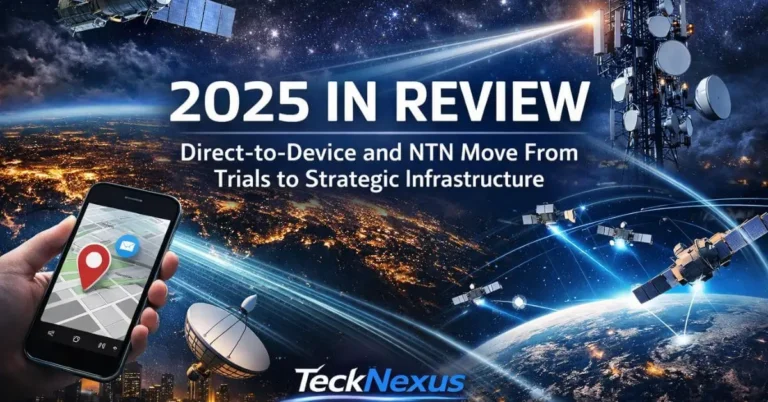
In 2025, direct-to-device (D2D) satellite connectivity and non-terrestrial networks (NTN) advanced from experimental trials to critical infrastructure. With commercial D2D services going live, mobile operators and satellite providers redefined network coverage, service resilience, and long-term positioning. North America led the competitive rollout, Europe balanced innovation with sovereignty, and new players, including cable operators - joined the ecosystem.
Rogers Communications has moved from beta to a commercial footprint for satellite-to-mobile in Canada, extending basic connectivity and select apps to consumer smartphones while adding an industrial IoT tier for remote operations. The new Rogers Satellite service enables a curated set of popular apps to work beyond terrestrial coverage, including WhatsApp calling, Google Maps, AccuWeather, X, and CalTopo on most modern smartphones. In parallel, Rogers introduced satellite-to-mobile for IoT businesses, targeting asset tracking along highways and rail, as well as sensor telemetry in forestry, mining, and other resource sectors where terrestrial cellular is sparse.
SCF (Small Cell Forum) has published a new report exploring how proven small cell design principles and open interfaces can help the ecosystem overcome some of the challenges facing emerging 5G Non-Terrestrial Networks (NTNs), particularly regenerative LEO satellite systems. The paper, Small Cells and Non-Terrestrial Networks: Common Challenges and Common Solutions, explains that although terrestrial and space-based networks operate in very different environments, they share several engineering and operational constraints, including strict SWaP (Size, Weight and Power) requirements. Compact and efficient radio designs, modular architectures and standardized interfaces are essential in both domains. SCF’s existing body of work provides a set of components and frameworks that can be reused or adapted for 5G NTN satellite payloads and hybrid terrestrial–satellite deployments.
New consumer research commissioned by Viasat and executed by GSMA Intelligence signals that non-terrestrial networks (NTN) are becoming a mainstream buying factor for mobile subscribers. The survey of more than 12,000 smartphone users across 12 countries finds persistent coverage gaps: over a third of respondents lose basic cellular service multiple times per month. That pain point is translating into intent. Roughly six in ten consumers say they would pay extra for satellite-enabled connectivity on their phones, and nearly half indicate they would switch operators if out‑of‑coverage service were included in their plan. On average, those willing to pay would accept a 5–7% uplift on their current monthly bill, with outliers such as India approaching a 9% premium.
AST SpaceMobile is signaling a pivotal year ahead as it moves from demonstrations to commercial direct-to-device coverage with major operators and an aggressive launch schedule. The company’s plan to begin “intermittent nationwide” service in early 2026, followed by continuous coverage later in the year, is also a forcing function for device vendors, standards work, and MNO network integration. As AST scales to 45–60 BlueBird satellites by end-2026, pass frequency and overlap increase to support “continuous” service across the U.S., Europe, Japan, and other priority markets. AST reports over $3.2 billion in cash and liquidity.
BT Group and its consumer brand EE plan to offer a Starlink-powered home broadband product focused on underserved locations where fixed-line build is constrained by terrain, sparsity, or cost. The service targets “ultrafast” downlink performance, with Starlink capable of delivering up to roughly 280 Mbps and latency in the low tens of milliseconds. Commercial availability is slated for the second half of 2026, giving BT time to industrialise ordering, installation, support, and integration into its existing product catalogue and systems. LEO fills the last 1–5% gap where full fibre is slow or uneconomic to reach.

Frequently Asked Questions

What is a Non-Terrestrial Network (NTN)?
NTN refers to connectivity delivered via satellites, high-altitude platforms, or other non-ground-based infrastructure, working alongside, not instead of, traditional cell towers to extend coverage to places terrestrial networks don’t reach. The concept has been formally incorporated into 3GPP’s mobile network standards specifically to ensure satellite-based connectivity can integrate technically with standard cellular networks, rather than existing as a completely separate, incompatible system. This standardization matters because it means NTN connectivity can, in principle, work seamlessly alongside regular cellular service, allowing a device to fall back to satellite coverage automatically when terrestrial signal isn’t available, rather than requiring users to manually switch between two entirely separate systems.
What are the different types of NTN?
  • Satellite networks: These networks use satellites in orbit around the Earth to transmit and receive signals and include geostationary and Low Earth orbit (LEO) satellite networks
  • Balloon networks: These networks use balloons that are floated high in the stratosphere to transmit and receive signals. They can be used for applications such as providing internet access in remote or hard-to-reach areas, as well as for remote sensing and scientific research.
  • High-altitude platform stations (HAPS): These networks use aircraft or airships that fly at high altitudes, such as the stratosphere, to transmit and receive signals. They can be used for similar applications to balloon networks, and they also have the added advantage of mobility.
  • Drone networks: These networks use drones, which are also referred to as unmanned aerial vehicles (UAVs), to transmit and receive signals. They can be used for a wide range of applications, such as providing internet access in remote or hard-to-reach areas, remote sensing, scientific research, and commercial uses like delivery and inspection.
  • Stratospheric platform stations (SAPS): This network uses a platform stationed in the lower part of the stratosphere, such as a blimp, that can relay communications between ground and satellites or between ground and another SAPS.
  • Laser Communications: This network uses a laser to transmit data between two points. This technology is still in development, but it has great potential to provide high-bandwidth, low-latency communications.
Is satellite internet going to make cell towers obsolete?
No. The industry consensus treats satellite and direct-to-device connectivity as a complementary layer that extends coverage to remote and underserved areas, not a replacement for dense terrestrial 5G networks in cities and suburbs where ground infrastructure remains far more efficient at handling large volumes of simultaneous users. Terrestrial cell towers can support vastly more simultaneous connections and far higher data throughput per user within a given area than current satellite technology can practically deliver, making satellite connectivity better suited for filling coverage gaps, like remote rural areas, maritime and aviation routes, or emergency situations where terrestrial infrastructure has failed.
What is direct-to-device (D2D) satellite connectivity?
Direct-to-device, often abbreviated D2D, lets ordinary smartphones connect directly to satellites for basic connectivity, such as text messaging and, increasingly, voice or limited data service, without needing a separate, dedicated satellite terminal or specialized hardware beyond what’s already built into many recent smartphone models. This represents a significant technical advance over older satellite phone technology, which required bulky, dedicated devices. Large satellite operators, including SpaceX’s Starlink, are positioning D2D as a broader connectivity layer that could eventually extend beyond emergency and remote-area use cases into more general-purpose coverage, though this more expansive vision remains considerably further from current commercial reality than basic emergency messaging service.
Why is satellite connectivity becoming a bigger topic in telecom circles in 2026?
Large satellite operators entering the connectivity market with very large addressable market projections are raising substantial industry questions about spectrum ownership, infrastructure economics, and how traditional telecom operators and satellite providers will share or compete for the same customers going forward. SpaceX’s Starlink, for instance, has framed its total addressable market across AI, connectivity, and space-enabled infrastructure as enormous, positioning direct-to-device satellite connectivity as a potential global connectivity layer. This scale of ambition has prompted genuine strategic concern within the traditional telecom industry about longer-term competitive dynamics and what role established carriers will play as satellite capabilities continue advancing rapidly.
How does NTN fit into 6G plans?
Standards bodies are explicitly designing 6G to include seamless integration between terrestrial and satellite networks as a core capability, aiming to close coverage gaps as a fundamental design goal rather than treating satellite as a bolt-on afterthought added after the main standard is already finalized. This reflects lessons learned from how NTN support was added to 5G somewhat later in that standard’s development process, with 6G planning intended to incorporate satellite integration considerations from earlier on. The explicit goal is a future network where a device can move seamlessly between terrestrial and satellite coverage without users needing to think about which type of connectivity they’re actually using.
What’s the difference between low-earth-orbit, medium-earth-orbit, and geostationary satellites for connectivity purposes?
Low-earth-orbit, or LEO, satellites orbit much closer to Earth than older satellite generations, typically a few hundred miles up, which significantly reduces signal delay, or latency, making LEO constellations considerably more suitable for real-time applications like voice calls than earlier satellite generations were. Medium-earth-orbit satellites sit considerably farther out and are less commonly used for the consumer broadband and direct-to-device connectivity currently generating the most attention. Geostationary satellites orbit much farther from Earth, remaining fixed relative to a specific ground point, useful for certain broadcast applications but introducing meaningfully higher latency, generally making them less suitable for interactive connectivity compared to LEO constellations.
Do existing smartphones actually support satellite connectivity today, or is special hardware required?
A growing number of recent smartphone models do support some form of satellite connectivity natively, generally for specific, limited use cases like emergency messaging when no cellular signal is available, rather than full general-purpose satellite data service. This built-in support typically depends on having a relatively recent device with a modem chipset specifically designed to support satellite frequencies, meaning older devices generally cannot access these features even through a software update. As direct-to-device satellite services continue expanding beyond basic emergency messaging toward more general data and voice capability, broader satellite support is expected to become a more standard smartphone feature over time, similar to how 5G modem support gradually became standard.
What regulatory and spectrum challenges does satellite connectivity raise for traditional telecom operators?
Spectrum that terrestrial carriers have historically used exclusively may need to be shared or coordinated with satellite operators offering direct-to-device service using similar or overlapping frequencies, raising technical interference concerns and complex regulatory coordination questions that vary by country. There are also competitive and regulatory fairness questions, since satellite operators offering connectivity services may not be subject to the same licensing requirements or local infrastructure investment expectations that traditional terrestrial carriers face in a given country, potentially creating an uneven competitive playing field regulators are still actively working through. These unresolved questions are part of why traditional operators have approached large-scale satellite providers with a mix of cautious partnership interest and genuine competitive concern.

Your Brand. Our Intelligence Tools.

Capture leads at the point of evaluation. Talk to Us →

Sponsored by Palo Alto Networks
⚡ Utilities ⏱ 8 min ✓ Free
This tool is built and hosted by TeckNexus.
Launch Tool →
Whitepaper
This whitepaper explains how utilities can use secure AI-enabled private mobile networks to modernize operations, support distributed intelligence, improve resilience, and strengthen cybersecurity across critical infrastructure. It covers AI applications, private network advantages, zero trust principles, multilayered security architecture, and governance considerations for AI-ready utility environments....
Whitepaper
Non-terrestrial networks are rapidly evolving from experimental satellite systems into an increasingly important part of the global 5G connectivity landscape. This eBook, developed by Radisys in collaboration with TeckNexus, explores how 3GPP standardization, satellite architecture innovation, and software-driven network design are reshaping NTN deployment models. It examines the transition from...
Whitepaper
Private cellular networks are transforming industrial operations, but securing private 5G, LTE, and CBRS infrastructure requires more than legacy IT/OT tools. This whitepaper by TeckNexus and sponsored by OneLayer outlines a 4-pillar framework to protect critical systems, offering clear guidance for evaluating security vendors, deploying zero trust, and integrating IT,...
Scroll to Top