AI Agent Competitive
Intelligence
Intelligence
Private Network
Intelligence
Intelligence
Intelligence Journeys
Utilities Private Broadband Planning
AI Use Case Planning for Utilities
Intelligence Tools
By Tool Type
▼
By Industry
▼
Access Type
▼
Resources
▼
Technology Hubs
▼
Partner Hubs
▼
Monthly Trackers
▼


Home » Network Infrastructure » Page 6
Network Infrastructure
Network infrastructure encompasses the physical and logical foundation of connectivity — radio sites, fiber, transport, data centers, and the equipment that ties them together. Modern infrastructure is increasingly software-defined, virtualized, and cloud-native, blurring the line between hardware and the software that runs on it. Decisions about infrastructure shape capacity, coverage, cost, and the ability to support new services like slicing, private networks, and edge computing. For operators and enterprises, infrastructure strategy balances capital cost, vendor choice, and the shift toward open, disaggregated, and cloud-based architectures. This channel covers network infrastructure across radio, transport, and core — including the move to virtualized and cloud-native systems, open architectures, and the vendors building them — with analysis of how operators are modernizing the foundations their services depend on, and what it costs.
- Tech News & Insight
- April 29, 2025
- Hema Kadia

Connecting the unconnected requires more than just broadband buildout. National digital inclusion strategies focus on affordability, digital skills, devices, and sustainable infrastructure to empower all communities. Learn how federal programs, state initiatives, and public-private partnerships are reshaping broadband access across America.
- Tech News & Insight
- April 29, 2025
- Hema Kadia

Artificial Intelligence is transforming metro infrastructure, placing new demands on data centers, fiber networks, and edge deployments. This article explores how operators are tackling power and cooling constraints, evolving network topologies, managing capital risks, and partnering with hyperscalers to build sustainable, AI-optimized metro ecosystems.
- Tech News & Insight
- April 29, 2025
- Hema Kadia

The fiber, data center, and telecom sectors are evolving rapidly amid rising AI workloads, cloud expansion, edge computing, and new investment models. This article breaks down the key trends — from fiber deployments in rural markets to secondary data center expansions and telecoms shifting to platform-based services, that are reshaping digital infrastructure for a hyperconnected future.
- Tech News & Insight
- April 28, 2025
- Robert James Armstrong

AI promises major gains for telecom operators, but most initiatives stall due to outdated, fragmented inventory systems. Discover why unified, service-aware inventory is the missing link for successful AI in telecom—and how operators can build a smarter, impact-ready foundation for automation with VC4's Service2Create (S2C) platform.
- Tech News & Insight
- April 26, 2025
- Hema Kadia
Legacy broadband networks are struggling to meet today’s demands. Open architectures — modular, interoperable, and standards-based — are revolutionizing broadband by promoting flexibility, cost-efficiency, and faster innovation. Learn how service providers can leverage open broadband strategies to scale, improve customer experiences, and build resilient, future-proof infrastructures ready for the digital economy.
- Tech News & Insight
- April 26, 2025
- Hema Kadia

As networks grow more complex, traditional management models fall short. This article explores how AIOps (Artificial Intelligence for IT Operations) enables autonomous networks that self-configure, self-optimize, and self-heal. Learn how service providers can use AIOps frameworks to achieve predictive maintenance, dynamic resource management, enhanced customer experiences, and operational scalability to thrive in the era of 5G, IoT, and beyond.
- Partner Event
- April 26, 2025
- Hema Kadia

Start: June 23, 2025
End: June 25, 2025
Venue: George R. Brown Convention Center, Houston, TX
Location: Houston
End: June 25, 2025
Venue: George R. Brown Convention Center, Houston, TX
Location: Houston
- Tech News & Insight
- April 22, 2025
- Hema Kadia
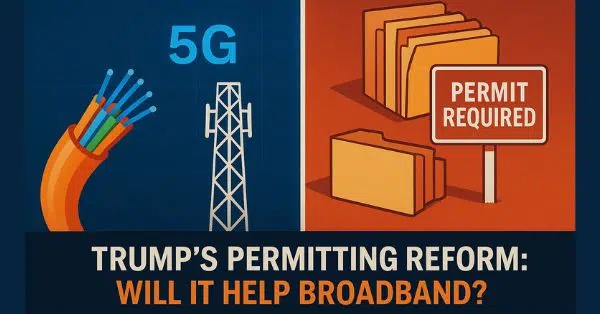
President Trump’s executive order to modernize environmental permitting may streamline U.S. infrastructure projects—but it notably omits telecom and broadband. Industry experts say pole attachments, state permitting rules, and access to federal lands remain critical hurdles. While the order could bring indirect benefits, real telecom reform still requires sector-specific solutions.
- Tech News & Insight
- April 17, 2025
- Robert James Armstrong

Low-code platforms like VC4's Service2Create (S2C) are transforming telecom operations by accelerating service delivery, reducing manual tasks, and simplifying integration with legacy systems. Discover how this technology drives digital transformation, improves efficiency, and future-proofs telecom networks.
- Article & Insights
- April 10, 2025
- Hema Kadia

In AI in Telecom: Strategic Themes, Maturity, and the Road Ahead, we explore how AI has shifted from buzzword to backbone for global telecom leaders. From AI-native networks and edge inferencing, to domain-specific LLMs and behavioral cybersecurity, this article maps out the strategic pillars, real-world use cases, and monetization models driving the AI-powered telecom era. Featuring CxO insights from Telefónica, KDDI, MTN, Telstra, and Orange, it captures the voice of a sector transforming infrastructure into intelligence.
- Tech News & Insight
- April 1, 2025
- Hema Kadia

CAMARA, under the Linux Foundation, launched its Spring25 Meta-Release, introducing 13 new and 23 updated APIs. This release enhances telecom operations with improved security, notifications, and error handling, supporting global telecom standards and fostering innovation.
Frequently Asked Questions
What’s typically included under ‘network infrastructure’ as a category?
It generally covers the physical and virtual building blocks of a telecom network: cell towers and small cells that handle wireless connections to devices, fiber-optic and microwave transport links that connect those cell sites back to the broader network, data centers running virtualized network functions and core network software, and increasingly, the cloud-based and virtualized systems that have replaced much dedicated, single-purpose hardware. It also encompasses supporting infrastructure like power systems, cooling, and physical site security at network facilities, which become increasingly important as networks add more, smaller, distributed sites to support 5G’s denser coverage requirements.
How has network infrastructure changed with the shift to 5G and cloud-native architectures?
Infrastructure has moved from largely fixed, purpose-built hardware toward software running on standardized servers, a shift broadly described as virtualization or cloud-native architecture. This makes infrastructure considerably more flexible to upgrade, scale, and reconfigure, since adding capacity or introducing a new network function often becomes primarily a software deployment rather than requiring new physical hardware installation at every affected site. However, this flexibility comes with added complexity: virtualized infrastructure running across cloud platforms, often from multiple different vendors, requires more sophisticated orchestration, security, and assurance tools than the comparatively simpler task of managing a fixed set of dedicated hardware boxes.
What’s driving continued infrastructure investment even after 5G is widely deployed?
Ongoing demand growth from video streaming, IoT device proliferation, AI workloads, and enterprise applications keeps pushing operators to add network capacity even after initial 5G coverage milestones are achieved. Densifying coverage with additional small cells remains necessary to deliver 5G’s fastest speeds consistently in crowded urban areas, since high-band 5G’s short range requires considerably denser site coverage than earlier, longer-range network technologies needed. Infrastructure also needs ongoing investment to prepare for 5G-Advanced features and eventual 6G requirements, meaning operators are frequently investing in upgrades simultaneously with, rather than strictly after, completing earlier-generation rollout milestones.
Why do ‘brownfield’ and ‘greenfield’ come up so often in infrastructure discussions?
Greenfield refers to building a new network from scratch with the latest available technology, which is generally easier to design optimally since there’s no legacy equipment to work around, but requires substantial upfront capital, making it more common for new market entrants or operators in regions without significant existing infrastructure. Brownfield refers to upgrading existing infrastructure, which is typically cheaper and faster than building entirely new infrastructure, but is constrained by legacy equipment, existing site locations, and earlier design choices. Most established carriers in mature markets operate primarily brownfield networks, continuously upgrading existing infrastructure incrementally rather than rebuilding it from the ground up.
How do operators decide where to invest limited infrastructure budget first?
Operators generally prioritize infrastructure investment based on a combination of factors: where existing network congestion is most acutely affecting customer experience, where competitive pressure from rival carriers makes infrastructure quality a more pressing business concern, where regulatory requirements or government incentives, like rural coverage mandates, create specific obligations, and where enterprise customer opportunities, like a major private 5G network deal, justify targeted investment. Dense, high-revenue urban and suburban areas typically receive investment priority since they generate the most subscriber revenue relative to infrastructure cost, while rural and remote area investment is often driven more by regulatory requirements or subsidy programs than purely commercial return calculations.
What’s the difference between core network infrastructure and access network infrastructure?
The core network refers to the central infrastructure that handles functions like routing calls and data, managing subscriber identity and billing, and connecting a carrier’s network to other networks and the broader internet, typically concentrated in a smaller number of data centers. The access network, sometimes called the radio access network or RAN, refers to the infrastructure that actually connects end-user devices to the network, including cell towers, antennas, and radio equipment distributed across thousands of physical locations to provide coverage. These two layers require different kinds of infrastructure investment: the core involves fewer, larger, centralized facilities, while the access network involves managing many smaller, distributed sites.
How does network sharing between competing carriers actually work?
Network sharing arrangements let two or more competing carriers jointly build, own, or use certain pieces of infrastructure, most commonly cell towers and sometimes radio access network equipment, rather than each carrier independently building entirely separate, duplicate infrastructure covering the same geographic area. This is particularly common for tower infrastructure, where independent tower companies often own physical structures and lease space on the same tower to multiple competing carriers’ equipment, reducing the capital cost and environmental footprint of network buildout. More extensive forms of sharing, extending to radio equipment itself, are more common in certain markets and regulatory environments than others, since regulators need to ensure shared arrangements don’t undermine meaningful competition.
What role does fiber play in supporting wireless network infrastructure?
Fiber plays a foundational role in supporting wireless network infrastructure, even though it’s not the wireless connection end users directly experience on their phones. Cell towers and small cells need to connect back to the broader network core, a connection known as backhaul, and fiber-optic cabling generally provides the most reliable, highest-capacity backhaul option compared to alternatives like microwave wireless links. As 5G networks add more, denser small cell sites to support high-band coverage in urban areas, the need for fiber backhaul connecting each additional site grows correspondingly, making fiber deployment an essential, if less visible, companion investment. In some cases, a lack of available fiber in a specific area becomes the actual limiting factor on how quickly 5G capacity can be added there.




Telco AI Agent Leadership