Private Network
Intelligence
Intelligence Journeys
Utilities Private Broadband Planning
AI Use Case Planning for Utilities

Policy

Deutsche Telekom is formalizing a sovereignty-first cloud strategy with the launch of T Cloud and new leadership roles that aim to reduce European dependence on non-EU technology stacks. At Digital X in Cologne, Deutsche Telekom’s enterprise arm T-Systems introduced T Cloud, an independent, multi-cloud offering positioned around “levels of sovereignty.” For telcos, public-sector buyers, and regulated enterprises, the message is clear—data location, jurisdiction, and operational control are now first-class design choices, not afterthoughts. T Cloud is pitched as a seamless partner ecosystem spanning public and private cloud, with services tailored to workload criticality and data classifications.
The Small Cell Forum’s 2025 Market Forecast points to a market shifting from experimentation to scaled deployment, with enterprise demand and new business models driving a faster cadence. SCF forecasts cumulative small-cell shipments to reach 61 million units by 2030, supporting an installed base of roughly 54.4–54.5 million radio units and annual vendor/integrator revenues of about USD 4.23 billion. Indoor enterprise deployments continue to dominate, representing about 60% of rollouts in 2023–2024. SCF expects 5G SA small cells to grow at a 56% CAGR through 2030, with two-thirds of enterprise small cells co-located with edge compute by 2030.
Ericsson and Thailand’s Digital Economy Promotion Agency (depa) have extended their 5G cooperation for two more years to accelerate industrial digitalization under the Thailand 4.0 agenda. The updated memorandum of understanding renews a public–private framework that began in 2022 and centers on applied 5G innovation for manufacturers, logistics providers, energy firms, and smart city programs. A focal point remains the 5G Innovation and Experience Studio (5GIX Studio) in Thailand Digital Valley, Chonburi, which functions as a testbed and service hub for advanced wireless trials, spectrum sharing scenarios, and industry-grade applications.
France’s space agency CNES has selected Capgemini, Thales, and Thales Alenia Space to lead a national demonstration of 5G direct-to-device (D2D) satellite connectivity under the France 2030 investment program. The consortium will deliver “U DESERVE 5G,” a government-backed project designed to prove that standard mobile devices and fixed terminals can connect directly to a satellite using 5G non-terrestrial network (NTN) technology. The team will launch a low Earth orbit (LEO) demonstrator satellite equipped with an active antenna payload able to form and steer beams directly to devices. The trial will evaluate interoperability with terrestrial 5G, handover behavior between networks, and user experience under varying coverage conditions
SpaceX agreed to acquire EchoStar’s AWS-4 and H-Block spectrum licenses in a transaction valued at up to $17 billion, split between as much as $8.5 billion in cash and up to $8.5 billion in SpaceX equity. As part of the package, SpaceX will also cover approximately $2 billion in cash interest payments on EchoStar debt through November 2027. The parties have also signed a long-term commercial agreement that would allow EchoStar’s Boost Mobile subscribers to access SpaceX’s next-generation Starlink “Direct to Cell” service once live.
Cisco’s Secure AI Factory with NVIDIA, now integrated with VAST Data’s InsightEngine, targets the core blocker to agentic AI at scale: getting proprietary data to models quickly, securely, and at enterprise breadth. The new joint solution aims to collapse RAG pipeline delays from minutes to seconds, reduce integration risk with validated reference designs, and keep every interaction within security and compliance controls. By aligning Cisco’s AI PODs, NVIDIA’s AI Data Platform and DPUs, and VAST’s data intelligence layer, the offering provides a turnkey workload data fabric for production-grade AI agents. Cisco AI PODs now ship with VAST InsightEngine using NVIDIA’s AI Data Platform reference design, turning raw enterprise data into AI-ready indices and vectors in near real time.
Mistral AI’s new $14B valuation cements its role as a European AI powerhouse. As data sovereignty, GDPR, and the EU AI Act drive demand for open, governable AI, Mistral’s multilingual models and telco-friendly deployments position it at the center of sovereign AI adoption. From edge inferencing to RAN automation, European telcos and enterprises are rethinking AI stack choices.
Private 5G Networks are enterprise-controlled wireless systems offering secure, reliable, and high-performance connectivity. Learn what Private 5G Networks are, how they compare to Wi-Fi and public 5G, and how industries like manufacturing, logistics, and healthcare use them to power automation, IoT, and real-time data applications.
Telefonica is weighing a bid for Vodafone Spain from Zegona, setting up a pivotal consolidation moment in a four-player Spanish market under tight EU scrutiny. State-aligned and strategic investors appear open to a scaled Spain-centric strategy that leans into Europe while pruning Latin American exposure. Spain's market has shifted after the combination of Orange Spain and MasMvil (MasOrange), creating a heavyweight rival to Telefonica. A successful deal would reshape Spains operator landscape and signal how far EU policymakers will allow scale plays to go in mature markets. The European Commission has shown willingness to approve in-country consolidation with tough conditions.
DE-CIX India has become the first internet exchange in India to integrate Starlink’s low Earth orbit (LEO) satellite service, marking a strategic advance in non-terrestrial network (NTN) capabilities. With 25–220 Mbps throughput and low latency, Starlink's interconnection via DE-CIX enables local breakout, cloud on-ramps, and SD-WAN optimization across hard-to-reach regions. As regulatory approvals move toward completion, satellite connectivity shifts from pilot to production-ready, opening new paths for mobile backhaul, enterprise WANs, and e-governance.
O2 Telefónica Germany has deployed a Large Telco Model powered by Tech Mahindra and NVIDIA to transform its operations into a service-centric, AI-native system. By integrating telemetry, tickets, and service topology into a unified AI fabric, the model enables automated root-cause analysis, dispatch optimization, and intent-based workflows. This marks a tangible shift toward autonomous network operations, with measurable gains in operational efficiency, SLA compliance, and customer experience.
Salesforce is moving to close the gap between slick AI demos and operational reality by stress-testing agents inside simulated business environments before they ever touch production. Salesforce introduced CRMArenaPro (a digital twin for enterprise workflows), an Agentic Benchmark for CRM (to compare agents across business-centric metrics), and new Account Matching capabilities (to unify records and clean underlying data). The Agentic Benchmark for CRM evaluates accuracy, cost, speed, trust and safety, and environmental sustainability. Stand up a sandbox that mirrors production and run agents through end-to-end scenarios with synthetic-but-realistic data. Tighten OAuth and third-party risk controls before expanding agent privileges

Partner Hubs

Telco AI Agent Leadership

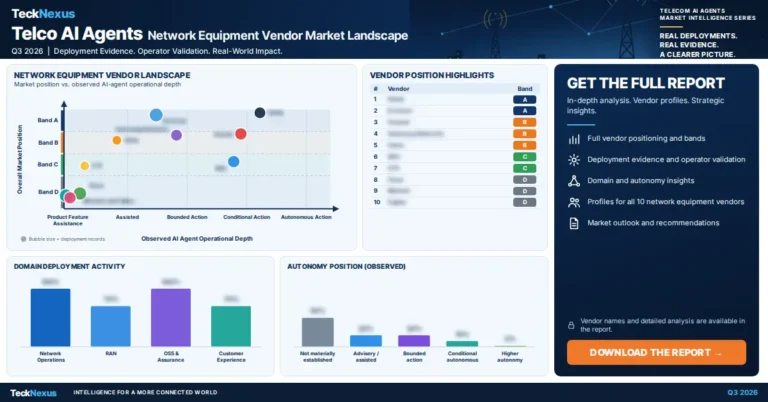
Telco AI Agent Leadership Landscape - Network Equipment Vendors
Network Equipment Vendor Report
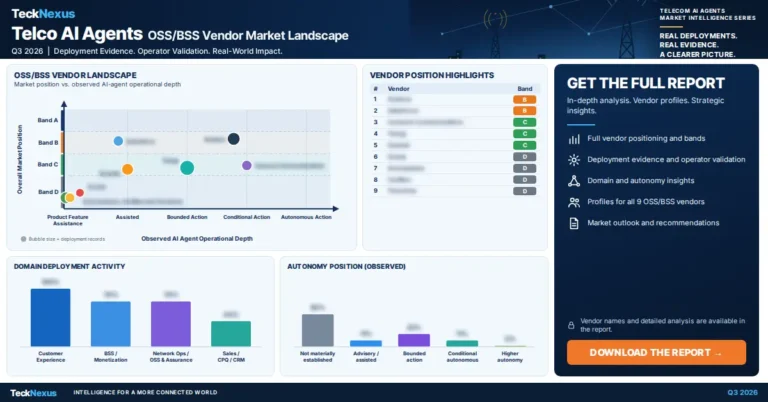
How are Amdocs, Salesforce, Comarch, Totogi, Qvantel, Oracle and other OSS/BSS vendors deploying telecom AI agents?
OSS/BSS Vendor Report
How are Amdocs, Salesforce, Comarch, Totogi, Qvantel, Oracle and other OSS/BSS vendors deploying telecom AI agents?
System Integrator Report
Scroll to Top