Private Network
Intelligence
Intelligence Journeys
Utilities Private Broadband Planning
AI Use Case Planning for Utilities
https://www.ciena.com/insights/blog/2026/rls-hyper-rail-solving-the-challenges-of-multi-rail-photonics?campaign=X1994626&channel=media-direct-buy&medium=display&source=tecknexus&ad-type=&campaign-type=&term=&region=&lid=D3JLmZ

GenAI

A study from Cambridge University and the Chinese Academy of Sciences warns that by 2030, generative AI could produce e-waste on an unprecedented scale, with projected volumes reaching millions of tons annually. As AI hardware life cycles shorten to meet the demand for computational power, researchers emphasize the urgent need for sustainable practices. Proposed solutions like hardware reuse, efficient component updates, and a circular economy approach could significantly mitigate AI's environmental impact, potentially reducing e-waste by up to 86%.
A recent study highlights how banks are leading in the adoption of generative AI (GenAI). With 60% of banking leaders already utilizing GenAI and 98% planning future use, financial services are seeing notable improvements in areas like risk management, compliance, and customer satisfaction. However, challenges like data privacy and regulatory issues remain. Discover more about banks’ investment in AI and their early returns.
Qualcomm and Google are collaborating to bring advanced AI-powered voice assistants to vehicles, using Qualcomm’s Snapdragon Digital Chassis. This partnership aims to enhance driver safety and personalization by enabling real-time navigation, fatigue monitoring, and route suggestions. As AI becomes more integrated into cars, drivers can expect smarter, more responsive in-car systems that improve overall driving experiences and lay the foundation for future developments in autonomous technology.
Ericsson has launched the "Ericsson Hackathon 2024" in collaboration with key Indonesian government and academic partners to foster innovation in smart manufacturing. Focused on leveraging 5G technology and Generative AI, the hackathon invites participants to develop cutting-edge solutions addressing key challenges in the manufacturing sector. With a prize pool of USD 3,200 and hands-on mentorship, the event aims to accelerate Indonesia's digital transformation toward Industry 4.0.
Responsible AI (RAI) is a game-changer for telecom companies, offering solutions to enhance customer experience, reduce risks, and drive new revenue streams. McKinsey estimates that by 2040, RAI could unlock $250 billion in value for telcos, representing 44% of the total AI potential in the industry. This article explores how telcos can implement AI responsibly, building trust and improving operations while navigating industry challenges.
SLMs present an exciting opportunity for creating a more energy-efficient and sustainable approach to AI. They lower computational requirements, facilitate edge deployment, and maintain similar performance levels for certain tasks, which can help lessen the environmental footprint of AI while still providing essential advantages. Additionally, prioritizing data privacy and responsible data management can greatly reduce energy use in data centers. By encouraging ethical data practices, empowering users, and promoting energy efficiency through SLMs, we can pave the way for a greener and more privacy-aware digital landscape.
AI can drive innovation, efficiency, and competitive advantage in organizations. However, implementing AI projects can be challenging, especially when endpoints are unclear and outcomes are uncertain. To effectively apply AI, focus on tasks that humans find tedious or complex, well-defined information environments, and opportunities to capture critical knowledge. Overcoming common challenges in AI project implementation includes focusing on measurable outputs, iterating and refining AI systems, and distinguishing between bugs and limitations in AI architecture. Maximizing the value of AI in an organization involves enhancing human capabilities, focusing on how AI can make employees more effective and efficient. By implementing these strategies, organizations can maximize the value of their AI investments and drive innovation, efficiency, and competitive advantage.
Amazon is transforming online shopping in the UK with the launch of Rufus, a generative AI-powered shopping assistant, and AI Shopping Guides. These tools streamline the shopping experience by providing personalized recommendations, comparing products, and simplifying decision-making. Rufus helps customers find what they need faster, while AI Shopping Guides offer curated information across 100+ product categories, from tech gadgets to everyday essentials. Integrated within the Amazon Shopping app, these AI innovations are designed to enhance convenience, accuracy, and personalization for UK customers.
NVIDIA has partnered with major U.S. tech companies such as AT&T and Lowe’s to drive AI transformation across industries, using its advanced NeMo™ and NIM™ microservices. These collaborations aim to create AI-powered solutions that enhance productivity and operational efficiency in sectors like telecommunications, retail, and education. Consulting firms like Accenture and Deloitte are leading AI integration efforts, using NVIDIA’s tools to build custom AI applications that revolutionize healthcare, manufacturing, and financial services. This initiative highlights the growing role of AI in shaping the future of global industries.
AI and generative AI hold significant promise for telecom, from network optimization to customer service automation. However, a cautious approach is necessary, as over 80% of AI projects fail. Telecom professionals remain skeptical, questioning AI's scalability and transparency. A balanced, evidence-based outlook can help telecom operators responsibly integrate AI, avoiding the pitfalls of early adoption while maximizing its transformative potential.
Large Language Models are beginning to ‘express opinions’ on controversial topics. But do they have the right to free speech? What happens if an AI defames someone? Find out in this article looking into how GenAI models, and in particular SCOTi, answered some controversial questions.
Explore how Generative AI is transforming telecom infrastructure by solving critical industry challenges like massive data management, network optimization, and personalized customer experiences. This whitepaper offers in-depth insights into AI and Gen AI's role in boosting operational efficiency while ensuring security and regulatory compliance. Telecom operators can harness these AI-driven solutions to enhance performance, improve customer satisfaction, and future-proof their businesses in a rapidly evolving market.
https://www.ciena.com/insights/blog/2026/rls-hyper-rail-solving-the-challenges-of-multi-rail-photonics?campaign=X1994626&channel=media-direct-buy&medium=display&source=tecknexus&ad-type=&campaign-type=&term=&region=&lid=D3JLmZ
TECKNEXUS PRIVATE NETWORKS
Congratulations to the 2026 Award Winners
Celebrating the deployments, technologies, and partnerships advancing private networks worldwide.
Explore the Winners →

Partner Hubs

Telco AI Agent Leadership

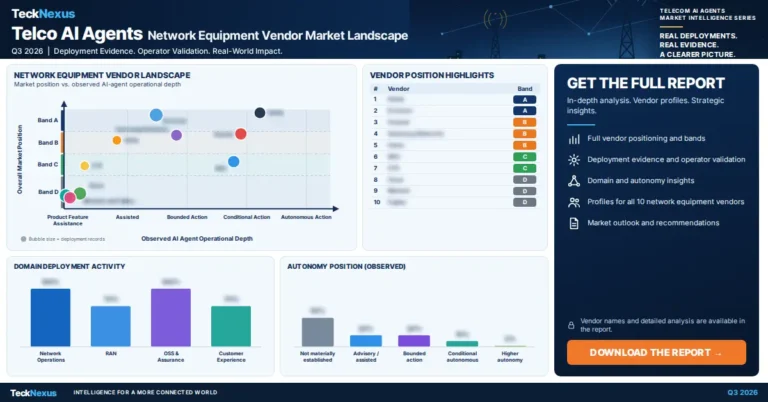
Telco AI Agent Leadership Landscape - Network Equipment Vendors
Network Equipment Vendor Report
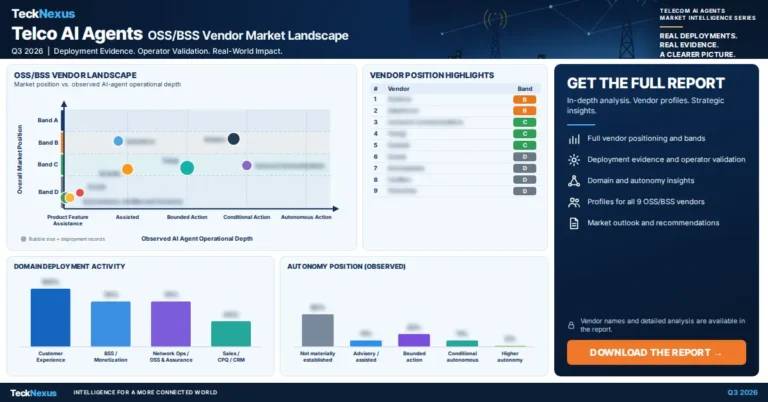
How are Amdocs, Salesforce, Comarch, Totogi, Qvantel, Oracle and other OSS/BSS vendors deploying telecom AI agents?
OSS/BSS Vendor Report
How are Amdocs, Salesforce, Comarch, Totogi, Qvantel, Oracle and other OSS/BSS vendors deploying telecom AI agents?
System Integrator Report
Scroll to Top