Private Network
Intelligence
Intelligence Journeys
Utilities Private Broadband Planning
AI Use Case Planning for Utilities

AWS

Qualcomm is moving from mobile NPUs into rack-scale AI infrastructure, positioning its AI200 (2026) and AI250 (2027) to challenge Nvidia/AMD on the economics of large-scale inference. The company is translating its Hexagon neural processing unit heritage—refined across phones and PCs—into data center accelerators tuned for inferencing, not training. AI200 and AI250 will ship in liquid-cooled, rack-scale configurations designed to operate as a single logical system. Qualcomm is leaning into that constraint with a redesigned memory subsystem and high-capacity cards supporting up to 768 GB of onboard memory—positioning that as a differentiator versus current GPU offerings.
A new partnership between Palantir and Lumen Technologies signals a shift from internal AI pilots to packaged enterprise services delivered over a telecom-grade edge and network footprint. Palantir will provide its Foundry and Artificial Intelligence Platform (AIP) as the data and decisioning layer for Lumen’s enterprise AI offerings, which Lumen plans to deliver on top of its edge computing nodes, broadband infrastructure, and managed digital services. The companies position this as a multi-year, strategic collaboration focused on operational AI use cases, not just experimentation. While exact terms were not disclosed, multiple reports indicate Lumen’s total spend could exceed $200 million over several years.
Netflix is expanding generative AI across recommendations, ads, and production workflows, signaling how big media will operationalize AI at scale without replacing human creativity. The company highlighted recent use in final footage, de-aging in a new film, and pre-visualization for set and wardrobe design. This is not about automating storytelling; it is about compressing timelines, lowering iteration costs, and enabling more variants for testing and localization. Expect AI to touch asset creation, trailer and thumbnail generation, dubbing and subtitling, quality control, and promotional creative — all tied to measurable uplift in engagement and ad yield.
AWS experienced a major outage centered on its US-EAST-1 region in Northern Virginia, triggering cascading failures across dozens of cloud services and dependent applications worldwide. The incident began in the early hours of Monday and was initially mitigated within a few hours, though residual errors and recovery backlogs persisted through the morning in US-EAST-1. Engineering updates point to a DNS resolution problem affecting a key database endpoint (DynamoDB) alongside internal network and gateway errors in EC2, which then propagated across dependent services such as SQS and Amazon Connect. When a foundational component like DNS or an internal networking fabric falters, service discovery and API calls fail in bulk.
T-Mobile US expanded its Advanced Network Solutions portfolio with Edge Control and T-Platform, aiming to deliver private network-like performance over its nationwide 5G-Advanced footprint while simplifying how enterprises deploy, govern, and scale edge workloads. Edge Control enables cellular traffic to exit locally and flow directly into an enterprise’s edge compute environment, rather than traversing centralized cores or the public internet. T-Platform is T-Mobile’s customer portal for managing business services, including Edge Control. Traditional MEC offers low-latency access to hyperscaler edge zones but often relies on internet or backhaul paths that add jitter and sovereignty concerns.
South Korea is funding a national AI stack to reduce dependence on foreign models, protect data, and tune AI to its language and industries. The government has committed ₩530 billion (about $390 million) to five companies building large-scale foundation models: LG AI Research, SK Telecom, Naver Cloud, NC AI, and Upstage. Progress will be reviewed every six months, with underperformers cut and resources concentrated on the strongest until two leaders remain. The policy goal is clear: build world-class, Korean-first AI capability that supports national security, economic competitiveness, and data sovereignty. For telecoms and enterprise IT, this is a shift from “consume global models” to “operate domestic AI platforms” integrated with local data, compliance, and services.
Lumen is accelerating a multi-year, multi-billion-dollar expansion of its U.S. backbone to match the explosive rise of AI-driven traffic. The company plans to add 34 million new intercity fiber miles by the end of 2028, targeting a total of 47 million intercity fiber miles. In 2025, Lumen has already added more than 2.2 million intercity fiber miles across 2,500+ route miles, with a year-end target of 16.6 million intercity fiber miles. Network capacity grew by 5.9+ Pbps year-to-date, and Lumen earmarked more than $100 million to push 400Gbps connectivity across clouds, data centers, and metros—now covering over 100,000 route miles with 400G-enabled transport.
Gartner’s latest outlook points to global AI spend hitting roughly $1.5 trillion in 2025 and exceeding $2 trillion in 2026, signaling a multi-year investment cycle that will reshape infrastructure, devices, and networks. This is not a short-lived hype curve; it is a capital plan. Hyperscalers are pouring money into data centers built around AI-optimized servers and accelerators, while device makers push on-device AI into smartphones and PCs at scale. For telecom and enterprise IT leaders, the message is clear: capacity, latency, and data gravity will dictate where value lands. Spending is broad-based. AI services and software are growing fast, but the heavy lift is in hardware and cloud infrastructure.
SK Telecom has been named OpenAI’s exclusive B2C partner among Korean carriers as OpenAI opens its Korea office, signaling an aggressive push to scale consumer AI access and localize go-to-market in a strategically important market. The two companies unveiled a promotion for ChatGPT Plus, giving new or returning subscribers who purchase one month two additional months at no cost. While the immediate focus is consumer-facing, SK Telecom indicates the partnership will extend toward business services and potential collaborations across the broader SK Group.
SpaceX’s $17 billion purchase of EchoStar spectrum signals a deliberate push to blend satellite and mobile connectivity at consumer scale. SpaceX is acquiring EchoStar’s AWS-4 and H-Block licenses, adding roughly 1.9–2.0 GHz spectrum into its portfolio for direct-to-device (D2D) service in the U.S. Owning licensed spectrum lets SpaceX widen capabilities beyond roaming-style add-ons, potentially toward a branded service that spans home broadband and handset connectivity. A two-year window for first compatible handsets is a realistic baseline. Analysts broadly expect Starlink to expand via partnerships: wholesale arrangements to MNOs for satellite fallback, and potentially an MVNO to bring a Starlink-branded phone plan to market.
Lumen has introduced Wavelength RapidRoutes, a pre-engineered 100G/400G service with a 20-day delivery SLA aimed at removing months-long bottlenecks from enterprise and hyperscaler connectivity. The company is packaging pre-defined, high-demand optical paths as a catalog of ready-to-deploy waves, removing custom design cycles from many standard routes. Lumen’s RapidRoutes offers 100G and up to 400G wavelength services on prioritized intercity routes with an industry-forward 20-day service delivery SLA, shifting the customer experience from quote-engineer-build to select-provision-activate on pre-engineered paths. A portal-enabled experience with AI-driven tools and more than 300 automated workflows underpins ordering, change management, and capacity scaling.
AI buildouts and multi-cloud scale are stressing data center interconnect, making high-capacity, on-demand metro connectivity a priority for enterprises. Training pipelines, retrieval-augmented generation, and model distribution are shifting traffic patterns from north-south to high-volume east-west across metro clusters of data centers and cloud on-ramps. This is the backdrop for Lumen Technologies push to deliver up to 400Gbps Ethernet and IP Services in more than 70 third-party, cloud on-ramp ready facilities across 16 U.S. metro markets. The draw is operational agility: bandwidth provisioning in minutes, scaling up to 400Gbps per service, and consumption-based pricing that aligns spend with variable AI and data movement spikes.
TECKNEXUS PRIVATE NETWORKS
Congratulations to the 2026 Award Winners
Explore the Winners →

Partner Hubs

Telco AI Agent Leadership

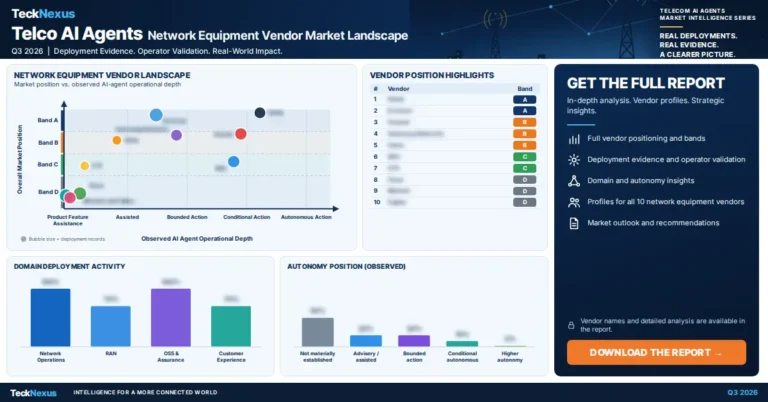
Telco AI Agent Leadership Landscape - Network Equipment Vendors
Network Equipment Vendor Report
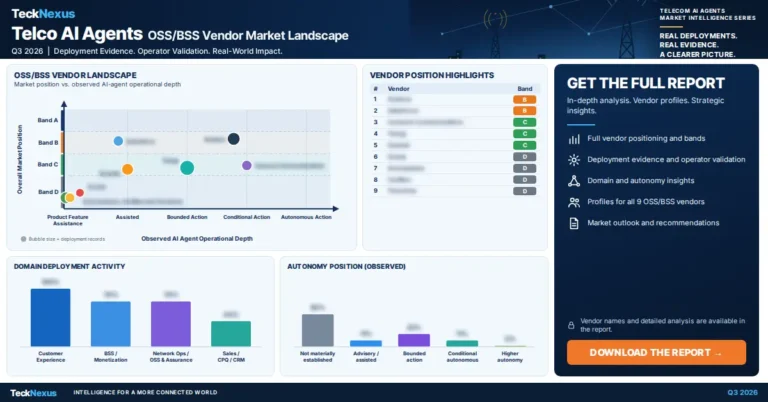
How are Amdocs, Salesforce, Comarch, Totogi, Qvantel, Oracle and other OSS/BSS vendors deploying telecom AI agents?
OSS/BSS Vendor Report
How are Amdocs, Salesforce, Comarch, Totogi, Qvantel, Oracle and other OSS/BSS vendors deploying telecom AI agents?
System Integrator Report
Scroll to Top