Assurance

India’s Department of Telecommunications has ordered major messaging apps to implement continuous SIM binding and frequent web re-authentication to curb fraud, with compliance expected in early 2026. The directive applies to app-based communication platforms that use mobile numbers as identifiers, including WhatsApp, Telegram, Signal, Snapchat, ShareChat, JioChat, Josh, and regional players like Arattai. Apps must continuously verify that the SIM linked to the registered number is present and active on the device, not just at account setup. Additionally, web sessions (e.g., WhatsApp Web) must auto-logout every six hours, forcing users to re-link via QR code.
Ericsson’s latest Mobility Report points to a clear shift: operators are turning 5G capabilities into differentiated, SLA-backed services rather than just selling more data at higher speeds. After years of building coverage and capacity, 5G networks are mature enough to commercialize features like guaranteed latency, uplink boosts, and application-aware prioritization. The catalysts are in place: more 5G Standalone (SA) cores, rising traffic from video creation and immersive apps, and enterprise demand for predictable performance across sites and clouds. The net result is momentum behind premium, differentiated connectivity that can be priced, assured, and exposed to partners.
Verizon will cut more than 13,000 roles as part of a broader restructuring aimed at simplifying operations and resetting its cost base for the next phase of growth. The reduction represents roughly 13% of Verizon’s reported ~100,000 full-time workforce and about one-fifth of its non-union management ranks, according to figures shared alongside the announcement. In parallel, Verizon plans to curb outsourcing and other external labor spending, convert 179 company-owned retail stores to franchise operations, and shutter one store. The restructuring reflects subscriber headwinds and a need to rebalance costs as 5G investment priorities shift from buildout to monetization and automation.
Nokia is restructuring to monetize the AI supercycle across fixed and mobile networks while tightening focus on profitable growth. The company’s new strategy concentrates on: accelerating in AI and cloud; leading the next era of mobile with AI-native networks and 6G; co-innovating with customers and partners; concentrating capital where it can differentiate; and unlocking sustainable, consistent returns. Nokia will move from four primary segments to two, with changes effective 1 January 2026. The company is targeting comparable operating profit of €2.7 billion to €3.2 billion by 2028.
Cisco’s intent to acquire Seattle-based NeuralFabric signals a decisive shift toward practical, domain-specific AI that meets real-world constraints around data, compliance, and infrastructure. Cisco plans to acquire NeuralFabric, an enterprise AI platform focused on building small language models (SLMs) from proprietary data with deployment across SaaS and on-premises environments. By focusing on SLMs trained on enterprise data and deployable in hybrid environments, Cisco aims to shorten time-to-value while keeping control where it belongs—inside the business. They reduce inference cost, improve latency, and can be deployed on-premises or at the edge—critical for sectors like telecom, financial services, and healthcare.
Multiple media reports say Verizon plans to cut roughly 15,000 jobs and shift about 180–200 company-owned stores to franchise operators, marking its most significant restructuring to date. According to reports citing unnamed sources, Verizon is preparing layoffs equal to about 15% of its workforce, with some estimates suggesting cuts could reach up to 20,000 roles when store conversions are included. Verizon ended 2024 with roughly 100,000 U.S. employees after several years of incremental reductions. Leadership has signaled the need to simplify operations and reset the expense base following heavy 5G investment and a more promotional market.
CAF’s signalling division and Cellnex demonstrated that OPTIO, a modular and multi-bearer CBTC platform, operates reliably on a private 5G network in both lab and field conditions, including challenging scenarios such as tunnels. The system already supports Wi‑Fi and LTE; adding 5G confirms a multi-access design that lets operators choose the right bearer per line, phase, or location. Private 5G brings ultra-low latency, higher capacity, stronger QoS control, and end-to-end security under the operator’s domain. The project received European co-financing via the Recovery and Resilience Facility under Spain’s UNICO Sectorial 2023 program, underscoring public support for digital rail modernization.
Ookla’s new handheld analyzer targets the in-building Wi‑Fi blind spot that drives churn, repeat truck rolls, and enterprise downtime. Across fiber, DOCSIS 4.0, fixed wireless access, and emerging LEO satellite, access speeds to the premises keep rising, but customer satisfaction is slipping because the experience is now judged over Wi‑Fi inside the site. Households run dozens of wireless devices, ethernet ports are disappearing, and enterprises are shifting to wireless‑first architectures on Wi‑Fi 6/6E today and Wi‑Fi 7 (802.11be) next. Surveys show most households faced Wi‑Fi issues in the past year, a large share required a truck roll, and a meaningful portion of those visits did not resolve the issue on the first attempt—fueling churn and avoidable Opex.
A new joint plan from Vodafone and AST SpaceMobile aims to deliver satellite broadband directly to standard smartphones across Europe under a sovereign operational model. AST SpaceMobile has submitted plans through Germany for a space-based network designed to provide broadband directly to devices across Europe. Operations would run through SatCo, a Luxembourg-based joint venture with Vodafone announced earlier this year. The timing aligns with looming European spectrum decisions and intensifying competition in direct-to-device (D2D). S-band at 2 GHz is up for renewal across the region in 2027, and 700 MHz public protection and disaster relief (PPDR) frequencies are central to resilient communications strategy.
Google has unveiled next‑generation TPU accelerators with up to a 4x performance boost and secured a multiyear Anthropic commitment reportedly worth billions, signaling a new phase in AI infrastructure competition. Google introduced new Tensor Processing Units that deliver roughly four times the performance of prior generations for training and inference of large models. Beyond speed, the design targets better performance-per-watt, a critical lever as AI energy costs surge. Anthropic has secured access to Google Cloud TPU capacity at massive scale, with reports citing availability up to one million TPU chips over the term of the agreement.
BT Group and its consumer brand EE plan to offer a Starlink-powered home broadband product focused on underserved locations where fixed-line build is constrained by terrain, sparsity, or cost. The service targets “ultrafast” downlink performance, with Starlink capable of delivering up to roughly 280 Mbps and latency in the low tens of milliseconds. Commercial availability is slated for the second half of 2026, giving BT time to industrialise ordering, installation, support, and integration into its existing product catalogue and systems. LEO fills the last 1–5% gap where full fibre is slow or uneconomic to reach.

Your Brand. Our Intelligence Tools.

Capture leads at the point of evaluation. Talk to Us →

Sponsored by Palo Alto Networks
⚡ Utilities ⏱ 8 min ✓ Free
This tool is built and hosted by TeckNexus.
Launch Tool →
Whitepaper
This whitepaper explains how utilities can use secure AI-enabled private mobile networks to modernize operations, support distributed intelligence, improve resilience, and strengthen cybersecurity across critical infrastructure. It covers AI applications, private network advantages, zero trust principles, multilayered security architecture, and governance considerations for AI-ready utility environments....
Whitepaper
Non-terrestrial networks are rapidly evolving from experimental satellite systems into an increasingly important part of the global 5G connectivity landscape. This eBook, developed by Radisys in collaboration with TeckNexus, explores how 3GPP standardization, satellite architecture innovation, and software-driven network design are reshaping NTN deployment models. It examines the transition from...
Whitepaper
Private cellular networks are transforming industrial operations, but securing private 5G, LTE, and CBRS infrastructure requires more than legacy IT/OT tools. This whitepaper by TeckNexus and sponsored by OneLayer outlines a 4-pillar framework to protect critical systems, offering clear guidance for evaluating security vendors, deploying zero trust, and integrating IT,...

It seems we can't find what you're looking for.

Scroll to Top

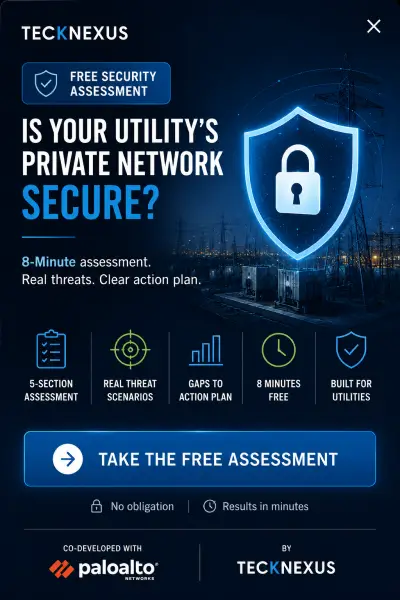
Map your security gaps to real threat scenarios – including Salt Typhoon, Volt Typhoon, AI data poisoning, rogue devices, and unencrypted OT traffic.

Take the free 8-minute assessment built for utility operators evaluating AI-enabled private mobile networks. Get a readiness score across five critical domains, see where your gaps are, and receive a prioritized action plan for what to fix first.

Free • 8 minutes • Built for private network security