Private Network
Intelligence
Intelligence Journeys
Utilities Private Broadband Planning
AI Use Case Planning for Utilities

5G

5G is the fifth generation of cellular technology and the current global standard, succeeding 4G LTE with faster speeds, lower latency, and the capacity to connect far more devices per cell. Standardized by 3GPP from around 2017 and launched commercially in 2019, it has become the dominant connectivity technology across most major markets. 5G spans low-, mid-, and high-band (mmWave) spectrum and two architectures — non-standalone, which runs on a 4G core, and standalone, which unlocks network slicing and the lowest latency. The standard continues to evolve through 5G-Advanced, adding AI-native management and tighter satellite integration. For enterprises and operators, the questions have shifted from coverage to monetization, private deployments, and standalone migration. This channel tracks 5G developments across vendors, operators, and enterprise verticals, with analysis and decision tools for teams evaluating real deployments.

India’s mobile industry lobby is pushing for tariff corrections as network spending rises faster than service revenues. The Cellular Operators Association of India (COAI) says operators face a growing mismatch between capital outlays and tariff-led returns. By its estimate, the cumulative gap up to 2024 was already around Rs 10,000 crore and is widening in 2025 as data consumption accelerates. COAI argues that a handful of large traffic generators (LTGs) are responsible for most network load without directly contributing to network build costs. Expect a mix of tariff rationalization, plan redesign, and targeted capex as operators chase sustainable returns.
India and the United Kingdom have launched the India–UK Connectivity and Innovation Centre to accelerate secure, AI-driven, and resilient telecom technologies over the next four years. The two governments committed an initial £24 million—roughly ₹250–₹282 crore depending on exchange rates—to fund applied research, joint testbeds, field trials, and standards contributions in emerging telecom domains. The investment concentrates on three pillars: AI in telecommunications, non-terrestrial networks (NTNs) for satellite and airborne connectivity, and telecoms cybersecurity with open, interoperable systems. The multi-year window aligns to the critical runway for 5G‑Advanced and early 6G experimentation.
Telecom Secretary Neeraj Mittal underscored that AI will be central to the next generation of networks, not an add-on. The direction aligns with industry momentum: 5G-Advanced is already introducing AI-enabled RAN and core features via 3GPP, while 6G initiatives under the ITU-R IMT-2030 framework envision AI-native control loops, sensing-assisted connectivity, and tight integration of compute and communications. India expects 6G trials to begin around 2028, with commercial deployments to follow. Operators that harden their AI and automation capabilities during 5G-Advanced will enter 6G with a competitive execution advantage.
After two years of decline, telecom equipment spending is edging back into positive territory with early signs of a broad-based rebound. Dell’Oro Group’s preliminary data indicates worldwide telecom equipment revenues across six tracked sectors rose 4% year over year in the first half of 2025, with markets outside China up a stronger 8%. The rebound was not limited to a single pocket of spend, but three areas led the gains: mobile core networks, optical transport, and service provider routers and switches. By contrast, RAN remains comparatively muted in many markets as 5G macro buildouts mature.
BMW has launched a private 5G- and AI-powered EV plant in Debrecen, Hungary, its first fully AI-controlled automotive factory. With over 1,000 robots, autonomous vehicles, and digital twins integrated across a hybrid 5G network, the site sets new standards for real-time quality control, low-carbon manufacturing, and scalable production of next-gen EVs like the iX3. Operated by Magyar Telekom, the facility is a model for smart, sustainable automotive production.
Verizon has entered a definitive agreement to acquire Starry, a fixed wireless broadband specialist focused on MDUs across Boston, New York, Los Angeles, Denver, and Washington, D.C. Starry brings nearly 100,000 broadband customers and an MDU-centric network architecture built around wideband millimeter-wave and hybrid fiber. Verizon said the move will support its ambition to double fixed wireless subscribers to roughly 8–9 million by 2028 and extend availability to about 90 million households. Starry’s in-market MDU know-how and neutral-host friendly building relationships give Verizon a fast path to scale in cities where it already owns substantial fiber backhaul and large 28/39 GHz mmWave holdings.
India Mobile Congress 2025 in New Delhi framed a clear ambition: scale domestic innovation, shape 6G, and turn telecom into a larger engine of GDP growth. Leaders underscored a whole-of-government approach, with multiple ministries backing IMC and the Department of Telecommunications and the Cellular Operators Association of India co-hosting. India’s telecom and digital sector is estimated to contribute roughly 12–14% to GDP today. Leaders at IMC projected this could reach about 20% by the mid-2030s if India scales advanced connectivity, software-led services, and domestic manufacturing. India’s 6G push was tied to a potential GDP uplift exceeding a trillion dollars by 2035.
Intel detailed its first client and server products on the new 18A process, positioning the company for AI PCs and power‑efficient cloud at a time when onshore manufacturing and TCO matter more than ever. Intel previewed Core Ultra series 3 “Panther Lake,” its first client SoC line on 18A, with a multi‑chiplet design that blends new performance and efficient cores with an upgraded Arc GPU and dedicated AI acceleration across the CPU, GPU, and NPU. On the server side, Intel previewed “Clearwater Forest,” branded Xeon 6+, its next‑gen E‑core product built on 18A and targeted for launch in the first half of 2026.
Qualcomm is acquiring Arduino to anchor an end-to-end developer funnel from hobbyist prototypes to commercial robots and industrial IoT systems. As part of the announcement, Arduino introduced the Uno Q, a new board priced around $45–$55 featuring Qualcomm’s Dragonwing QRB2210 processor that runs Linux alongside Arduino tooling and supports vision workloads. By meeting developers at the prototyping bench and offering an upgrade path to production-grade SoCs and modules, Qualcomm aims to convert experimentation into long-term silicon design wins. The Arduino tie-up broadens access to Qualcomm compute for small teams while reinforcing an ecosystem play that spans on-device AI, connectivity, and lifecycle operations at the edge.
India is poised to greenlight commercial satellite communication services once TRAI issues final pricing for satellite spectrum use and associated charges. The communications minister indicated the policy and licensing groundwork for satellite broadband is largely complete, with two GMPCS licenses issued and one additional letter of intent granted. The final trigger is the Telecom Regulatory Authority of India’s decision on spectrum pricing and usage fees for satcom bands. After that, operators can commence rollouts—initially for enterprise and backhaul, then for consumer broadband in selected markets. Bharti-backed Eutelsat OneWeb and Reliance Jio’s satellite unit are positioned to move early, with constellation capacity and gateways progressing.
At India Mobile Congress 2025, Jio framed a broad agenda that ties devices, networks, AI skills, and safety into a national-scale digital strategy. The message from Jio’s chairman was clear: India’s telecom flywheel now spans the full value chain, from semiconductors and device platforms to fraud management and the next wave of 6G research. Telcos are shifting from pure connectivity to platform businesses that bundle devices, cloud access, security, and AI services. JioPC is positioned as an “AI-ready” computer that turns any screen into a managed endpoint, delivered through a subscription model.
Sweden’s largest passenger rail operator SJ is consolidating its communications estate with Telia to accelerate 5G, IoT, and crisis-readiness across trains, stations, depots, and corporate operations. The partnership positions Telia as SJ’s primary provider for nationwide mobile and fixed communications, combining public 5G/LTE coverage with managed services that support day‑to‑day rail operations and passenger experience. For passengers, more consistent Wi‑Fi backhaul and seamless digital services are the immediate wins; for operations, the prize is reliability and faster recovery when incidents occur. European operators are scaling beyond discrete connectivity pilots toward platforms that unify onboard systems, station sensors, and back‑office analytics.

Frequently Asked Questions

What actually makes 5G different from 4G LTE?
5G introduces three core technical improvements over 4G LTE: significantly higher peak data speeds, in some cases multiple gigabits per second under ideal conditions compared to 4G’s typical tens to low hundreds of megabits per second; substantially lower latency, the delay between sending and receiving data, which matters for applications like gaming, video calls, and industrial automation where responsiveness is critical; and far greater device density support, allowing a single cell site to maintain reliable connections with a much larger number of simultaneous devices, which matters increasingly as IoT sensors and connected devices proliferate. These improvements come from a combination of new radio technology, additional spectrum bands made available for 5G use, and a redesigned network architecture that’s considerably more flexible and software-driven than 4G’s architecture was.
What’s the difference between low-band, mid-band, and high-band (mmWave) 5G?
Low-band 5G uses similar frequencies to 4G LTE, offering wide coverage area and good building penetration but speeds not dramatically faster than good 4G performance, making it most useful for extending broad geographic coverage rather than delivering 5G’s headline speed improvements. Mid-band 5G offers a more balanced tradeoff between coverage and speed, generally delivering meaningfully faster performance than 4G across a reasonably wide area, and has become the most common band used for mainstream 5G deployment in most markets globally. High-band 5G, often called mmWave, delivers by far the fastest possible speeds, but its very short range and poor ability to penetrate walls means it’s typically deployed only in dense, high-traffic urban areas like stadiums, rather than for broad area coverage.
What’s the difference between 5G NSA (non-standalone) and 5G SA (standalone)?
5G non-standalone, or NSA, runs 5G radio technology on top of an existing 4G core network, meaning certain control functions still rely on 4G infrastructure even though the actual data connection itself uses 5G radio technology; this was the faster, easier path many operators took for their initial 5G launches, since it could be deployed by upgrading existing 4G infrastructure rather than building an entirely new core network from scratch. 5G standalone, or SA, uses an entirely new, independently functioning 5G core network rather than relying on 4G at all, unlocking more of 5G’s distinctive advanced capabilities, including network slicing and the lowest possible latency, that NSA architecture generally can’t fully support. Many operators have been gradually transitioning from NSA to SA, though this migration has generally taken longer than initially anticipated.
How widespread is 5G coverage and adoption globally in 2026?
5G has become genuinely widespread rather than experimental. Global subscriptions surpassed 3.1 billion in early 2026, with another 162 million subscriptions added in just the first quarter of the year, reflecting continued strong growth even years after 5G’s initial 2019 commercial launch. Coverage varies considerably by region and band: low and mid-band 5G now reaches the substantial majority of the population in most major markets including the U.S., much of Europe, China, and South Korea, while high-band mmWave coverage remains considerably more limited and concentrated in dense urban areas given its short range. Adoption has progressed furthest in markets with aggressive early infrastructure investment, particularly China and South Korea, while other regions, especially parts of the developing world, continue working through earlier stages of 5G buildout.
What is ‘5G-Advanced,’ and how is it different from regular 5G?
5G-Advanced, sometimes marketed by certain vendors and operators, particularly in China, as 5.5G, refers to the next phase of 5G standards development beyond the original 2019 specification, formalized starting with 3GPP Release 18 and continuing through subsequent releases. It introduces capabilities including better support for reduced-capability IoT devices that don’t need full 5G performance, tighter integration with non-terrestrial satellite networks, more sophisticated AI-native network management built directly into the standard, and further uplink and capacity improvements beyond the original 5G specification. Rather than representing a completely new generation the way 5G itself was relative to 4G, 5G-Advanced is best understood as a substantial, ongoing evolution and refinement of the existing 5G standard, extending its useful commercial life well beyond what the original 2019 specification alone delivered.
Why do real-world 5G speeds vary so much between users and locations?
Real-world 5G speeds vary considerably because of the fundamental tradeoffs between different frequency bands: a user connected to low-band 5G in a rural area will experience meaningfully slower speeds than someone connected to mid-band 5G in a well-covered urban area, who in turn will experience slower speeds than someone briefly connected to high-band mmWave near a stadium or dense downtown location. Network congestion also plays a significant role, since a cell site serving many simultaneous users, particularly during peak usage periods, will generally deliver lower per-user speeds than the same site serving fewer users. Device capability matters too, since a phone’s specific modem chip determines which frequency bands and 5G features it can actually access, meaning even within the same coverage area, different devices can experience meaningfully different real-world performance.
Is 5G actually necessary, or is 4G still ‘good enough’ for most uses?
For many everyday tasks like browsing, messaging, and standard video streaming, 4G genuinely remains adequate, and many consumers report not noticing a dramatic difference in daily use compared to a well-performing 4G connection, which is part of why 5G monetization has proven harder than the industry initially expected. However, 5G’s advantages become considerably more apparent for specific use cases: dense urban areas with heavy simultaneous network usage benefit meaningfully from 5G’s greater capacity, fixed wireless access using 5G can deliver genuinely faster home broadband than many alternatives, and emerging applications like cloud gaming, AR and VR, and industrial automation benefit directly from 5G’s lower latency and higher reliability in ways 4G generally can’t match. Whether 5G feels necessary depends heavily on a specific user’s actual usage patterns and location rather than being a universal yes or no answer.
How does 5G relate to other technologies like network slicing, private networks, and FWA covered elsewhere in this reference?
5G is the foundational technology underlying many of the more specific capabilities covered elsewhere in this reference. Network slicing depends specifically on 5G standalone’s more flexible core network architecture to create multiple differentiated virtual networks on shared infrastructure. Private networks increasingly use 5G rather than 4G LTE as their core technology for new deployments, given 5G’s superior capacity and lower latency for industrial use cases. Fixed wireless access has become one of 5G’s clearest commercial monetization successes, using 5G’s speed and capacity to deliver home broadband as an alternative to cable or fiber. Open RAN’s disaggregated, multi-vendor approach to radio equipment is increasingly being applied specifically to 5G network deployments, making 5G the underlying connectivity layer most other categories in this reference build upon.


Partner Hubs

Telco AI Agent Leadership

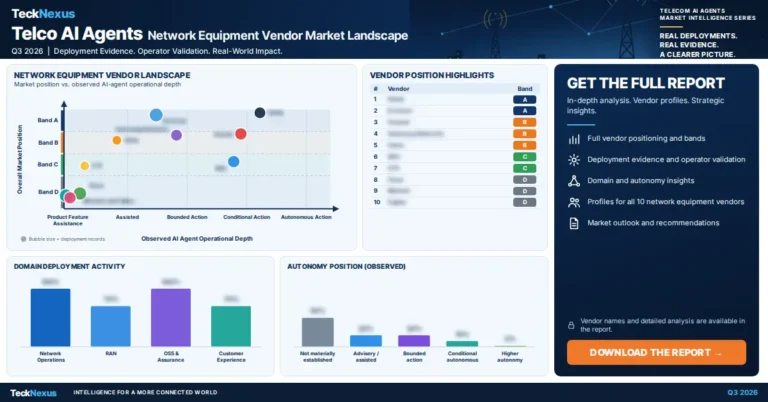
Telco AI Agent Leadership Landscape - Network Equipment Vendors
Network Equipment Vendor Report
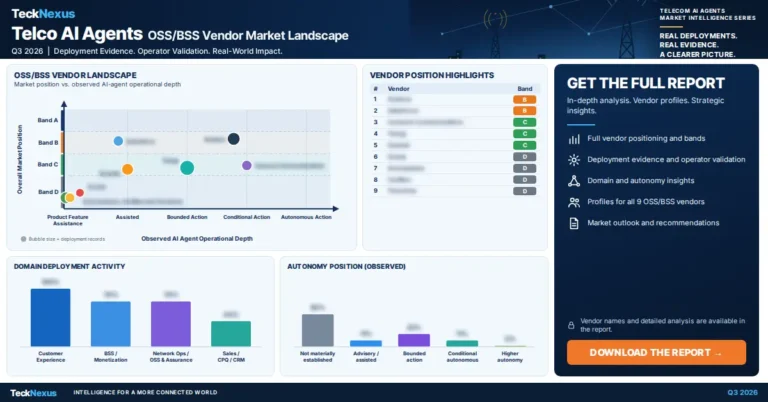
How are Amdocs, Salesforce, Comarch, Totogi, Qvantel, Oracle and other OSS/BSS vendors deploying telecom AI agents?
OSS/BSS Vendor Report
How are Amdocs, Salesforce, Comarch, Totogi, Qvantel, Oracle and other OSS/BSS vendors deploying telecom AI agents?
System Integrator Report
Scroll to Top