Private Network
Intelligence
Intelligence Journeys
Utilities Private Broadband Planning
AI Use Case Planning for Utilities

Policy

Automotive digitization now hinges on 5G's ability to deliver reliable, low-latency, and scalable connectivity that 4G/LTE cannot sustain for safety-critical use cases. Advanced driver assistance, cooperative perception, and remote operations require millisecond-class response and deterministic reliability across dense traffic conditions. 5G Standalone (SA) with Ultra-Reliable Low-Latency Communications (URLLC), improved positioning, and enhanced uplink meets these thresholds, enabling vehicles and infrastructure to exchange time-sensitive data continuously. This is the foundation for C-V2X, high-fidelity telematics, and closed-loop control that 4G/LTE struggles to support consistently. 5G enables dynamic traffic orchestration, energy-aware routing for EVs, and advanced safety services that can reduce incidents and congestion.
Palo Alto Networks PAN-OS 12.1 Orion steps into this gap with a quantum-ready roadmap, a unified multicloud security fabric, expanded AI-driven protections and a new generation of next-generation firewalls (NGFWs) designed for data centers, branches and industrial edge. The release also pushes management into a single operational plane via Strata Cloud Manager, targeting lower operating cost and faster incident response. PAN-OS 12.1 automatically discovers workloads, applications, AI assets and data flows across public cloud and hybrid environments to eliminate blind spots. It continuously assesses posture, flags misconfigurations and exposures in real time and deploys protections in one click across AWS, Azure and Google Cloud.
SK Telecom is partnering with VAST Data to power the Petasus AI Cloud, a sovereign GPUaaS built on NVIDIA accelerated computing and Supermicro systems, designed to support both training and inference at scale for government, research, and enterprise users in South Korea. By placing VAST Data's AI Operating System at the heart of Petasus, SKT is unifying data and compute services into a single control plane, turning legacy bare-metal workflows that took days or weeks into virtualized environments that can be provisioned in minutes and operated with carrier-grade resilience.
Beijing's first World Humanoid Robot Games is more than a spectacle. It is a live systems trial for embodied AI, connectivity, and edge operations at scale. Over three days at the Beijing National Speed Skating Oval, more than 500 humanoid robots from roughly 280 teams representing 16 countries are competing in 26 events that span athletics and applied tasks, from soccer and boxing to medicine sorting and venue cleanup. The games double as a staging ground for 5G-Advanced (5G-A) capabilities designed for uplink-intensive, low-latency, high-reliability robotics traffic. Indoors, a digital system with 300 MHz of spectrum delivers multi-Gbps peaks and sustains uplink above 100 Mbps.
More than $14 billion has been invested across the CBRS stacklicenses, RAN, devices, infrastructure, sensors, and software. Over 420,000 CBRS radio nodes (CBSDs) are in service. The device ecosystem is broad: Apple and Samsung ship n48-capable handsets; industrial and FWA suppliers support n48 CPEs and routers; Ericsson, Nokia, Samsung, JMA Wireless and others provide radio and DAS. This is not a pilot; it is production infrastructure. Refarming would force replacement or retuning of hundreds of thousands of base stations and millions of end devices, plus upgrades to SAS integrations and enterprise control planes.
An unsolicited offer from Perplexity to acquire Googles Chrome raises immediate questions about antitrust remedies, AI distribution, and who controls the internets primary access point. Perplexity has proposed a $34.5 billion cash acquisition of Chrome and says backers are lined up to fund the deal despite the startups significantly smaller balance sheet and an estimated $18 billion valuation in recent fundraising. The bid includes commitments to keep Chromium open source, invest an additional $3 billion in the codebase, and preserve current user defaults including leaving Google as the default search engine. The timing aligns with a U.S. Department of Justice push for structural remedies after a court found Google maintained an illegal search monopoly, with a Chrome divestiture floated as a central remedy.
NTT DATA and Google Cloud expanded their global partnership to speed the adoption of agentic AI and cloud-native modernization across regulated and dataintensive industries. The push emphasizes sovereign cloud options using Google Distributed Cloud, with both airgapped and connected deployments to meet data residency and regulatory needs without stalling innovation. The partners plan to build industry-specific agentic AI solutions on Google Agent space and Gemini models, underpinned by secure data clean rooms and modernized data platforms. NTT DATA is standing up a dedicated Google Cloud Business Group with thousands of engineers and aims to certify 5,000 practitioners to accelerate delivery, migrations, and managed services.
Trump’s AI Action Plan marks a major shift in U.S. technology policy, emphasizing deregulation, global AI exports, and infrastructure acceleration. The plan repeals Biden-era safeguards and aims to position American companies ahead of China in the global AI race, while sparking debate on jobs, environmental costs, and the limits of state-level regulation.
India’s rejection of Nokia’s 5G network slicing patent highlights a growing legal battle over telecom IP. Nokia’s appeal challenges India’s strict stance on software patents, while global competitors like Huawei and Ericsson dominate the 5G patent race. This decision may reshape vendor strategies, investment priorities, and legal precedents in next-gen telecom.
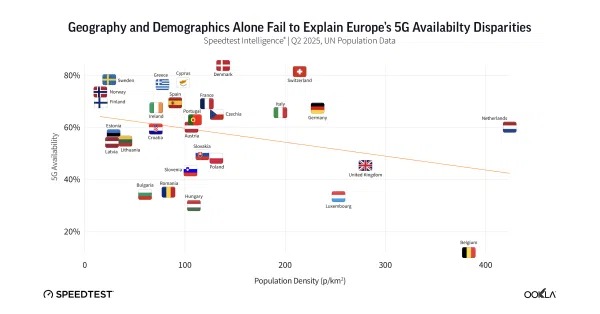
Europe’s 5G progress is accelerating but unevenly. Denmark, Sweden, and Spain lead with strong 5G availability and SA deployment, driven by early spectrum allocation and targeted policy. Meanwhile, the UK, Belgium, and Hungary trail due to regulatory delays, infrastructure bottlenecks, and weak investment. With the Digital Decade 2030 goal in sight, aligning on policy, spectrum, and subsidies will be key to closing the EU’s internal 5G divide.
Connected aviation is reshaping airports with autonomous systems, from security drones to robotic baggage vehicles and self-driving tugs. Automation improves safety, cuts turnaround times, and delivers a smoother passenger experience. Learn how airports use AI and robotics to stay competitive.
TECKNEXUS PRIVATE NETWORKS
Congratulations to the 2026 Award Winners
Explore the Winners →

Partner Hubs

Telco AI Agent Leadership

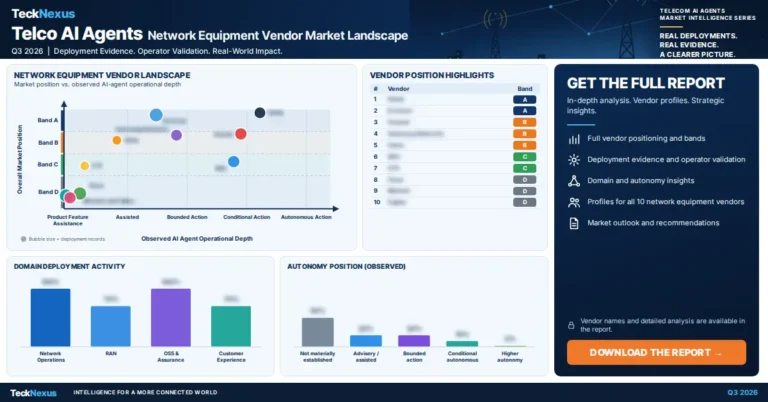
Telco AI Agent Leadership Landscape - Network Equipment Vendors
Network Equipment Vendor Report
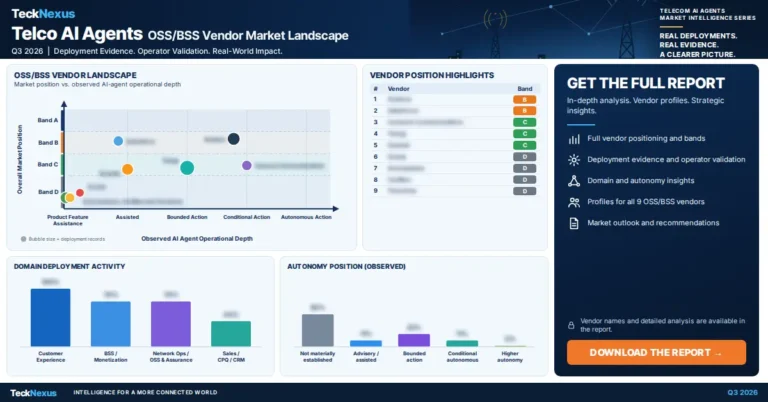
How are Amdocs, Salesforce, Comarch, Totogi, Qvantel, Oracle and other OSS/BSS vendors deploying telecom AI agents?
OSS/BSS Vendor Report
How are Amdocs, Salesforce, Comarch, Totogi, Qvantel, Oracle and other OSS/BSS vendors deploying telecom AI agents?
System Integrator Report
Scroll to Top