Private Network
Intelligence
Intelligence Journeys
Utilities Private Broadband Planning
AI Use Case Planning for Utilities

Google

AI buildouts and multi-cloud scale are stressing data center interconnect, making high-capacity, on-demand metro connectivity a priority for enterprises. Training pipelines, retrieval-augmented generation, and model distribution are shifting traffic patterns from north-south to high-volume east-west across metro clusters of data centers and cloud on-ramps. This is the backdrop for Lumen Technologies push to deliver up to 400Gbps Ethernet and IP Services in more than 70 third-party, cloud on-ramp ready facilities across 16 U.S. metro markets. The draw is operational agility: bandwidth provisioning in minutes, scaling up to 400Gbps per service, and consumption-based pricing that aligns spend with variable AI and data movement spikes.
Google will pay a US$35.8 million (A$55 million) penalty and change how it structures Android default search agreements with Australian carriers and OEMs. The Australian Competition and Consumer Commission (ACCC) alleged that Googles contracts with Telstra and Optus from December 2019 to March 2021 blocked rival search engines on carrier-sold Android devices via platform-wide default settings and revenue-sharing incentives. Google admitted the conduct likely lessened competition and agreed to court-enforceable undertakings to remove restrictions that mandated Google Search as the exclusive, out-of-the-box option across search access points (browser defaults, widgets, and in-phone settings).
An unsolicited offer from Perplexity to acquire Googles Chrome raises immediate questions about antitrust remedies, AI distribution, and who controls the internets primary access point. Perplexity has proposed a $34.5 billion cash acquisition of Chrome and says backers are lined up to fund the deal despite the startups significantly smaller balance sheet and an estimated $18 billion valuation in recent fundraising. The bid includes commitments to keep Chromium open source, invest an additional $3 billion in the codebase, and preserve current user defaults including leaving Google as the default search engine. The timing aligns with a U.S. Department of Justice push for structural remedies after a court found Google maintained an illegal search monopoly, with a Chrome divestiture floated as a central remedy.
NTT DATA and Google Cloud expanded their global partnership to speed the adoption of agentic AI and cloud-native modernization across regulated and dataintensive industries. The push emphasizes sovereign cloud options using Google Distributed Cloud, with both airgapped and connected deployments to meet data residency and regulatory needs without stalling innovation. The partners plan to build industry-specific agentic AI solutions on Google Agent space and Gemini models, underpinned by secure data clean rooms and modernized data platforms. NTT DATA is standing up a dedicated Google Cloud Business Group with thousands of engineers and aims to certify 5,000 practitioners to accelerate delivery, migrations, and managed services.
Lumen surpassing 1,000 customers on its Network-as-a-Service platform is a clear marker for where enterprise networking is headed. AI adoption, multi-cloud architectures, and distributed applications are pushing organizations toward on-demand, software-driven connectivity. Lumens platform bundles three core service types under a single digital experience. The platform integrates with major hyperscalers, enabling direct paths to AWS, Microsoft Azure, and Google Cloud. All can be provisioned self-service, scaled up or down based on demand, and stitched to cloud regions and third-party data centers via cloud on-ramps.
Perplexity’s new Comet browser blends AI search, summaries, and an integrated AI assistant to automate tasks like managing tabs and summarizing emails. Launched for its $200/month Max plan subscribers, Comet aims to rival Chrome and Edge by redefining how we browse and work online.
GFiber Labs and Nokia are partnering to shape the future of home internet with network slicing. Network Slicing lets customers customize bandwidth for gaming, work, and secure tasks. GFiber’s successful demo with Nokia shows how slices can create smoother gameplay, better video calls, and safer online banking - all while putting real-time control in users’ hands.
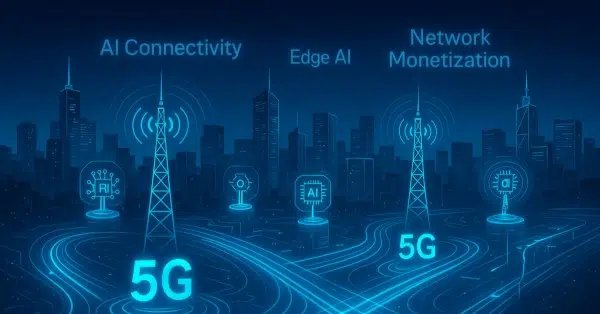
As AI workloads explode in complexity and scale, telecom providers face a $1B+ opportunity to evolve from traditional carriers into AI connectivity enablers. This article explores how telcos can monetize AI-driven traffic through dynamic network infrastructure, edge AI hosting, and cloud-like billing models tailored to modern enterprise demands.
The fiber, data center, and telecom sectors are evolving rapidly amid rising AI workloads, cloud expansion, edge computing, and new investment models. This article breaks down the key trends — from fiber deployments in rural markets to secondary data center expansions and telecoms shifting to platform-based services, that are reshaping digital infrastructure for a hyperconnected future.
Indian telecom companies such as Jio and Airtel are moving beyond internal AI use cases to co-develop monetizable, India-focused AI applications in partnership with tech giants like Google, Nvidia, Cisco, and AMD. These collaborations are enabling sector-specific AI tools across healthcare, education, and agriculture, boosting operational efficiency, customer experience, and creating new revenue streams for telecom operators.
TECKNEXUS PRIVATE NETWORKS
Congratulations to the 2026 Award Winners
Explore the Winners →

Partner Hubs

Telco AI Agent Leadership

Telco AI Agent Leadership Landscape - Network Equipment Vendors
Network Equipment Vendor Report
How are Amdocs, Salesforce, Comarch, Totogi, Qvantel, Oracle and other OSS/BSS vendors deploying telecom AI agents?
OSS/BSS Vendor Report
How are Amdocs, Salesforce, Comarch, Totogi, Qvantel, Oracle and other OSS/BSS vendors deploying telecom AI agents?
System Integrator Report
Scroll to Top